

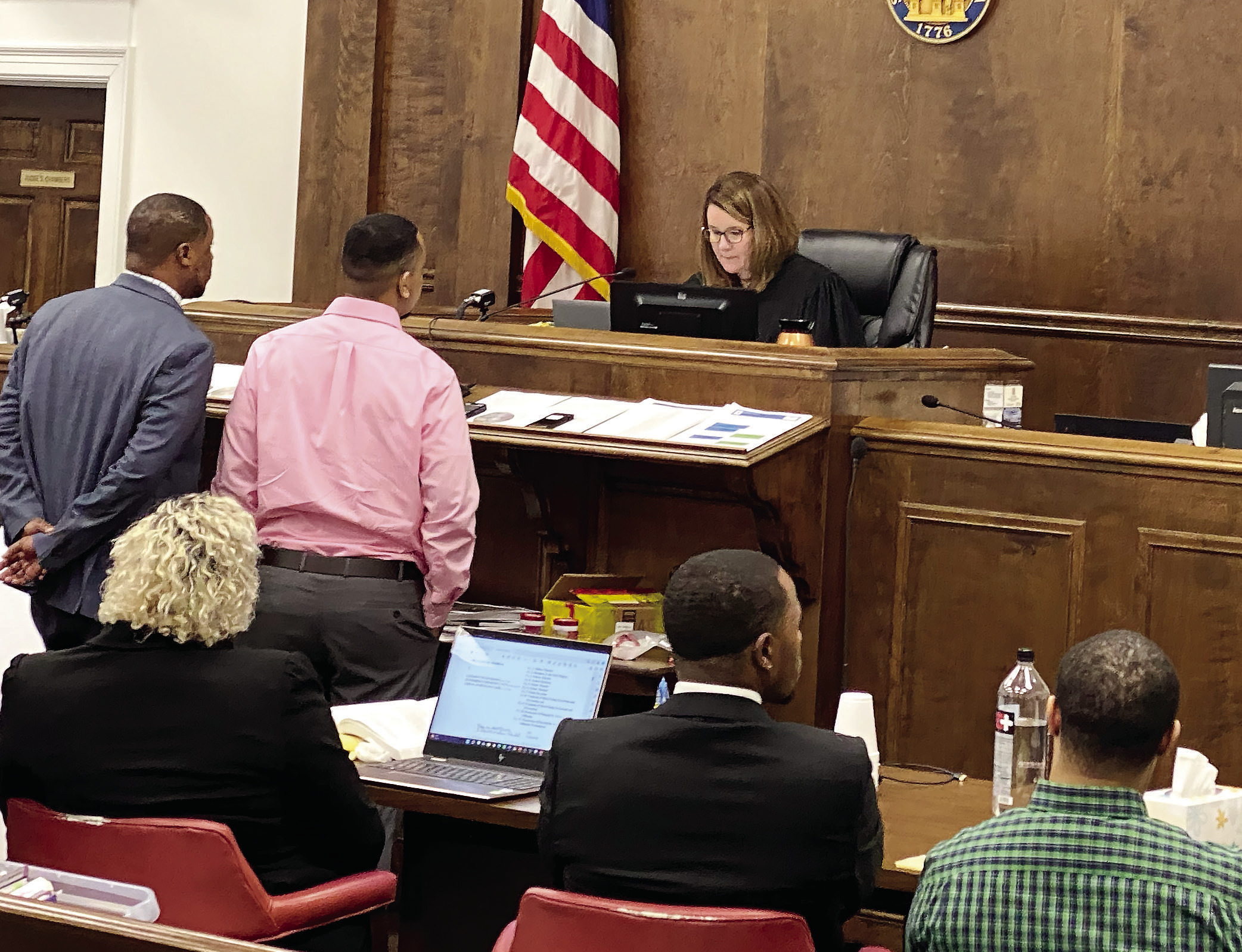
A defendant from a 2022 murder trial, facing life imprisonment, was in Jones County Superior Court last week seeking a new trial.
Cameren Myles Banks and his attorney Eric C. Crawford appeared in the courtroom April 30 via Zoom. Their primary argument concerned issues with Bank’s previous attorney Melvin Raines ll, who was disbarred in 2025.
Reason given for the motion for a new trial was ineffective assistance of counsel.
The trial of Banks, Justerrious Shyhem Canty and Jaqualan Desean Clark ended Oct. 6, 2022, following six days of testimony in Jones County Superior Court.
The three defendants were arrested in December of 2017 for the Nov. 13, 2017, murder of 24-year-old Donald Marquis Hardwick. At the time of his arrest, Banks was 19.
The jury found the three defendants guilty on all counts for which they were charged.
Banks was sentenced to life without the possibility of parole for the crime of malice murder, 20 years for the crime of burglary in the first degree, a life sentence for the crime of armed robbery, a life sentence for the crime of home invasion, and 20 years for the crime of Violation of Street Gang Terrorism and Prevention Act. Banks’ total sentence is life without the possibility of parole, plus life, plus life, plus 40 years.
Superior Court Chief Judge Alison Burleson presided over the 2022 trial, and Banks’ motion for a new trial was brought before her last week. The trial was delayed multiple times with the pandemic playing a large role.
It was set to begin March 23, 2020, but was derailed by the March 14, 2020, announcement by Georgia Supreme Court Judge Harold Melton, declaring a statewide judicial emergency due to the pandemic. The courts were ordered closed for 30 days but ended up being closed for more than eight months for in-person court proceedings.
The court system reopened in 2021, but there continued to be multiple delays, including a Georgia Supreme Court ruling.
Crawford briefly went over Banks’s motion, which was previously sent to the judge. The defense attorney argued that any competent attorney would have objected to the expert testimony at the trial pertaining to a shard of glass found in Banks’ vehicle.
He contended the glass was the only thing that linked his client to the murder.
“The attorney did not object. The testimony should not have been allowed,” he said.
Crawford stated that the expert did not perform the test and only looked at the report. He said that evidence should never have been admitted.
Burleson said the appeal submitted on behalf of Banks after the trial was boiler plate and asked Crawford if the motion would be proceeding on the new arguments he had raised. The answer was yes.
The state was represented in the hearing by Assistant District Attorney Cara Fiore. She commented that the defense’s task was to prove ineffective assistance, which is a difficult burden to overcome without the testimony of the attorney.
Fiore said the defendant would have to prove the admittance of the evidence was prejudicial. She said that was not the case because the evidence against all the defendants was overwhelming. Banks’ involvement in the crimes was as the driver of the car that took Clark and Canty to and from the scene of the murder.
Fiore said there was also testimony that proved his involvement with codefendants, the planning of the crime and stalking the victim prior to his murder. She said cell phone records put Banks, Canty and Clark together near the victim’s residence on the night of the murder.
“The evidence is overwhelming without the glass evidence,” Fiore said.
The judge asked if the state would concede the point that there should have been an objection to the evidence of the glass.
Fiore said no. She said the foundation was laid and the witness did have a part making sure the procedures were followed.
“The case was not prejudiced by the glass,” she added.
Crawford also disputed the cell phone evidence.
At the conclusion of the hearing, Burleson said she would take the motion and all the arguments under consideration. She said she will make her ruling and prepare an order. The judge noted for the defense, if she does not grant the motion for a new trial, the ruling may be appealed.
