
“If someone came to us and said they had a new business coming to Georgia with 28,000 jobs, $70,000 per job, we’d get pretty darn serious as a state.”
That comment came from Dr. Dean Burke, state senator and chief medical officer at Bainbridge Memorial Hospital and Manor, during the Lt. Governor’s Business and Education Summit held in Gray Sept. 29. Those jobs are available, but the education system has to catch up in filling them.
The COVID-19 pandemic affected the healthcare industry in many ways, and in long-term care facilities, staff burnout was a major factor, according to Dr. Keitta Evans, senior vice president of clinical practice at Ethica Health.
“The lack of human resources has really advertisely impacted skilled nursing centers,” she said. “They have lost health providers for a list of reasons, and I’m sure this relates to other health care centers. Who knew when we embarked on this journey in 2020 that it would be a 2-plus year journey that would continue?”
Increased costs are another issue as centers turn to contracted staff and meeting increased requirements to ensure the wellbeing of patients.
“Everywhere you go, you see the decreased people of the workforce in long-term care, and we’re certainly in a workforce crisis,” she said. “However, our crisis didn’t begin with the pandemic. There were things primary to the pandemic that contributed to our workforce challenges.
“Prior to the pandemic, our competition for employees were other healthcare facilities. Now, we have to compete with foodservice, warehouses and other industries because they have had to increase their wages during the pandemic.”
Dr. Tracy Suber at Phoebe Putney Health System in Albany spoke about similar challenges in the hospital setting.
“COVID exacerbated everything 10-fold,” she said. “We were already in a shortage in 2019, and I was in discussions with our CEO about being progressive in partnership with our schools to get more students in our programs.”
Suber presented a slide showing the country is short one million nurses with Georgia being 28,000 short. The projection is the state will be 80,000 short by 2030.
“This is a real problem, and we have to do something about it,” she said. “And we are. At Phoebe, that’s the reality. We’re on the trajectory to spend $100 million on just contract labor.”
That means more than 50 percent of the workforce does not work in the community, and local wages are not being invested locally.
Ian Caraway of Gov. Brian Kemp’s office explained that some COVID relief money that was meant for education and workforce went into a CNA pilot program at a cost of around $800,000 will be spent for 500 dually enrolled students in college and career academies to be fully funded through their CNA exams.
“One of the reasons we were so excited is this shows how it’s supposed to work,” he said. “The partnership, the connection, from the career academy, to TCSG, to industry partners, all three working together to meet local needs.”
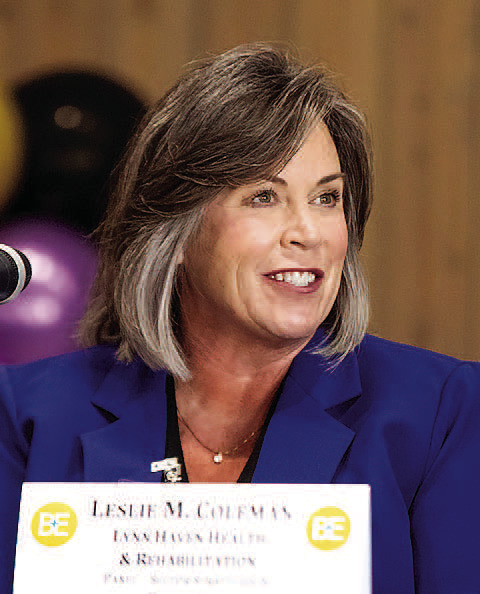
Leslie Coleman of Lynn Haven Health & Rehabilitation has three Jones County College & Career Academy students working at her facility as CNAs.
“One is a recent graduate, and two are seniors at JCHS,” she said. “The program has worked really well for us because those students came to us job-ready. They came to us with their certification, with their clinical practice already done. They had some mentorship already done with some rotations already done in our facilities. They knew they wanted to be in healthcare and had a good start. We’re very grateful for that.”
Coleman said one student has received a higher certification and sees opportunities to work together more with the CCA.
“I can’t say enough about the importance of people coming into the nursing home and working,” she said. “We have such a myriad of disease processes. Our day is much different than inside hospitals, and our nurses really want to mentor young nurses. I really think our residents are more receptive to student nurses than those at hospitals.”
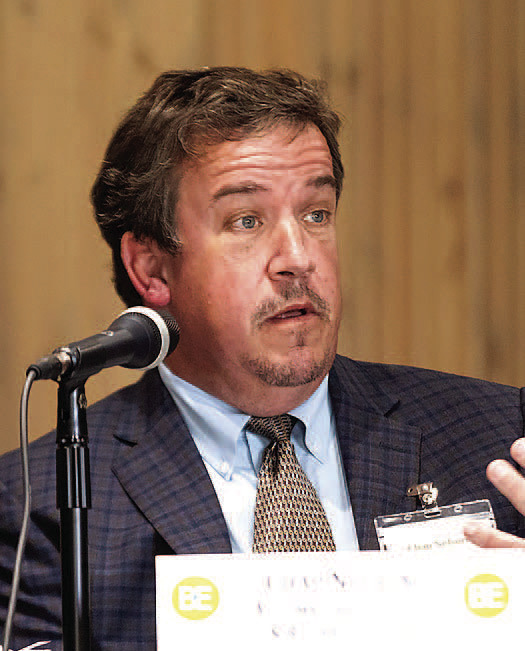
Chap Nelson of Autumn Lane Health & Rehabilitation was asked to speak about his facility’s relationship with the CCA.
“The CCA reached out to us and found out early on that what they were doing in healthcare didn’t really match the jobs,” he said. “They adjusted the healthcare teachings and brought immediate results for us and asked us to be involved.”
Nelson pointed out that students won’t know they really want to be in healthcare until they are in that setting.
“Maybe one out of 10 said they don’t want to do it,” he said, “but the rest of them are on fire about it. Some want to be CNAs, but others want to move on to be nurses or doctors.”
This is the fourth in a series of articles about education and industry from the Sept. 29 Lt.Governor’s Business and Education Summit.
