
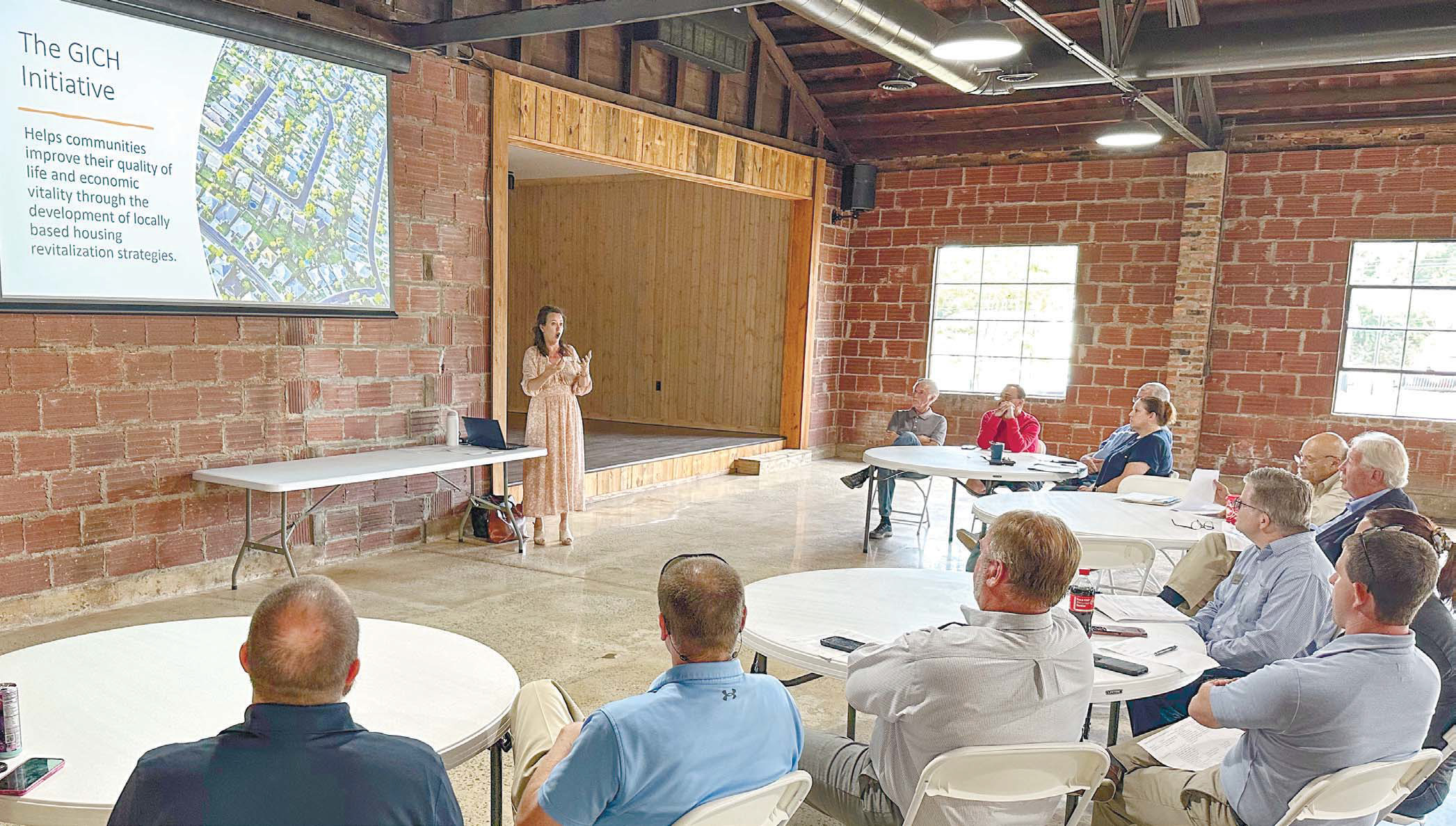
A dedicated group of volunteers has accomplished its mission after more than a decade of advocating for Gray and Jones County’s housing needs, according to elected officials who met Sept. 28 at Butler Hall.
The city was represented by Mayor Pro Tem James Collins and councilmen Terrell Fulford and Terry Favors. The county was represented by Commission Chairman Chris Weidner and Commissioners Sam Kitchens and Wendy Vaughn. The Board of Education was also invited but did not have any representatives at the meeting.
Housing history
The Housing Committee was originally formed through Jones County PLAN, a grassroots organization that has since disbanded. The committee set its sights on becoming a Georgia Initiative for Community Housing (GICH) community and was successful, starting the process in 2009.
At the heart of that effort was Donald Black, who has chaired the committee since its inception and recently decided to retire from the volunteer role due to health and travel restrictions.
“In 2009, Gray and Jones County had a site visit from GICH, and we talked about what the program would entail,” Black said. “We had 19 members on the committee at that time, and there were five representatives from the city council and county commission.”
The committee also had business leaders and interested citizens. Funding was provided by the city and the county in the amount of $5,500, according to Black.
“We were doing this just to see what we would need to do to become a GICH community,” he said. “For the first three years, every retreat that we went to, we had a big contingency of people there.
“Three or four years later, we went to a retreat at ABAC as a presenter, and people wanted to know how we were able to keep the committee together. But, things change, and that’s why we’re here today.”
GICH status
The meeting was facilitated by Joy Carr, who gave some background into the community’s GICH status and what was needed if there was an effort to reapply.
“We’re at a point where, this year, we did not qualify to recertify for this particular year,” she said. “However, we can recertify for the coming year. We have to determine if we want to do that.”
Carr had a presentation with help from Dean Nelson of the Middle Georgia Regional Commission, who was also in attendance.
GICH helps to improve communities through quality of life, economic development and vitality through all aspects of housing, according to Carr.
“Gray-Jones are unique in that most GICH communities are just a city or county,” she said.
Nelson added that only one other city-county partnership exists in the state, which is in Troup County and involves three cities.
“In the initial three-year process if you’re selected as a GICH community, you have a structured team to help you make your goals a reality,” she said. “Five communities are selected on an annual basis, and there are retreats to facilitate your freshman year. Workshops are provided by experts in their fields.”
Carr said GICH provides a way for the committee to network and learn from other communities to see how others have used the program.
Being an active GICH community also adds points to some grant applications, including CHIP and CDBG grants, and communities are exempt from the every-other-year rule, meaning they can apply for CDBG grants annually instead of having to wait.
So what does it take to be a GICH community? “Teams are required to attend two retreats per year during the three-year process, and each team must ensure at least four members attend each retreat,” she said. “There must also be adequate attendance at those retreats to maintain active status.”
After the initial three years, the community becomes an alumnus.
“As an alumnus, you go through that process, and only communities that recertify every two years are eligible to maintain that status,” she said.
For 2023 recertification, the community needed to have an updated housing plan from the previous three years, which it does. The latest plans were updated in 2021.
Other factors are team continuity, retreat attendance, continuing education and team meetings at least quarterly. The committee has not been able to maintain all of those.
“Do we continue on?” Carr asked. “Is this of value, or is this something [the city and county] could do individually. March 2024 will be here soon, so we would have to try to recertify by then.”
Input from officials
Housing committee member Milton Appling said the initial purpose of the group was to do the leg work and provide suggestions to local elected officials on what the community needs.
“At this point, if you guys don’t see any need for that kind of input, we actually don’t serve a purpose anymore,” he said.
Kitchens said the current board of commissioners has been more proactive with community issues than previous boards.
“We’re losing the real support from you guys that pushes us to make decisions,” he said. “It seems like we’re getting less support from the community, but that’s in everything now.
“You can look at the planning we’ve done over the past 10 years; senior housing communities; the blight committee, where we identified what resources and policies were needed; and we made those changes.”
The commissioner said code enforcement has been involved in taking down blighted houses but that many others were fixed by the property owners.
“The number of times we’ve done community cleanups and resources we’ve had join us,” he said. “The CHIP grant, we’ve struggled the last three rounds. There are hundreds of thousands of dollars available, no one signs up. You just don’t get the buy-in.”
Kitchens said if efforts are not supported by the community level, it’s hard to make it work.
Collins said affordable housing isn’t discussed enough.
“Housing is no longer affordable,” he said. “If housing was affordable, I think we have tons of it. The problem is that the economy has made mortgages skyrocket.”
Kitchens added that housing needs affect the city more than the county because the county doesn’t have sewer.
“The developers are not beating down our door to build housing because they can’t put them on septic tanks, unless we’re building subdivisions, which doesn’t put them in the affordable range,” Kitchens said. “Like James said, affordable housing is non-existent.”
Appling added that, when the GICH team was formed, the elected officials at the time were not taking an active role in housing.
“You guys have taken a much more proactive role in what we’re discussing here that previous commissioners were not doing,” he said. “You’re basically doing the things that we were asking you to do. Do we even need it anymore? You guys have a different mindset than those who were here earlier.
“I think we’ve accomplished most of what we set out to do. I’m not sure there’s anything else we can do.”
Kitchens commended the work of the housing committee.
“You had an intense purpose when you started,” he said. “Whatever it is, we’ve done the things that you guys did the legwork on, and it’s successful. Do we need to keep doing that or do we just say ‘attaboy?’” Black said the committee has had a frustration for a long time about lack of community support but will not completely go away.
“We fulfilled a need at that time,” he said. “But don’t think we won’t make suggestions to you guys when we see things.”
Nelson said the GICH team could form again later if a need arises. “As an alumnus, you can still go to retreats,” he said. “You don’t get expelled from the program. There’s nothing inherently wrong with backing out and letting it go and one day coming back. You can apply to go through the three-year process again. The city could do it or the county could do it.”
