
TECHNICAL EDUCATION
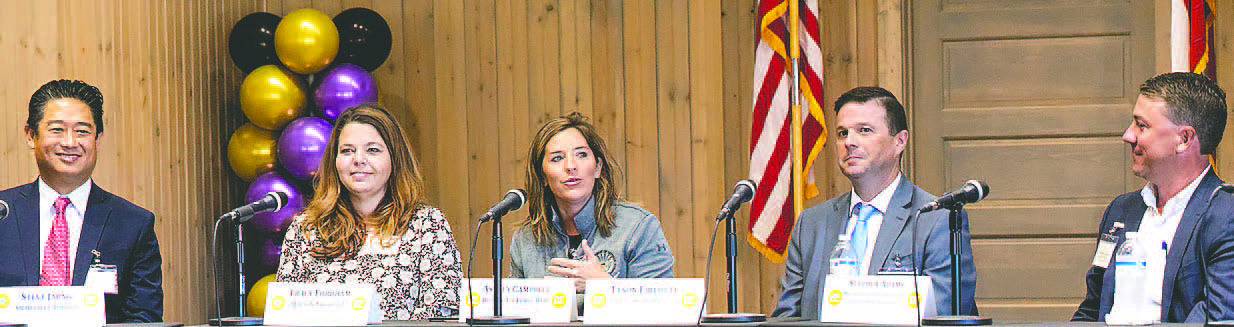
A panel of industry leaders who have created jobs for Georgians explained why Georgia is the No. 1 place to do business during the Lt. Governor’s Business and Education Summit held Sept. 29 in Gray. The conversation was moderated by Ben McCumber of the Technical College System of Georgia, who said the panel was focused on emerging industries that are in need of workers.
The first was Steve Jahng of SK Battery America, which is the sole provider of batteriy cells for electric F-150s.
Next was Tracy Fordham of Qarbon Aerospace in Milledgeville, which is on the cutting edge of composite components and assembly of parts for commercial air and the military.
Ashley Campbell of Robins Air Force Base oversees more than 1,400 computer scientists and engineers and each year hires hundreds more.
Tyson Firlotte of Irving Consumer Products said his company has about 18,000 employees and in Middle Georgia produce toilet paper and paper towels using advanced manufacturing methods.
Stephen Adams, director for the Macon-Bibb County Industrial Authority, said he was there to discuss his role in recruiting companies like Irving Consumer Products to Middle Georgia.
McCumber asked Jahng for an outlook on the electric vehicle industry and the workforce needs.
“The dual enrollment technical college system in Georgia is right in line with what we need going forward,” he said. “Our facility is not like any other facility that you’ve probably seen. We take advanced manufacturing to a new level. We have a clean room, and robots are doing the manufacturing.
“All the programs at technical colleges that offer advanced manufacturing fit right into the future of manufacturing in Georgia in every industry. We have Rivian coming soon, Hyundai Motors coming to Savannah, and I can’t vouch more for what others have said. America has veered slightly too far toward four-year degrees in the last 30 years or so, while what’s being taught at these technical colleges offer good-paying jobs and a good future for these students.”
Fordham was also asked about workforce needs and how Qarbon has engaged with college and career academy programs.
“We’re growing. We currently have 450 employees, and we hope to double that as we win work,” she said. “Many years ago, when I was in high school, I was in the Jones County program, I was provided with the opportunities to make me successful. Then, years later, when my children attended JCHS, it provided them with that foundation. They’re on their own and doing well.”
Fordham said she reached out to JCHS and now has seven students who are being trained to work at Qarbon, and they are excelling at the class.
“We’re looking forward to doing that year after year and even looking at expanding that to other counties,” she said. “So long as they have the attitude, we can teach them the skill. It’s the soft skills that the school districts are teaching the students. It’s a partnership so we can form the next generation.”
Campbell was asked to talk about how engaged the Air Force has been with high schools and CCAs.
“We first engaged with Houston County and had students come out and form a robotics club,” she said. “It grew from that into an internship program. The school allowed me to get into the school system and talking to students in dual enrollment classes. From there, we were able to invite students to embed with us for eight to 10 works to learn, not do any work, but go to college and come back to us in the summer.
“In the first year, we had 28 students from Houston and Bibb County. Those students were able to not only learn skills that they would learn in college but one came back and said, he was in Georgia Tech, his classes were a breeze because of what he learned with us.”
Campbell said they then put together a program that drew 94 applicants. Now, they are working to launch to more school districts.
“We’re allowing students to seek opportunities that are here and do really cool stuff,” she said. “They got to go out and launch F-15s on the flight line. They were able to embed in the air combat rescue helicopter program. They can see what opportunities are here without having to leave the area.”
Firlotte was asked about how advanced manufacturing techniques have impacted Irving’s workforce needs. “Our facility here in Middle Georgia produces double the amount of any of our other facilities with the same amount of employees,” he said. “It takes a lot of robotics and automation to do that. The impact from an employee perspective is a high amount of trades required from electrical instrumentation, PLC, understanding robotics.
“We train our employees to do these things. We enjoy more of the will than skill. Will goes a long way because we do our training internally, but we partner with a lot of our local school systems to leverage more of what they can provide us.”
Why choose Georgia?
McCumber asked the panelists why companies locate in Georgia, like Irving’s $870 million investment in Macon-Bibb County.
Firlotte said he wasn’t sure if he could do the question justice in two minutes.
“I was part of the selection committee that went to various locations,” he said. “Our organization is a unique one. It’s a unique one, a family business that’s been around for 135 years. We don’t plan to be here for 10 years. When we select an area, we plan to be here for 100 years.
“It was QuickStart, it was the technical college, it was meeting with the Chamber and Development Authority, from there we were as much selecting a community as selecting a location. We want to give back and be a part of the community. It really was available workforce, the agencies, ease to do business, and technical things like lots of water and gas.”
Campbell said the selection of Robins Air Force base was a presidential decision back in 1923 but, in 1996, the program was 90% hardware and 10% software.
“Today, the new generation of aircraft are 90% software and 10% hardware,” she said. “We started in a really small office doing software engineering with one community. But, this community quickly pumped out talent.”
Fordham said Qarbon has been at the facility in Milledgeville since 1975, although under many different names, including Northrup-Grumman.
“The name has changed, but the people are the same,” she said. “When Qarbon looked to acquire us, she looked at the culture, the people. We’re known as the hidden gem and many people don’t know we exist. The workforce and the community keep us where we are.”
Jahng closed the panel by speaking about what attracted SK Battery America to Georgia, and he said he could speak the rest of the day on the topic.
“It’s very simple. It starts at the top,” he said. “It was Gov. Deal, then Gov. Kemp … the whole economic development team in Georgia is very supportive. The Southeast is the new Detroit. All of the automakers are here. Period. Full stop.
“In the middle of that is Hartsfield airport. We have I-95, I-85, I-75 all running through the state that connects all of the Eastern Seaboard. The biggest port, the most western port on the Eastern Seabord is Brunswick. Georgia has everything working for it.”
Jahng said academic programs have shown Georgia can create a pipeline of workers, which will keep industries coming.
“Electrification starts here in Georgia,” he said. “The suppliers will come. It’s a matter, if you build it, they will come, and Georgia is in a very ideal location.”
This is the third in a series of articles about education and industry from the Sept. 29 Lt.Governor’s Business and Education Summit. Read next week’s edition for the next installment.
