
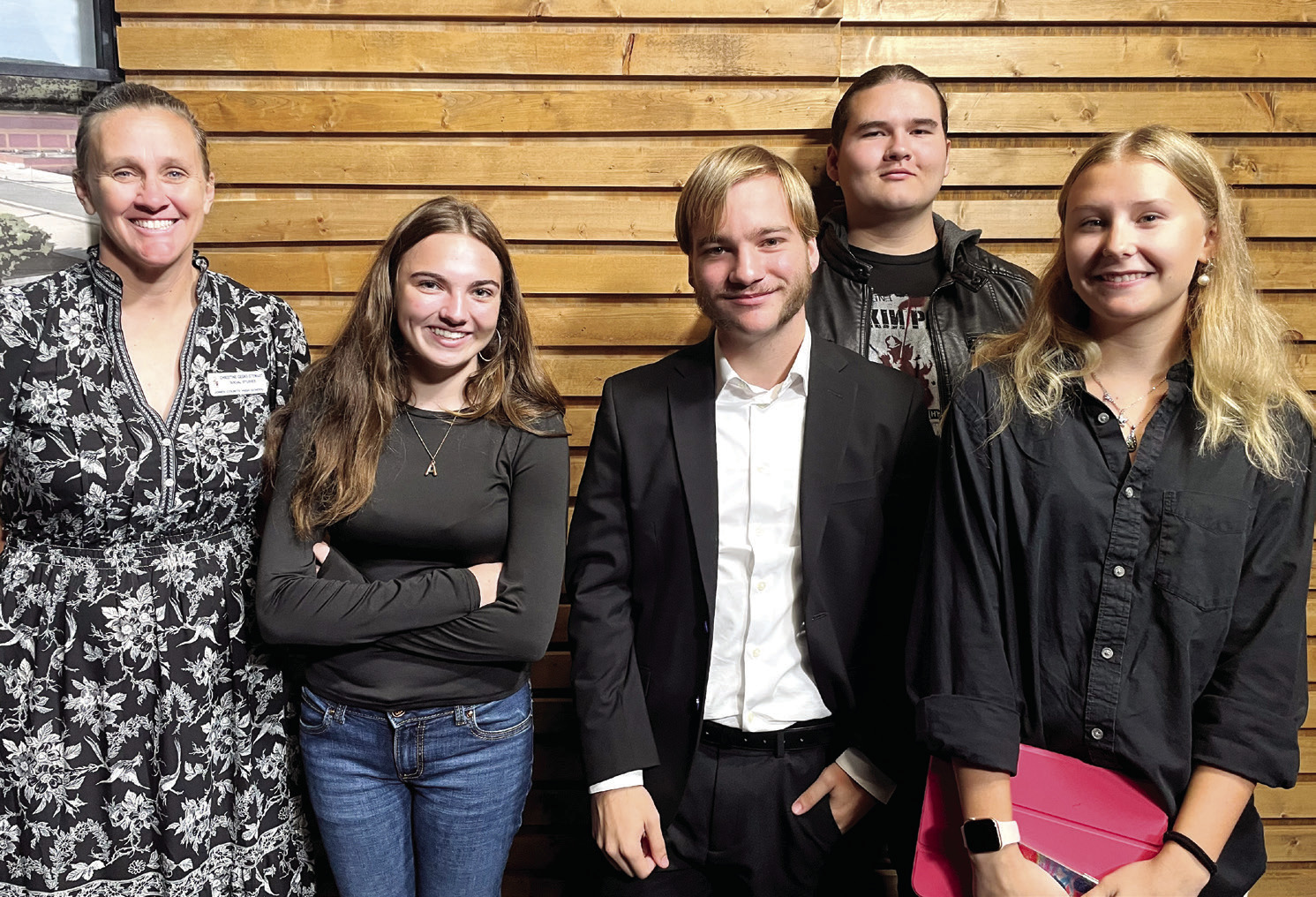
The Jones County High School AP Government classes conducted mock elections for the president of the United States to enhance students’ understanding of government and encourage civic responsibility through a real-world application assignment.
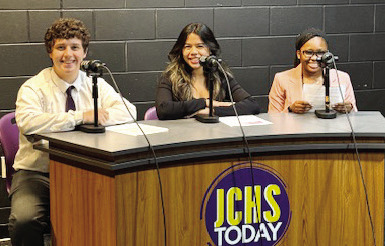
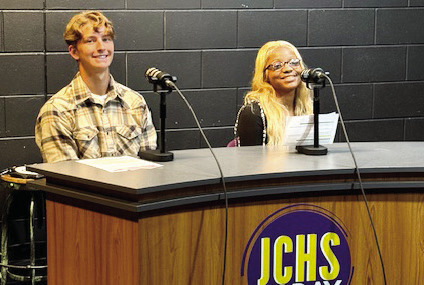
To begin the project, Jones County High School Social Studies Teacher Christine Geske-Stewart instructed her second- and third-period AP Government students to select a role that is pivotal in the process of electing a US president, including a Republican candidate, a Democratic candidate, a third-party candidate, campaign advisors, a conservative media news host, a liberal media news host, an independent media news host, reporters, pollsters, presidential debate moderators, a Republican campaign commercial producers/actors, a Democratic campaign commercial producers/actors, corporate/ special interest lobbyists and union lobbyists.
After students selected the roles they wanted to fill, each class began undertaking its own mock election.
Students worked together to learn about and complete specific tasks relating to their chosen role, aiding their understanding of the election process.
Student Ariana Epps, the independent candidate in the third-period class, discussed learning about significant issues to make an informed decision about what she wanted to address with her platform in the classroom assignment.
“I think I am interested in getting teachers paid more,” the student said.
Epps added that she enjoyed working with her classmates on the assignment.
“I like that we are all working together and appreciating all the different opinions,” she said.
Student Dylan Crumbley, another Independent candidate, addressed issues important to him.
“I am concerned about lowering taxes, regulating businesses and helping the environment. I feel like I am learning how to speak to people about what I believe and ask questions,” the student said.
Student Ava Long, the third-period Republican candidate, said she enjoyed working with her classmates in preparation for the mock debate portion of the assignment.
“Groups are great. My campaign advisor is my new best friend. During the debate, my group will focus on immigration, the economy and abortion,” Long said.
The third-period Democratic campaign advisor, Laila Wright, commented on her peers’ cordial behavior toward each other throughout the process.
“Everyone in the class is taking the assignment seriously, working well together and being respectful,” Wright said.
For the mock election assignment, the students followed an eleven-step process drafted by Geske-Stewart that the students completed throughout the weeks of completing the classroom project: 1. Voterstakea10-question pre-poll.
2. Pollstersdeliversummarized results to candidates and the media.
3. Theclassworkstofilm, plan, and interview based on students’ roles.
4. Candidatesnegotiate funding from lobbyists and unions, with each commercial costing $25 million. 5. Votersviewcommercials. 6. Votersviewnewsprograms. 7. Candidatescompletea debate in class, filmed by the independent media.
8. Voterstakeapost-poll. 9. Votersviewthefinal commercials. 10. Studentsvoteonclass election day. Candidates will receive three additional votes for each union endorsement and one additional vote for each lobbyist endorsement. 11. Allvoters(students)will complete a one-page write-up in class, explaining their vote and reviewing the mock election process.
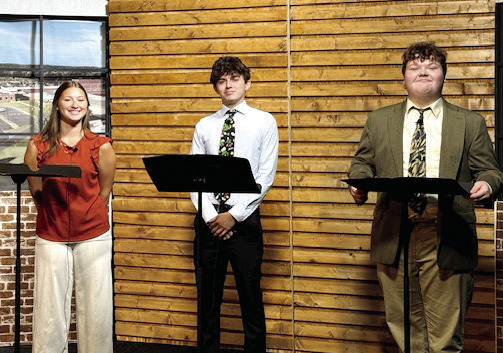
One of the most extensive portions of the assignment was step number seven, the mock presidential debate, where student candidates answered a wide variety of questions created by the student debate moderators, including: “Considering ongoing attacks on reproductive rights, how do you plan to expand access to reproductive healthcare?”
“How does your administration plan on fixing policies to benefit the American people and address the growing wealth gap to ensure economic growth benefits all Americans?”
“Should the United States prioritize unilateral national interests or multilateral cooperation and international institutions in its foreign policy?”
The student Republican, Democratic and independent candidates used the debate to express their stances and attempt to sway their classmates to vote for them based on their performance.
When mock election day arrived, students in the second-period class voted for Kenzie Rodriguez, the Republican candidate. The students in the third-period class voted for Ava Long, also a Republican candidate.
Geske-Stewart noted the importance of the assignment.
“The idea behind the project is for students to understand how government works, the role of the media as a linkage institution between the people and the government and understanding the ins and outs of a presidential election,” the teacher said.
Geske-Stewart mentioned that she usually assigns this project to students in the spring semester. However, she thought it was necessary to swap around the classroom units so that the mock election aligned with the current presidential election and students could utilize real-world scenarios and events to understand classroom content.
“This assignment is a complete application of everything we have been learning in the classroom. Students apply what they learn in class and practice socialization skills by learning to compromise in groups by working together,” the teacher continued.
The teacher praised her classes for their ability to solve problems.
“The students are very respectful in finding ways to mediate situations, effectively learning how to get people to respond. The project has many moving parts. If one person does not do their job, the dominoes start to fall, and we find a way to keep them from falling. It is a real-world application,” Geske-Stewart said.
Geske-Stewart also discussed with her AP Government the importance of registering to vote during an election year, as some students are 18 or approaching voting age.
“We talk about registering to vote to engage with our civic responsibility. When students learn how to exercise their right to vote and use their voice, it gives them an incentive to want to vote,” the teacher concluded.
