
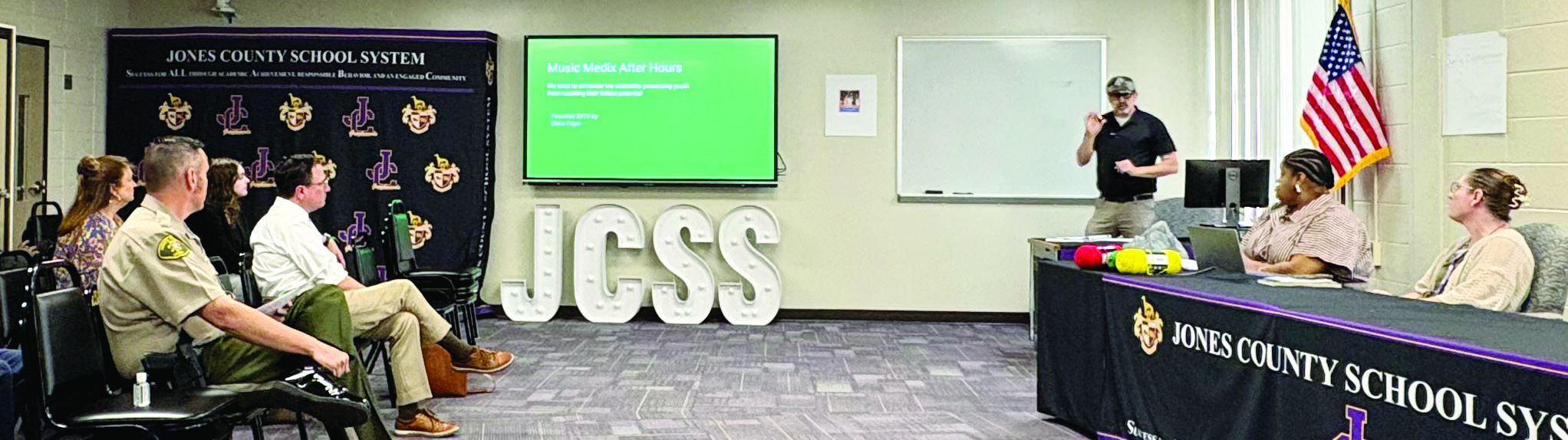
Jones County’s Suicide Prevention Coalition met in a new location last week with an added feature and the inclusion of law enforcement officers.
The March 31 meeting attendees were welcomed by Community Program Coordinator Sheryl Alexander, and the first item on the agenda was an icebreaker to get conversation flowing.
Giuliana Oliff gave an update on Project Alert that concentrates on the issues of vaping, tobacco and alcohol use for students. She said the focus of the campaign is positive norms using themes such as eight of 10 students disapprove of electronic cigarettes and 97 percent of students choose not to drink.
Coalition member Leslie Poythress said the posters are working. She said she heard students referring to those choosing to use alcohol as three percenters. The posters appear to be using peer pressure in a positive way.
Music Medix
The group had its first local coalition member spotlight presented by Chris Pope, founder and operator of Music Medix and Music Medix afterhours. Pope spoke what his music academy is doing to support the efforts of the coalition.
He said the afterhours program was started in 2019 with the purpose of eliminating obstacles that prevent young people from reaching their full potential. He said over the years they learned the biggest problems are not usually financial, technical or educational.
“There are a lot of programs out there that address these issues. What we have found is that most of the real obstacles are internal,” he said. “To put it another way, the biggest obstacles most kids face today are self-imposed.
Pope said young people make bad decisions because they are trying to fit in.
“That want acceptance. They want belonging. They want to feel valuable,” he added.
The speaker said many times suicide is linked to depression, and that comes from feeling like they do not have a community. He said they are very lonely and feel like no one understands them.
Pope said it is important to understand that high-risk behavior in teenagers is part of normal development. Young people challenge their authority, their environment and themselves.
“That’s been going on forever; we’ve always done that. When you are full of hormones and feel invincible, why wouldn’t you do these things the rest of us consider risky?” he asked.
The speaker said the problem is the risks today are more dangerous, addictive and life-altering than ever before. He said it is vital to get that information out there, but when adults say it, young people are not listening.
Pope stated it is important to remember that the first time anyone tries a cigarette, it is not about nicotine; the first vape is not about flavor; the first drink is not about alcohol; and the first joint is not about the high.
“It’s usually about belonging, trying to fit in and be part of a community. A need to be liked and accepted, and with so much time spent on social media, it’s easy to see how young people are missing out on personal connections,” he said.
The speaker said young people need a place to belong and social connections. He said they can get that in churches but about 60 percent of the population, especially millennials, do not have a church; they do not have that community.
Pope said at afterhours they create an environment where a young person does not have to prove their worth. He said they already have value, and they are made to feel welcome to be themselves.
“They are musicians. Some of them want to wear eyeliner and get up on stage performing music that is kind of edgy. I’m like cool, let’s do that instead of cocaine,” he continued.
The speaker pointed out that being on stage is what they consider highrisk behavior because most people are afraid of performing or speaking in public. To them this takes the place of taking other risks.
He said they help young people move from trying to fit in to making a difference. Now their value comes from making a contribution, not imitation.
Pope talked about their youth work labs where young people come up with real solutions to help businesses and the community. He said an example of that is their social media marketing lab.
“Students help local businesses with real social media content. Through that they gain responsibility, experience, creative involvement, decision-making ability, and most important, a sense of impact,” he said.
Pope said the process involves looking at generated AI content. He said the students are put in a supervisory position to evaluate, refine and improve the content to benefit the business. They have the chance of editing the content and making it their own.
“In doing this, they develop judgement, their own standards, they take ownership of it and begin thinking differently about themselves,” he said. “This is where we start talking about preplanning and knowing how we are going to react in different situations.”
Pope said the youth work labs are also used in areas of photography, marketing content, project coordination, music performance management, community support roles, and socialization programs for special needs youth.
He emphasized these are not pretend roles, and they are making a difference in the community.
“They are the managers. They don’t answer to me. You just do it and do it the best you can,” he said. “We are not just teaching music. We are building their self confidence. We are building belonging. We are building responsibility, and we are building purpose.”
Pope pointed out if they are focused on serving others, they are probably not in the mindset of trying to fit in.
“They’re already fitting in, and the next step is taking action,” he said. “When they have purpose, they don’t chase acceptance. They don’t need to follow the crowd. They don’t need to take destructive risks to feel like they belong. They already belong.”
Pope said Music Medix currently has 20 students with 14 who perform on stage and in the afterhours program.
He concluded by stating, “Through what we are doing, they have something meaningful to contribute.”
Wrap up
Alexander announced there were no deaths by suicide in Jones County in February. With none reported in January, that is a good start for 2026.
She introduced Shanda LaPointe, a new program assistant, who is a former teacher.
The Jones County Suicide Coalition was created in 2019 in partnership with Richmond County following alarming statics about the number of deaths by suicide in both counties. Under the leadership of Augusta University, the counties applied for and received a fouryear grant from the Georgia Department of Behavioral Health and Developmental Disabilities to help both counties reduce those numbers. The grant was renewed last fall.
In Jones County, suicide was the ninth leading cause of death from 2013-17 and the number one cause of death for the time period for ages 15-19. It was also the number two cause of death for ages 45-54. The county had eight deaths by suicide in 2016 and seven deaths by suicide in 2018. That number spiked to eight again in 2022 but dropped to one in 2023. The number of deaths by suicide in 2024 was four and that increased to seven in 2025.
It is concerning that the suicide numbers do not include deaths from overdoses unless a note is left by the victim.
The major focus of the coalition is getting the word that help is available for everyone in crisis, 24/7 by calling or texting 988. The number for the Georgia Crisis and Access Line that is also available 24/7 is 800-715-4225.
