
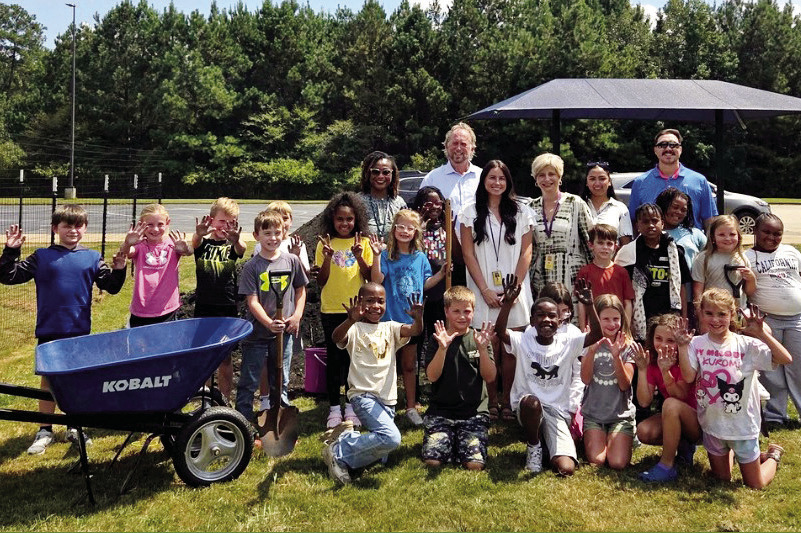
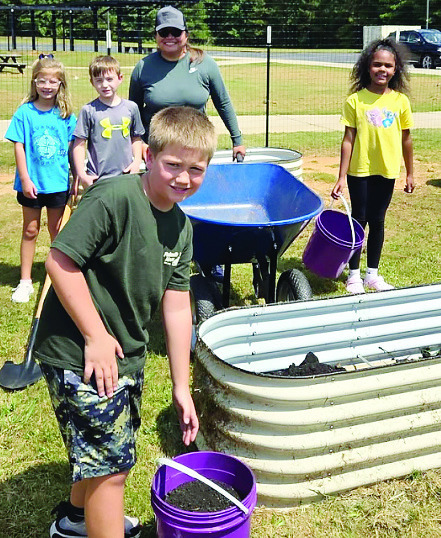
Turner Woods Elementary plants seeds of change
Turner Woods Elementary, with support from Shaome Cooperative, has launched Jones County Schools’ first GROW (Growing with Real Organic Wisdom) initiative to help students and families grow their own food, embrace healthier living, and explore STEM-based learning through gardening activities that build lifelong skills.
The GROW program is bringing a full-scale edible garden, a food forest, and a hands-on curriculum that connects students to realworld learning and wellness at Turner Woods Elementary.
Shaome Cooperative is a Georgia-based nonprofit that works to create food security across the state through education and the development of edible gardens and food forests, which they are implementing at Turner Woods’ campus.
Chelsea McClain, President and CEO of Shaome Cooperative, shared the organization’s vision.
“Our North Star is to make Georgia the first food-secure state in the nation. We realize that it is a lofty goal, but we are up for the challenge,” McClain said.
Shaome’s website defines food insecurity as the inability to consistently feed one’s family without relying on grocery stores, especially in situations where supply chains are disrupted or access to stores is limited. More than 1.2 million Georgians are already considered food insecure, even without such disruptions, which underscores the need for community- based solutions that promote self-reliance, sustainability, and longterm access to nutritious food.
A generous donation from the Bresse Family, whose three children attended Turner Woods, made it possible to fully implement the GROW initiative on the school’s campus. Turner Woods also received a Whole Kids Foundation Garden Grant, which supports garden-based learning across core subjects, including Science, Math, English Language Arts, Social Studies, Health and PE, and Fine Arts.
Keisha Pitts, Principal of Turner Woods, expressed gratitude for the school’s partnership and explained the resources provided by Shaome Cooperative.
“What Shaome Cooperative is providing to Turner Woods is a three-year contract commitment where they will support us with the initial installation of six raised garden beds per each grade level. They put up the fencing, provide the beds, soil, and all the materials to maintain the seeds we’re planting and help with establishing our food forest,” she said.
A food forest is a layered garden system that mimics a natural ecosystem, combining trees, shrubs, herbs, and ground cover to produce food sustainably.
McClain explained that the objective of the GROW Initiative is to help children see the potential in the land around them and learn how to transform it into something meaningful.
“Ultimately, what we are trying to do with our GROW program is to teach children to look at a blank piece of land and turn it into a food forest. That is what our curriculum teaches,” McClain said.
Shaome’s curriculum was developed by Macon-Bibb County educators and aligns with Georgia’s educational standards. It is adaptable for all K–5 grade levels. Pitts confirmed that the curriculum is already being implemented in the classroom at Turner Woods, connecting hands-on gardening with academic learning.
“Shaome provided the lesson plans for our STEM teacher, so she teaches all the lessons that are aligned with the Georgia Standards of Excellence. Each grade level will go out there, plant, water, and they’ll talk about what is growing and make connections to the science standards and also just real life,” Pitts said.
Olivia Martinez, STEM Teacher at Turner Woods, shared how students are engaging with the curriculum.
“We are currently building our foundation by learning about the seven different layers of the food forest. We’re learning about how all the different layers act together to form their own ecosystem, and how we, as humans, can positively impact this process.
They’ve been doing engaging activities such as designing their own food forests and discussing what fruits or vegetables fit into each layer,” Martinez said.
Students at Turner Woods will also learn sustainable gardening practices that support the environment and long-term food production. Lessons include composting, vermiculture, seed saving, and alternative watering methods, all of which are part of Shaome’s hands-on curriculum.
McClain explained that students are also being introduced to unique crops, including the Jerusalem artichoke.
“It’s not the green artichoke we usually think of. You eat the roots, and it’s very flavorful, more nutritious, and it’s perennial,” she said.
Perennials are plants that grow back year after year and are a key part of Shaome’s sustainability model. McClain shared that the organization encourages schools to plant perennials to ensure lasting harvests and reduce the need for replanting each season.
Turner Woods is also benefiting from Shaome’s partnership with a blueberry farm in Byron.
“They have 13 varieties of blueberries and donate bushes to all of our schools,” McClain said.
Students will also grow greens, lettuces, kale, and mint in the garden beds. These fast-growing plants will give children a quick visual return and help build excitement around the process.
“Mint grows very quickly, so the children will get a good return visually,” McClain said.
“We will probably start with some of those things and then add more as we have space,” she said.
To maintain healthy soil during colder months, McClain said students will plant dandelions and clover, which support soil succession and keep the ground covered. She also emphasized the importance of choosing native plants whenever possible.
“We always look for native plants first because that makes the most sense for the area. And then, we look to create the right balance of plants and trees to support each other. In the food forest, we plant things like fig trees and peach trees. If there is enough space, we plant things like pecan and avocado,” she said.
Pitts spoke about how the initiative enhances learning opportunities for students.
“It’s amazing, and the beauty in it for me as principal is the opportunity to extend our STEM program. It is such a blessing, and we are very excited about it,” she said.
She also highlighted how the program prepares students for future academic pathways.
“This also prepares students for middle school and beyond, getting them ready for those pathways over at the high school. This will spark an interest in some of our students, and we have some students out there that already have some knowledge from family members and even ones who don’t have gardens at home who may be interested,” the principal said.
McClain said the GROW Initiative is designed to equip students with lifelong skills that go far beyond the classroom.
“These are skills that they can take and use for the rest of their lives, and they can share them with others. So, you can see that there’s going to be a huge ripple effect, and this one school will impact thousands of people within the first three years,” she said.
McClain also shared that Shaome plans to establish a distribution system once the gardens begin producing enough food.
“The food source will go to people in the school community first,” she said.
“But once there is enough grown for the community, we will set up a distribution system for the school. We like to incorporate local business owners, places of worship, and help get the food distributed to people who need it. That will probably begin in the second or third year of the program,” McClain said.
Pitts looked at the deeper meaning behind the initiative and its impact on Turner Woods Elementary students.
“I think it’s beneficial for students to be able to extend their learning beyond the classroom, to engage in hands-on learning, and to learn more about growing and planting, and understand that our food doesn’t just come from the grocery store. It starts with growing, and it starts with planting a seed,” the principal said.
