
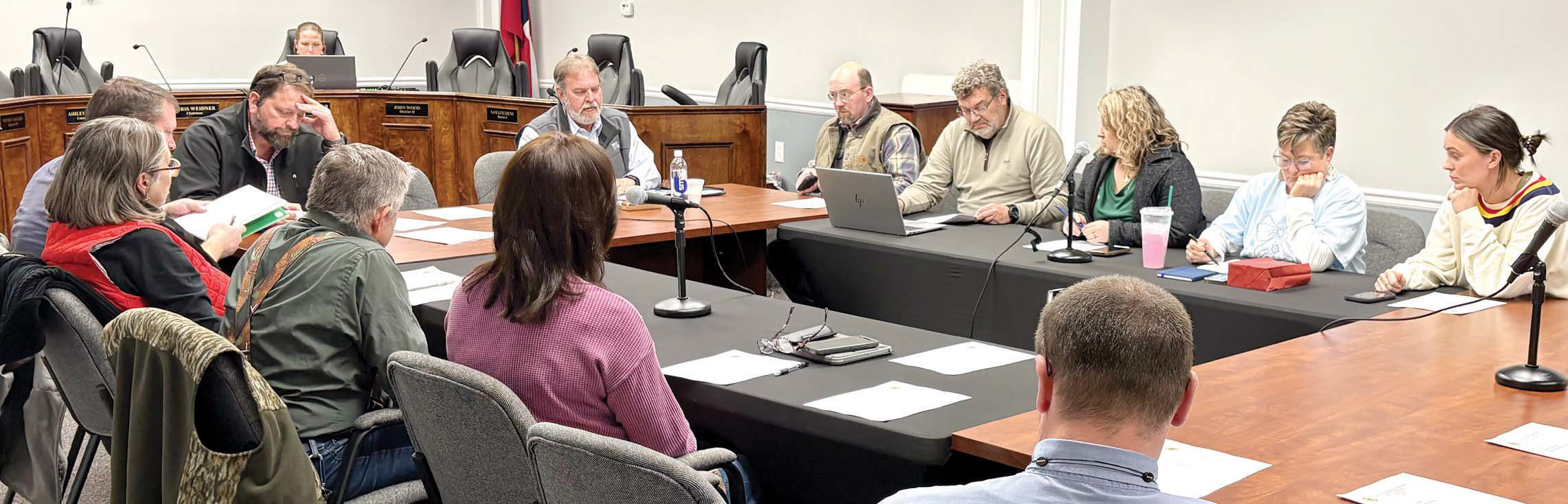
Jones County Commissioners hosted the third work session for the purpose of implementing protections in the event of the construction of data centers in the county last week.
The Dec. 8 session was called to order by the vice chairman Sam Kitchens in the absence of Chairman Chris Weidner. The focus of the meeting was a text amendment being created for the county’s industrial M-2 code and the creation of an M-3 zoning code.
The first of the work sessions was held Oct. 30. The event brought together commissioners, members of the county’s Planning and Zoning Commission and the executive director and members of the Development Authority of Jones County, all key players in the decision process.
The public was not only invited to attend, but members of a self-appointed community advisory group were given seats at the table to demonstrate their inclusion in the conversation.
Kitchens started the discussion with a point that he said was brought up by zoning board member Steve Hoyt in a previous meeting.
“He asked what is wrong with M-2 zoning, and can we fix it,” the commissioner said. “I took that to heart, but we also want to move forward with the M-3 zoning for the industrial park.”
Kitchens said the work sessions focus on data centers, and the commissioners approved the request by the zoning board to get expert legal help to create M-3 zoning. He then turned the meeting over to Zoning Officer Tim Pitrowski to go through a handout, which was a draft of the M-2 text amendment.
Data centers will be a conditional use under M-2 zoning, which requires the applications come before the zoning board and commissioners prior to receiving a building permit.
The document first defined a data center and three different types of the facilities. The definition of a data center is a facility engaged in the storage, management, processing and hosting or transmission of data and related services.
Cryptocurrency processing facilities are excluded.
The types of data centers begin with minor ones of 20,000 square feet or less. Jones County already has facilities that fall into this category. The next is a major facility with more the 20,000 square feet but less than 100,000 square feet, and the final category is the data center campus that exceeds the size, power or area thresholds of a major data center.
The amendment spells out height regulations, setbacks, buffer requirements, HVAC and mechanical screenings, lighting, noise and fencing for each facility.
Pitrowski took each section of the amendment and explained the reasoning behind it.
Alex Lefholz appeared to represent the citizens advisory group and had several questions and comments about what was being allowed and not allowed in other counties.
JCDA Chairman Erik Varnadoe questioned the difference between the regulations being required of data centers as opposed to other businesses and industry. He said the purpose of having an industrial park is for it to be as marketable as possible.
Commissioner John Wood added that the regulations, such as for noise, need to be at a reasonable level.
Kitchens agreed that an industrial park is designed to attract industry and does not need to be the focus of the regulations.
“At the end of the day, we have got to get to the point of doing something,” he said.
P&Z Commission Chairman Earlene Hamilton suggested different regulations for the industrial park and other areas.
“We don’t want to impact the industrial park,” she said.
Kitchens said neither do they want to be so unreasonable with regulations as to exclude all data centers.
“We need to find what is acceptable,” he said.
The commissioner said he believes the boards have done their homework and does not see the need for more work sessions. He said at this point the text amendment is ready for discussion and a recommendation by Planning and Zoning.
Kitchens said the process to create the M-3 zoning is a separate process.
“We have protections we did not have three months ago. More work sessions would just be kicking the can down the road,” he said.
The commissioner said the intent of the sessions was to ask for input, and they have gotten that.
“We’ve done what we planned to get the best information we can. The text amendment is all about local control,” he said.
Varnadoe took the opportunity at the end of the session to invite everyone to the Dec. 18 meeting to provide information about the economic development process. The meeting will be held at the Tri-County EMC Community Room beginning at 6 p.m.
