
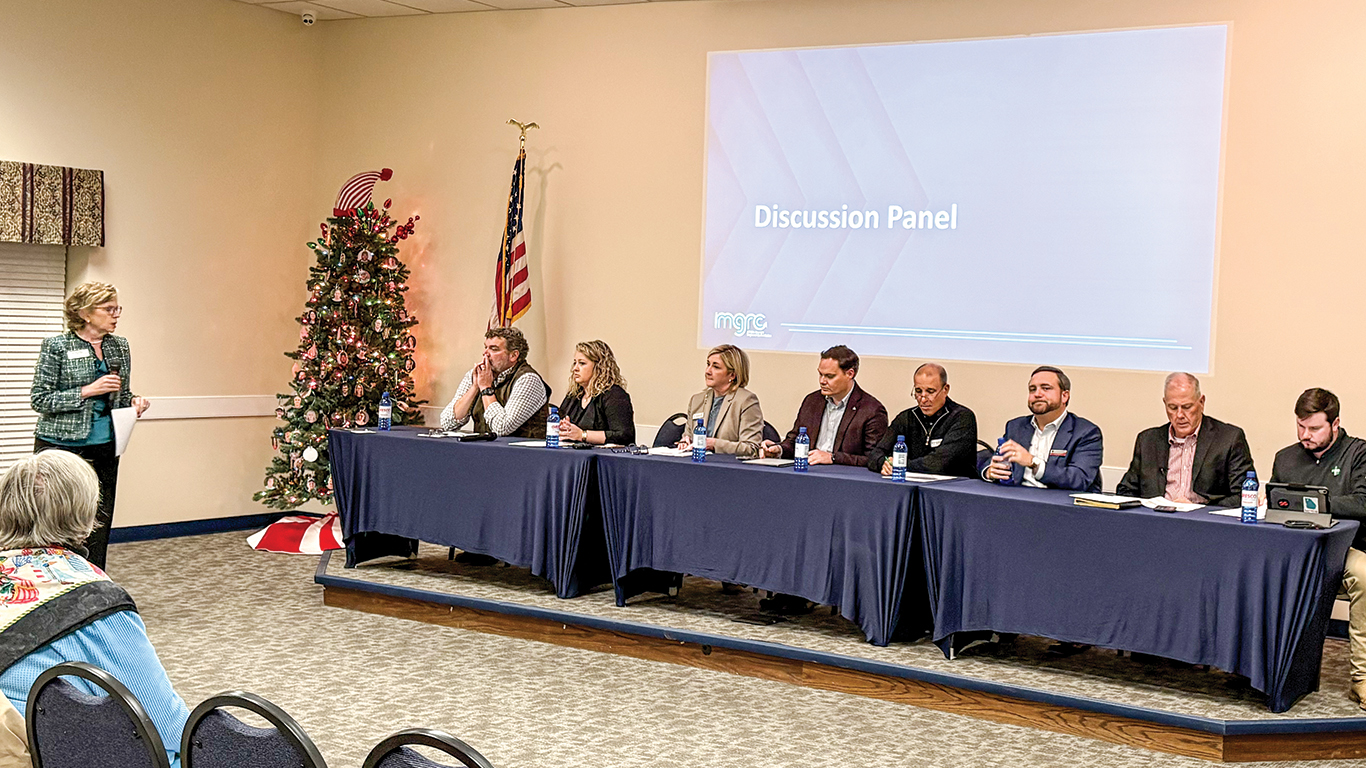
More than 60 people attended the Dec. 18 economic development information session hosted at Tri-County EMC for the purpose of educating the public in what economic development is and its benefits.
After a welcome by Erik Varnadoe, chairman of the Development Authority of Jones County, the session started with an overview of economic development by Greg Boike, director of planning and public administration with the Middle Georgia Regional Commission.
Boike’s presentation was followed by a panel discussion that included eight experts in their fields to discuss economic development, led by MGRC Executive Director Laura Mathis.
Boike started with a definition of economic development.
“Activities that involve private investment and/ or job creation, which are done for the purpose of improving the quality of life.”
The process can include new industry, existing industry, small businesses and commercial development. Boike said retail is also part of economic development.
He said local development authorities are involved in working with businesses and industries interested in locating in a community as well as local governments.
Boike explained there is a screening process on both ends of the process due to the changes that economic development can bring. That includes looking at labor costs, quality of life, energy, regulations and taxes for the companies.
“The Jones County Development Authority is the single point of contact for negotiations,” the speaker said. “Local elected officials may not even be involved in the beginning of the process.”
Boike said the state helps with matching businesses and industries to communities. He also showed the impact industries can have on the tax digest of cities and counties.
“The less that tax base, the fewer services the government can provide,” he said.
At the conclusion of the presentation, he noted that economic development is a choice.
Panel discussion
Panelists for the discussion, in addition to Varnadoe, were Haley Watson, executive director of the Development Authority of Jones County; Cassandra C. Cox, Georgia Power area manager; Ryan C. Waldrep, Georgia Power regional economic development manager; Ray Grinberg, CEO of Tri-County EMC; Joey Heath, transition services manager with Georgia Transmission Corporation; Tim Ingram, Ingram & Associates Consulting Engineers; and Brandon Stark, superintendent of the Jones County Water Department.
The discussion was led by Mathis, and she started with a question to Watson about the types of companies that have contacted her about locating in the industrial park. The director said, over the last 24 months, the types of projects that have shown interest included ammunition manufacturing, aerospace, tire companies, candy and soft drink production facilities, and data centers.
She said when the requests come in, they are evaluated. The authority also works with utility and railroad partners to determine the fit in Jones County.
“The best fit is felt to be aerospace, automotive warehouse and distribution, but in reality, we look at all projects. If the project is not the right fit, we turn it down,” Watson said.
Mathis asked the utility providers how its determined who will serve a business or industry.
Grinberg said part of that process is the amount of energy is needed.
“We are neutral until we understand that load and what it means to our business and existing customers,” he said.
Cox added they work closely with each other to help the community, and Waldrep said they are agnostic about the provider.
“Our role is to help the community put the very best foot forward they can,” he said. “Think of me as your unpaid staffer. We are here to help and want the community to be successful.”
Heath explained that Georgia Transmission is a transmission-only electric cooperative owned by the 38 Georgia Electric Membership Cooperatives it serves. Georgia Transmission is responsible for planning, building and maintaining high-voltage transmission lines and substations that carry power from generation facilities to local EMCs.
“We are not speculative. We look at loads that are planned now and look at ways to serve all the loads in Georgia,” he said.
Mathis asked about infrastructure and Jones County’s water and sewer capacity. She directed the question of how much capacity is available to Ingram.
The engineer said the county is currently going through a $25 million expansion project. He said that includes the elevated tank on Lite-N-Tie Road. He said at this time the county can provide 2.4 million gallons of water a day with its own resources.
Ingram said that does not include the two connections available from the Macon Water Authority. With those connections, the county could pump about 4 million gallons.
“Our capacity is pretty strong,” he said.
Ingram said the county is working to get two more wells online. He said meetings are held regularly with the county administrator and Stark to make sure the needs are met as best they can. The engineer said the pandemic revealed weaknesses in the system due to the increased demand of people being home all day.
“Our new projects are fixing those weaknesses,” he said.
Future
Mathis said asked about how utilities are planning for the future. Cox said Georgia Power is regulated by the Public Service Commission, and their planning process is evaluated every three years. They recently had to go back to them due to the need for larger loads.
Waldrep said those meetings focused on new rules and regulations and ways to protect rate payers. He said those meetings were focused on customers.
“We were able to change some of the rules to make sure safeguards and guardrails were put in place to make sure the improvements needed to be made are paid by these new customers who are coming in, not residential ratepayers,” he said.
Waldrep said the new regulations will actually reduce the rates being paid over time. He said that is due to the partnerships of utilities across the state.
“Customers want reliable, safe and affordable energy. That’s possible because of planning.”
Grinberg said they look locally but work with partners statewide. He said the size of the loads and landscapes have changed drastically.
“We are ++ just talking about data centers; the current landscape is a very different entity. Any load located at Griswoldville Industrial Park will need new service,” he said.
The new service would involve the construction of a new substation that would take two to three years.
The CEO said that larger load would involve Georgia Transmission.
Heath stated that the difference is looking at 10s, 100s and 1,000s of megawatts compared to projects with a load of two megawatts previously. He said the cost of the construction would be passed on to the data centers.
“It can also impact other counties when building transition systems,” he said. “Data centers are the shiny new penny. We have seen a big change in our generation landscape.”
Grinberg said every market is regional and not localized to Jones County. He said power plants open and close across the region, and the market moves according to supply and demand.
Stark said as for water, trends are tracked daily, monthly and yearly. He said the department works with the county to know when development is coming.
“We plan and make sure we have reserves,” he said.
At the conclusion of the session, questions were collected from the audience. Because of the number of the questions, there was not time to answer them at the meeting. Mathis said they would come up with a strategy for the questions to be answered.
