
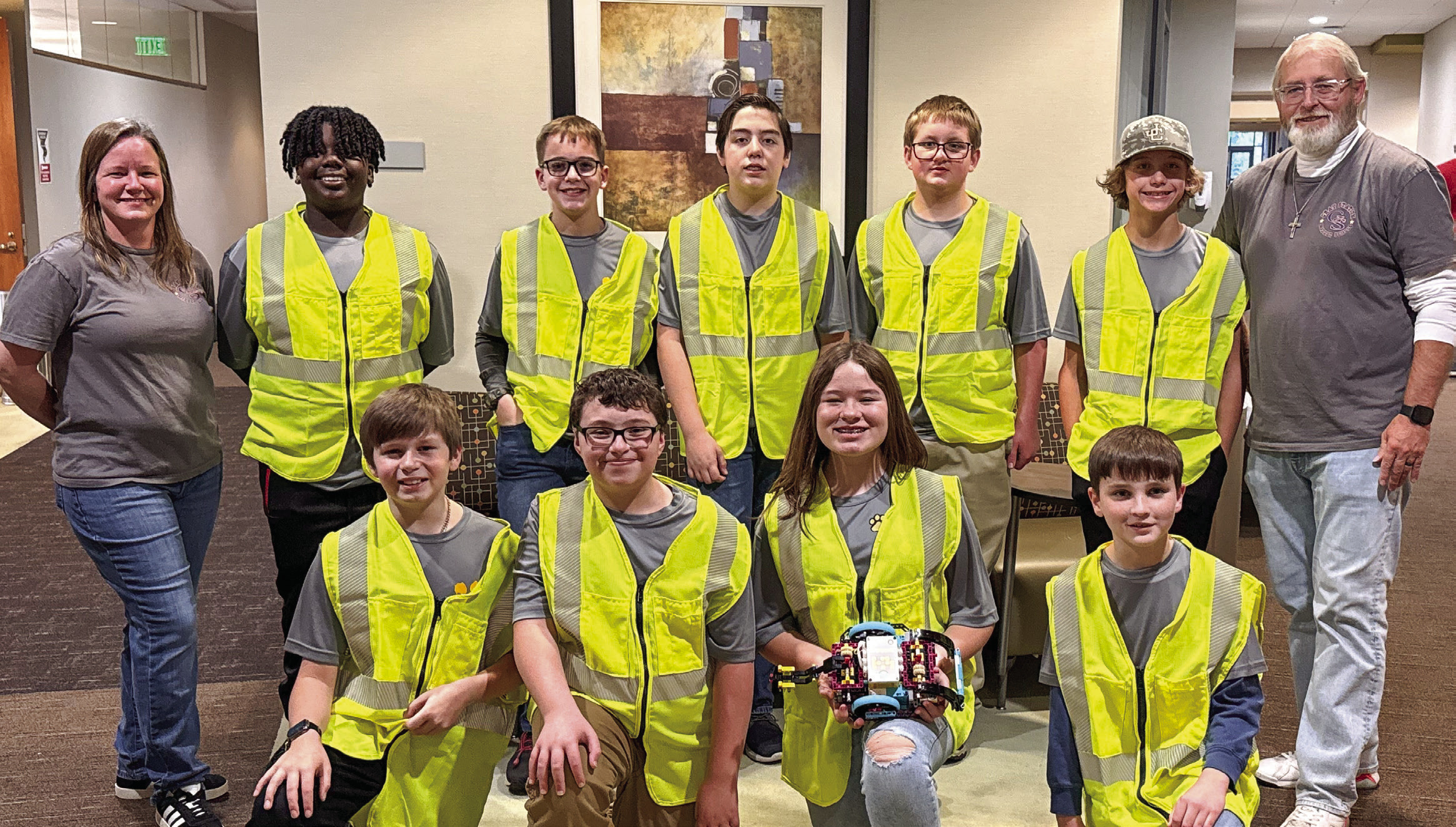
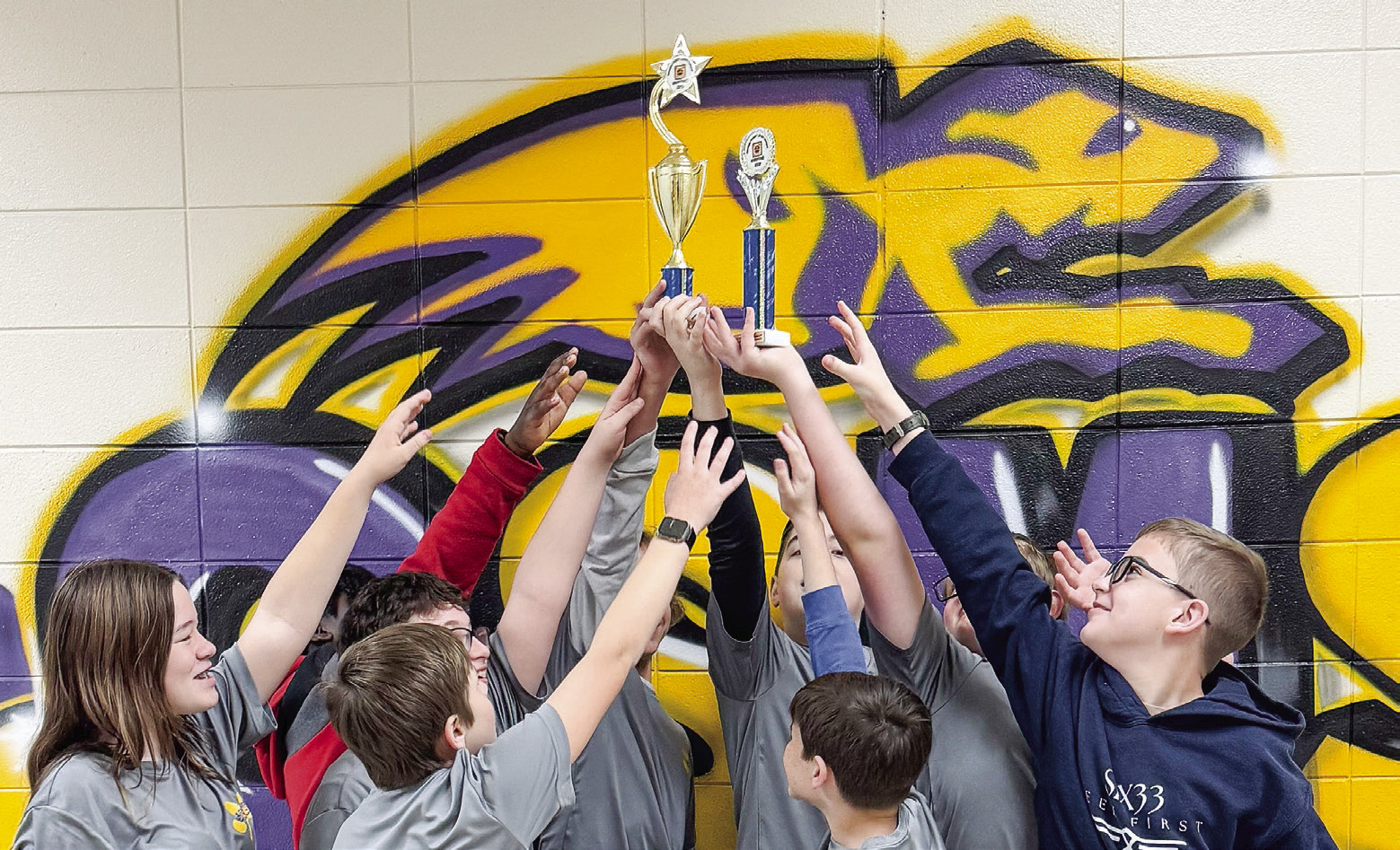
The Gray Station Middle School (GSMS) Robotics team celebrated a major milestone this winter after earning the title of Grand Champion at the First Lego League regional competition held at Middle Georgia State University.
The club, led by sixth grade math teacher Leroy Brooks, is only in its second year at GSMS. Brooks started the program two years ago and now coaches a team of nine students across sixth, seventh, and eighth grades.
The team includes sixth graders Mason Bright and Dawson Dipaolo, seventh graders Brantley Sementilli and Benjamin Litch, and eighth graders Cruz Hudgins, Chace Richards, Yareth Hasty, Jeremiah Thomas, and Avery Scott. Sixth-grade PEC teacher Jennifer Richards also serves as a coach.
Robins Air Force Base sponsors the club this year, allowing GSMS students to compete using high-quality equipment.
“We are being sponsored by Robins Air Force Base in Warner Robins. They are paying for everything from our robots to our entry fees for every tournament we were in as well,” Brooks said.
The team also received support from its 21st Century Partnership.
“We also have a 21st Century Partnership, where this representative donated $1,100 worth of robotics merchandise for us to create a larger robot, which took a lot more time for them to build, but worked a whole lot better for them than the tiny robot from last year. It helped the kids out a lot,” Brooks said.
The First Lego League competition features two main categories: robot games and an innovation project. Programs are divided into classifications based on experience, and GSMS currently competes in Class B since the club is still new.
The GSMS team excelled at the regional competition held on December 6.
“We won it all. We were the grand champions of our league. We also won the robot performance award,” Brooks said.
The win came against twelve schools, many of which have long-running robotics classes or full-time programs. GSMS operates as an after-school club that meets for an hour and a half once or twice a week, which makes the victory especially meaningful.
“Everybody was shocked, and everybody was so happy after winning regionals. A couple of weeks later, we went to super-regionals,” Brooks said.
Students competed against eleven schools at the super-regionals event at Macon State College on January 24. They did not place in the second tournament but gained valuable experience for next year.
“Overall, the kids had a good time, and it was a great season,” Brooks said.
The robotics table event challenges students to code a robot that completes missions related to a yearly theme. This season focused on archaeology, and missions involved moving or manipulating Lego archaeology-themed pieces to score points. Students cannot touch the robot once the run starts, or they lose points, making accuracy essential.
Four team members compete on the table while the remaining five work on the innovation project, which also follows the archaeology theme. Students researched the field and presented their findings to judges for additional scoring.
An archaeologist from Warner Robins, Josh Herring, visited GSMS to speak with students about his work. The team used his insights while preparing for their innovation project.
Brooks said the eighth graders played a key leadership role by teaching younger teammates and helping guide strategy. The teacher said he will miss the group as they move on to high school.
“Man, they are good. They facilitated a lot, and they always knew what they were doing, and they took on the tasks. They did really well. These kids treat it as a sport. They practice and practice, and when they get on the table, they take it seriously,” Brooks said.
The students enjoyed the season and developed teamwork, communication, and confidence.
Seventh grader Brantley Sementilli said this was her first year in robotics.
“It was my first year. It was really exciting. I got to be on the table with Cruz. It was really fun. The innovation project was a little stressful because I was one of the main ones working on it, and it was a lot to do. But I had fun overall,” she said.
Her favorite mission on the table was The Ship.
“We had to lift the sand off the ship, and that was probably my favorite part,” she said.
Sementilli said she learned communication and teamwork skills.
Brooks said he saw a major boost in her confidence and said she played a key role in the success of the innovation project.
“At the competition, when we were grand champions, we were really just crushing it, and it made me really happy. I want to do robotics again next year,” Sementilli said.
Eighth grader Cruz Hudgins served as one of the main coders and designers.
“I did most of the coding and robot design. The coding stuff was really tricky, and we just had to do trial and error over and over again. For the robot design, we went with the base design where we could attach different arms to help us accomplish different missions,” he said.
His favorite missions included the Mine Cart and the Silo challenge. He is considering pursuing engineering in high school.
Eighth grader Jeremiah Thomas said he enjoyed working with his teammates.
“It was really funny getting to work with everybody. It was nice,” he said.
He said he learned interesting facts about archaeology during the innovation project research.
“I learned that archaeologists, before engineers can build on certain grounds, go and inspect for artifacts, which is really cool,” he said.
Thomas said he gained confidence in his teamwork skills.
Parents supported the students throughout the season, and the school plans to celebrate the team’s accomplishments with a party before the school year ends. Last year, GSMS reached the state level based on its innovation project, and the team hopes to return next year.
Brooks said programs like this one help students discover interests that could grow into future careers.
“There is a lack of engineering. We need more people in aerospace and aeronautics,” he said.
He believes the club opens doors for students and gives them early experience in problem-solving, design, and coding.
