
Bruce Stanford began his law enforcement career answering and responding to telephone calls for Jones County. Forty years later, he is still doing a lot of that for the State of Georgia.
Stanford, 57, is deputy director of the Law Enforcement and Emergency Management division of the Georgia Department of Agriculture. The 1985 Jones County High graduate assumed that position in July of 2024, coming from the Georgia Public Safety Training Center in Forsyth, where he had been since 2001.
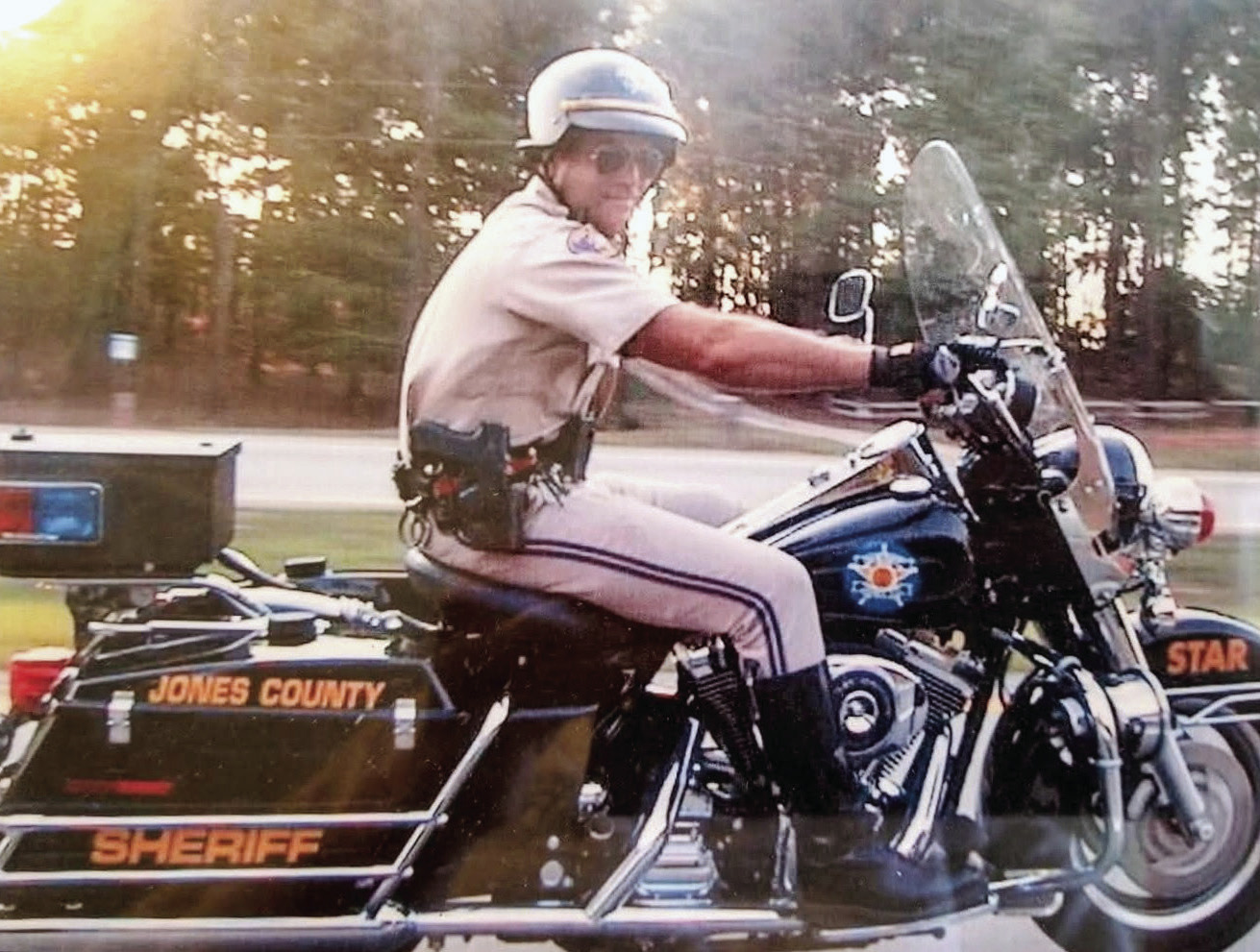
Stanford, who grew up in Wayside, went straight into law enforcement as a dispatcher for the Jones County Sheriff’s Office when he graduated from high school but took a leave of absence to go through basic training and joined the National Guard.
“And when I got back, the sheriff (Butch Reece) offered me a spot as a deputy on the road, and of course, I took it,” he said in an interview last week. “And in ‘89 is when I actually graduated from what we call mandate school.”
Stanford, after another short leave of absence, remained with the local sheriff’s office until 2001, when he was offered the position of teaching at the training center.
Stanford said he eventually started crash reconstruction courses — a supervisor’s position — then went to a senior manager’s slot. He was later promoted to director of the police academy division.
“That gave me some real good experience with big budgets,” he detailed, “with a lot of people, a lot of different divisions, and a lot of tasks and projects.”
Stanford said Agriculture Department Commissioner Tyler Harper took office in 2023 and prioritized law enforcement in the agency again.
“There’s such a need for it in agriculture,” he emphasized. “Obviously we deal with a lot of animal cases. It can be everything from animal welfare in cruelty investigations — people that are running puppy mills in poor conditions; people that have what we call companion animals, horses, donkeys, animals like that, that they’re not taking care — to cattle thefts and horse thefts.
“We’ve made an arrest in a multi-state cattle theft ring,” Stanford added. “Last year, we ran down a case that covered three states on stolen horses.”
Then, there’s always the drugs.
“There’s a lot of involvement trying to move drugs in produce. A lot of the produce that comes to America comes from Mexico. And so, last year in August,” Stanford recalled, “we assisted DEA (Drug Enforcement Agency) in intercepting a little over 2,500 pounds of methamphetamine at the Atlanta Farmers Market. It was the biggest methamphetamine bust to date in the state, and it came from Mexico, right across the border, all the way to Atlanta to be distributed.”
Atlanta’s market is a “really big hub for the produce,” Stanford pointed out.
“With that comes all the undesirables. Human trafficking and labor trafficking are somewhat prevalent in the ag industry due to migrant workers.”
Stanford cited a case in Pierce County last year in which smuggling was uncovered. “It was a marijuana grow operation that involved all Chinese (people) smuggled across the border, who were living in a compound with no phones, no papers, no cards. Food was brought to them on a weekly basis, and they never left the compound. It was pretty much modern-day slavery.”
Stanford said there are also challenges in the other arm of his division.
“When you get to the emergency management side, one of the biggest natural disasters we deal with is hurricanes. Hurricane Helene last year was historic, so much damage to chicken houses.
“Georgia is the No. 1 producer in the country of poultry, peanuts and pecans,” Stanford stated. “We produce 33 million pounds of chicken a day. That’s a hard number to wrap your head around, 33 million pounds per day. When you get up into North Georgia especially, the number of chicken houses is just unbelievable, and it’s non-stop.
“It also affects the entire nation, because there’s companies outside the state that are expecting to receive that product, to get it packaged up and moved to market.”
Stanford explained that, when a hurricane hits Florida but not Georgia, this state is still affected.
“If there’s a hurricane that’s hitting Florida and may not even be scheduled to hit Georgia, and people are evacuating, they’re coming up here, and they’re bringing all their domestic animals. A lot of them will bring their horses, things like that,” he said, adding that power outages pose a significant problem. “A lot of them have food to send to retail to be sold, and coolers go out, power’s out, things like that. All that has to be checked on before it can be sold again.”
Stanford said another threat that could be termed a natural disaster is avian influenza in the chicken houses. Luckily, Georgia has seen relatively few cases, but there have been incidents.
“Back in January, we had two commercial farms that got the avian influenza. And so that’s a two-and-a-half to threeweek process of quarantining those farms and handling that situation and getting everything to stop the spread.”
That, he added, can affect a lot of farms.
“If we have a farm that’s infected, we’ll set up a six-mile perimeter around that farm, and we have to inspect a certain percentage of the farms within that perimeter for the spread of the disease. And I think there were 100 or 102 farms within a six-mile radius of where the infection was.”
As deputy director of the agriculture department’s law enforcement division, Stanford spends a considerable amount of time ‘in the field,’ though he is in his Atlanta office across the street from the Capitol two to three days each week.
“I usually get in my truck and log on to my computer at anywhere from 5 till 6 to 5 after 6, kind of my little schedule” he said. “And I get home usually between 6:30 and 7 in the evenings.”
The question is, where is he headed when he gets in his truck?
“What’s interesting is you never know what or where the day is going to lead you when you come to work and the calls come in,” he said. “This is the most interesting job I’ve had, and it’s probably the most satisfying because the things that we’re responsible for and look after do touch everybody in the state.
“Agriculture is Georgia’s No. 1 industry,” Stanford pointed out. “I think the number for last year was about $91 billion in economic impact from ag. And one in seven people in Georgia are employed somehow connected to agriculture.”
The Jones County resident was headed to Cordele the day of the interview for this article.
“The next two or three weeks are probably the peak of the watermelon season, and Cordele’s location, I guess, makes it good geographically. We have a lot of trucks and trailers coming in from Florida that are selling in bulk. We have a lot of Georgia farmers that come in, and they sell directly to retail.”
Stanford described the agriculture agency as both proactive and complaintdriven, with farmers’ markets being examples of the former.
“There’s several markets across the state, and so we try to keep them in a position to where people are comfortable going to them safety-wise, and the food and the merchandise is fit for commerce and consumption, those kind of things. So that part, we’re very proactive.”
On the other hand, particularly in animal protection situations, the department is driven by complaints, Stanford explained.
“A lot of the cases we work we wouldn’t know about if there wasn’t a complaint. And a lot of counties reach out to us if they have a case that’s bigger than what they can handle as far as resources for rescuing animals.”
Seldom, he added, does a county have the capability to handle a significant number of animals, thus requiring his department to network across the state to find suitable relocation facilities.
“We worked one in South Georgia early this year, where we had to move 162 dogs. So, obviously, we had to bring in help from resources across the state to be able to move that many animals … They were breeding them. They were just doing nothing but running a breeding operation, and a puppy mill is what they call them.”
While he works long hours, Stanford does have another life. He is married to a former co-worker, Whitman, and has a daughter by a previous marriage, Lindsey Ray, who has two children. He has two step-daughters and a 1-year-old grandson by one of them.
Stanford has in the past enjoyed motorcycles, competing on a racing circuit for 10 years. That is behind him now.
“That’s one of those things that you kind of have to realize that you’re too old. You know it’s your time. It’s time to watch them instead of participating.”
These days, Stanford operates a portable sawmill, though not as frequently as he did before his work schedule became more demanding.
“I have not been running it but once a month or so in the last six months,” he commented. “There was a time when I was running it two or three days a week, every week. I’m not doing nearly as much as I was back when I could go get logs.”
Stanford, though, has remained active in the Masonic Sincerity Lodge #430, which he joined in 1997, and was a Worshipful Master a few years ago.
“I enjoy the things we do for the community: our big pheasant shoots, our Public Safety Appreciation Day, and of course, peanut and pork skin sales. We’ve done the parade for the last two years, and I enjoy being part of that to give back to the community. There’s just a great group of people there and good friendships.”
