
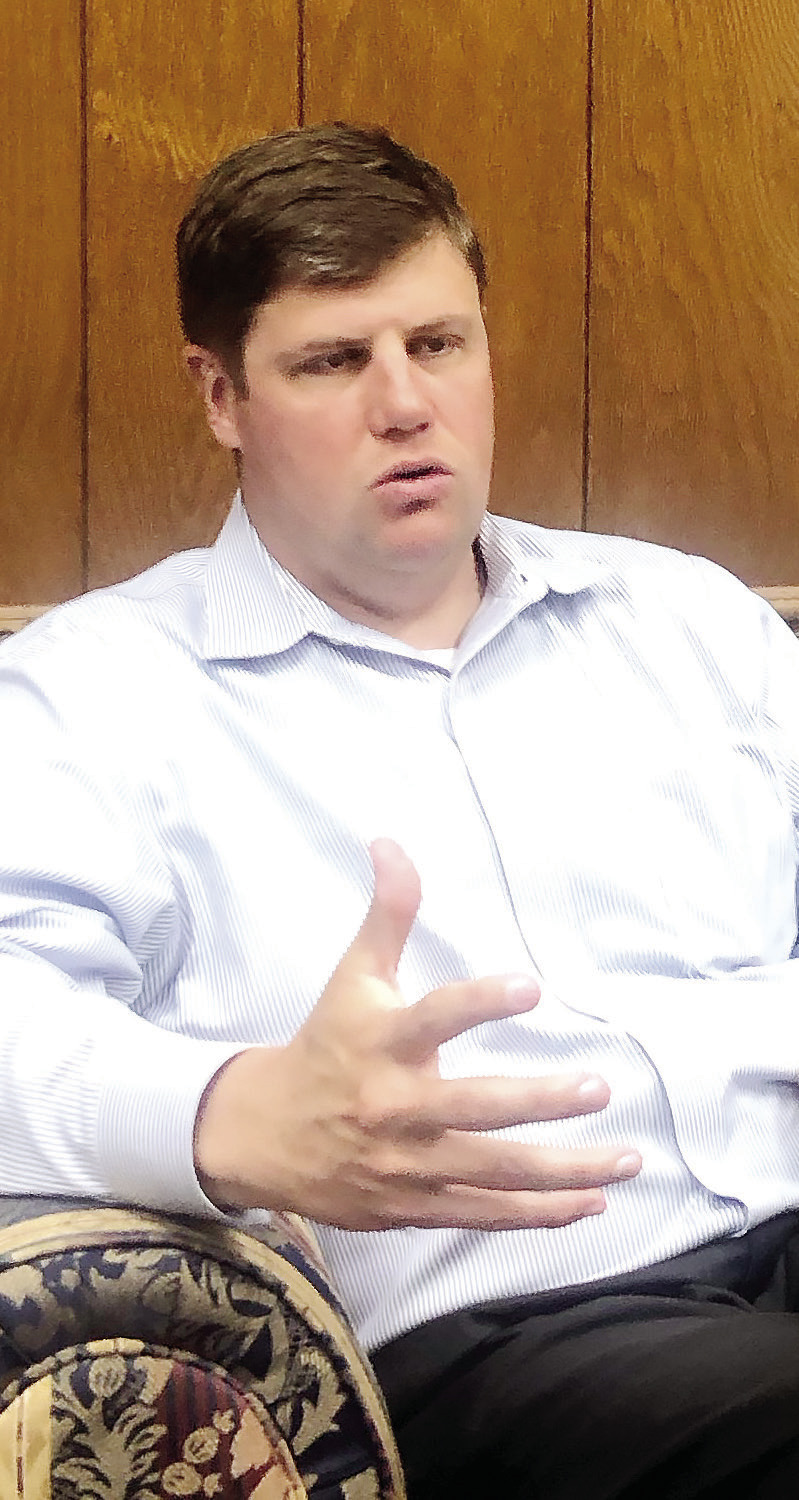
Ocmulgee Judicial Circuit District Attorney T. Wright Barksdale was one of three DAs to testify Aug. 9 before a Georgia Senate panel. He took advantage of the opportunity to highlight problems facing his office and others in the criminal justice system.
Earlier this month, Barksdale said he was contacted by State Senator Bill Cowsert of Athens, chairman of the Senate Special Committee on Investigations, and asked to appear at the hearing concerning possible legislation to oversee the conduct of district attorneys and the use of special grand juries and special prosecutors. The potential legislation is being pushed in part due to an ongoing saga involving Fulton County District Attorney Fani Willis.
“He (Cowsert) informed me he wanted me to come testify to give context of kind of how DA’s offices are financially set up,” Barksdale explained.
As he understands, Barksdale said, the allegation is that Willis paid her boyfriend (attorney Nathan Wade) several hundred thousand dollars, despite him allegedly having had no real experience in complex felony cases. However, Barksdale stressed, he tried not to speak directly on Willis and what she may or may not have done, as he had another goal in mind.
“My motivation in going up there was to highlight again how poorly funded the DA’s offices are from the state’s perspective,” he said.
The second-term DA explained he testified his office is funded from three sources: the state, counties, and grants.
“The State of Georgia provides us two secretaries, one victim’s advocate, seven attorneys, plus a drug court prosecutor, plus a juvenile prosecutor. That’s it for eight counties,” he said.
The counties, by statute, provide operating expenses.
“Fortunately,” Barksdale noted, “the counties provide us additional secretaries, additional attorneys, and Baldwin gives us an additional investigator.”
Barksdale said the grant received through the Criminal Justice Coordinating Council (CJCC) has been cut nearly in half, leaving him one position short in Jones County.
“I provided context to the Senate committee as to how the DA’s office is structured,” he said. “I also provided information as to how often I used a special prosecutor, because I guess that’s what took place in Fulton County.”
Barksdale explained the two options for employing a special prosecutor are a private attorney sworn in for that circuit, or an attorney from the Prosecuting Attorneys’ Council (PAC) of Georgia. However, he said he testified it is “pretty uncommon” for a special prosecutor to come from the private world.
Another focus of the committee’s hearing was the special-purpose grand jury.
“They are different from regular grand juries, and to get a special purpose grand jury, I have to petition the chief judge of Superior Court and ask that we bring in a special purpose grand jury,” Barksdale said. “If that chief judge is inclined, they go and present it for a vote to all the Superior Court judges (in the circuit). And, if a majority gives the green light, then a special purpose grand jury can come in.
“It’s very rare,” he added, saying he has spoken with only two district attorneys who have used that tool. “I don’t have the resources to even entertain calling in a special grand jury. I don’t have the resources to think about paying someone even $5,000 to be a special prosecutor, much less $700,000,” referencing the amount Willis allegedly authorized to be paid to Wade.
Barksdale said the committee acknowledged prosecutors and other members of the criminal justice system are underpaid.
“The State of Georgia now as far as prosecutorial pay is dead last in the Southeast,” he stated.
The committee also appeared concerned with the quality of prosecution and certain occurrences in recent years, including a district attorney who ended up in the state penitentiary, or others who “got sideways somehow with the law,” according to Barksdale.
“At the end of the day that was the catalyst for the DA oversight law to come into play,” which he and other DAs helped craft into legislation, Barksdale said.
After being opposed to the measure for two years, Barksdale said in the third year he realized it was going to happen, so he decided “to get in there and try to put in the best language to make sure it’s not weaponized by any form of politics.”
While he acknowledges some prosecutors have credibility issues, Barksdale said he feels most do the best job they possibly can.
“The term rogue prosecutor has been mentioned several times,” he said, adding that all DAs are subject to being painted with the same brush. “If the people with the microphone are looking at two or three bad examples, whether they mean to or not, they’re painting the whole profession.”
Barksdale said he and his peers must do their parts to offset that perception.
“We’ve got to hold each other accountable,” he declared. “We’ve got to support each other, too, but hold each other accountable and try to strive every day to do the best we can do and do the right thing.”
However, issues remain that affect not only his profession but others, too, Barksdale claimed.
“We are also struggling in a lot of different ways the public doesn’t see. And, that’s not just the prosecutors,” he said. “It’s our public defenders, who are short-staffed, and it’s also our judges, who are lacking law clerks.
“It’s because the State of Georgia is not paying a fair market value for those positions,” Barksdale concluded. “It really is.”
