
REGIONAL PERSPECTIVE
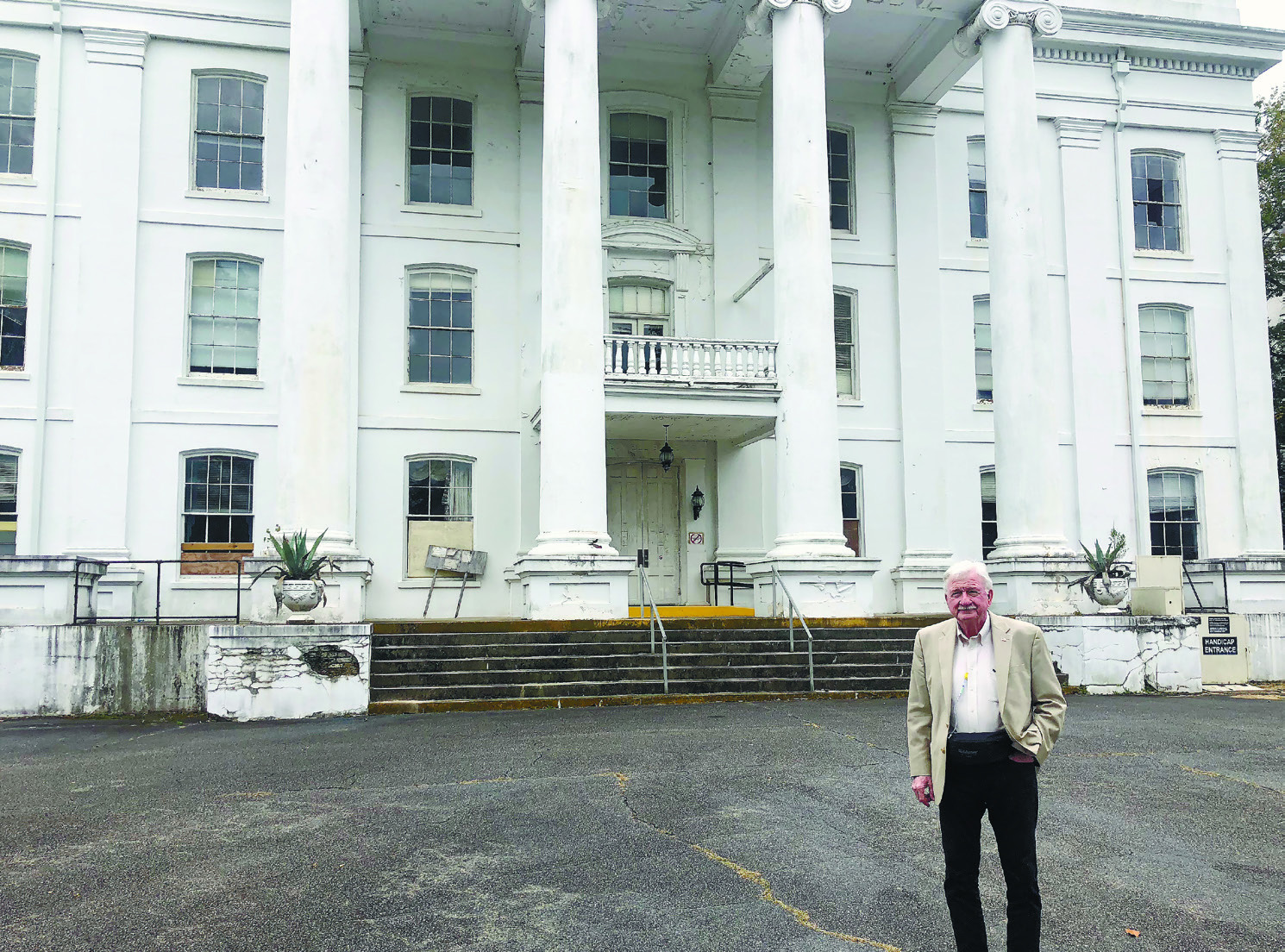
(Ed. Note: This is the first in a series of articles on the disease of mental illness as seen from a Baldwin County viewpoint. This week the focus is on one man’s experience with and at Central State Hospital.)
Baldwin County District 4 Commissioner Henry Craig is the current President of the Association of County Commissioners of Georgia (ACCG), and his number-one priority is to push for more funding from the state for the treatment of those with a mental illness.
Craig, a 20-year Army veteran and retired commercial airline pilot, has seen the disease up close, and he sat down recently to share some of his experiences. And, discussion of mental illness in Baldwin County wouldn’t be complete without including Central State Hospital (CSH).
As the plaque on the grounds of the now-closed facility states, what was originally known as Milledgeville State Hospital was authorized with a $20,000 appropriation from the state legislature in 1837 “for a dormitory near Milledgeville where the state’s mentally ill could receive custodial care.” The monument also indicates that a four-story building was opened on the site in 1842.
To say that single building and the care given within it expanded would be an understatement.
“If I were going to schedule an interview with you,” Craig said recently at the outset in the conference room at the Government Center, “I would be at Central State Hospital. I would stand outside there and tell you, ‘There were 13,000 patients at this institution in 1974. In 1974, it was the largest mental institution in the entire world.’” Craig should know. He lived on the CSH campus from 1961-68. His father, James B. Craig, was the hospital’s superintendent then, and the younger Craig worked there as a teenager.
“I worked there for about 18 months,” he recalled. “I got to go home and talk to the big boss, Dad. I would tell him, ‘I don’t understand this. I don’t understand that.’
“And I remember several things he used to tell me. One was, ‘We are all mentally ill to some degree, just some more than others.’ He said that often.”
Craig was a ward attendant in an area with about 20 mentally ill patients.
“Most of them were veterans, some were drug and alcohol addicts,” he said. “I made sure they were safe. I made sure they got their drugs. I observed them during the day and reported back to the doctors.”
The drugs were a mechanism that actually served to help protect the patient and perhaps others, Craig said.
“It made that person, that patient, who was sick into a situation where he wasn’t going to hurt himself, or hurt somebody. And put him in a position where he could be taken care of until a medical procedure, medicine, psychologist, or psychiatrist could help that person, put him back in business, put him back in his home.”
Craig noted that isolated incidents can affect the public’s perception, and that perception is not necessarily accurate.
“There was a place for families and sick people to be taken care of. And, like everything else in the world, if somebody did something wrong, that’s all anybody thought about.
“Out of 13,000 patients who were there,” Craig said, “there was one, two, maybe five that had questionable health care. The other 12,000 plus, had adequate health care, and families had a place they could put their families that was safe.
“I am not saying we should go back to institutionalizing or warehousing mentally ill,” Craig added, “but what is happening now is unacceptable. I do claim that the care given in the past was based on best medical practices for mental illness of the day and was based on the laws of the day.
“History always has a habit of finding faults of the past based on what is normal for the current day,” he noted.
Craig said some patients were at the hospital who today would not be placed in that environment. He talked about one man in particular, Burgess.
“Burgess was a big man, very big,” he recalled. “He weighed about 400 pounds and was close to seven feet tall. His sickness, we might call it, was mostly he offended his family. He was harmless. He was there mostly because his family didn’t want him. Based on the law at that time, it was much easier for a family to institutionalize someone than it is today.”
However, even if someone is correctly diagnosed with the disease, a misconception often results, Craig said.
“Just because you’re mentally ill doesn’t mean you’re crazy. It doesn’t mean you’re going to hurt someone.”
The county commissioner reiterated that he lived around those tagged as mentally ill and viewed his life in a mental health environment as ‘normal’.
“I would ride a bike, I would walk by mentally ill patients with families, I would pick up pecans in the orchard with mentally ill folks.”
Craig said he attended church there with mentally ill folks and reflected on occurrences that would not seem ‘normal’ to others.
“There was this one woman who had the Tourette Syndrome (condition of the nervous system that causes people to have sudden and repetitive movements, twitching, or unwanted sounds, as examples). During the holiest part of Mass, almost like clockwork, this woman would have an ‘event.’ She would come out with the filthiest curse words and descriptions of men and women, right in the middle of the holiest part of Mass.
“We would all just look at each other,” he said, shrugging his shoulders. “It was normal for us. For those that lived and worked there then, it was normal.”
Craig said there was one Georgia legislator who expressed his sentiments regarding CSH, its operations, and its expenditures of state funds. Then-senator Jimmy Carter, and Craig’s father had basic philosophical differences regarding policy and money, about which they occasionally argued.
Most of the demise of Central State occurred before Craig moved back home in 2008. He said it was not an overnight happening.
“It was progressive. Senator Jimmy Carter was the one who dad was arguing with. Jimmy Carter later became governor and continued to develop community-based mental health.
“It started with regional mental institutions, Savannah, Thomasville, Columbus, Rome, Atlanta,” he said. “Those were all regional mental health providers that the state ran. As those opened, Central State Hospital decreased in size.” Craig noted all that happened in the ’70s, ’80s and ’90s, while he was gone.
“When I left, the largest mental health institution in the world. Came back, it was done, closed,” he said. Craig did point out the facility didn’t actually close until 2014, “when the last developmentally disabled person left Central State.”
Next week, take a look at Craig’s views on mental health care in Georgia now and what he would like to see accomplished.
