
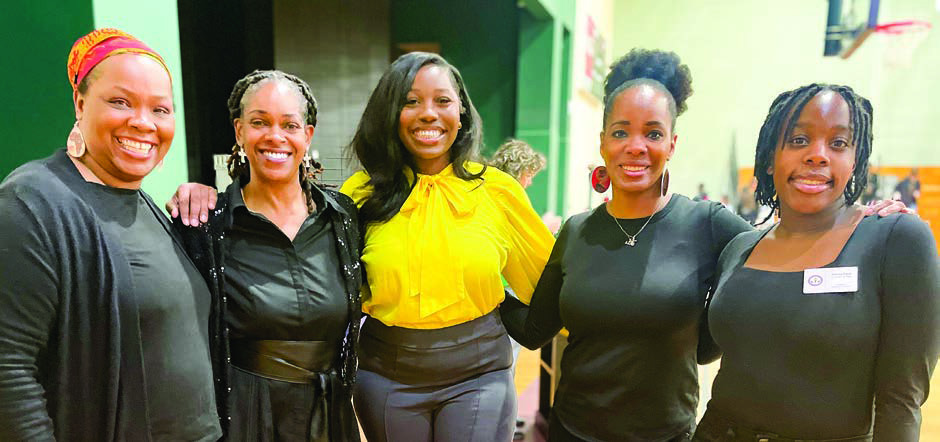
Clifton Ridge Middle School held a school-wide Black History Month program in the gym, featuring speeches, performances, and student presentations centered on culture, history, and the arts.
The Feb. 27 program was emceed by Megan Western, a journalist with 13WMAZ. Assistant Principal Shannon Smith introduced her as someone who is passionate about representing the Black community and uplifting underrepresented voices in media.
Western thanked the school for inviting her.
“I am so grateful to be invited here today. Today, we are going to be talking about Black history and all of the things you guys have been learning about Black history this month,” she said.
She encouraged students to view Black history as a shared heritage.
“Black history is not just one person’s history. It is not just for girls, it is not just for boys, and it is not just for people who call themselves Black. It is for all of us because Black history is American history. I think it is really important that, in the year 2026, we are celebrating our 100th year of honoring Black History Month. That also lines up with our 250th anniversary of America, so it all comes together to make a really important, one American history,” she said.
Seventh grader Chloe Blash then delivered a speech on the importance of Black History Month, reflecting on how the month encourages students to learn, honor, and appreciate the contributions of African Americans throughout history. Seventh-grade student Ivoree Jenkins followed with a recitation of an original poem that highlighted identity, pride, and the importance of remembering the past.
Western later spoke about the cultural impact of music.
“Music is a very important part of Black History Month. We really cannot talk about Black History Month without talking about music. Here in the Central Georgia area, you might have heard names like Otis Redding, who have made big contributions to music as a whole and to our Black history,” she said.
Teacher Ladonna Olivieri delivered a speech on the historical roots of music in African and African American communities. She explained that music and rhythm have been tied to identity and expression for centuries.
“Since before the Transatlantic Slave Trade, Africans traditionally expressed themselves in tribal dancing accompanied by rhythmic drums. Crossing the Atlantic Ocean, enslaved Africans used songs in their native languages to communicate in codes with one another,” she said.
Olivieri explained that music played a significant role in resistance, unity, and hope.
“After reaching the Americas and enduring the brutalities of slavery, many slaves attempted to escape from plantations in the American South; some even plotted revolts. Songs of freedom and redemption were sung to inspire hope and claim a sense of pride in the race of people who endured four hundred years of captivity and oppression,” she said.
She concluded by noting the lasting influence of music.
“Even after slavery ended, the era of the civil rights movement was marked by a catalog of soulful, empowering music that embodies the struggles imposed by society and the resilience of African Americans,” she said.
A student group led by teacher Shana Underwood-Stephens performed a musical medley that included “Lift Every Voice and Sing,” “Stand Up” by Cynthia Erivo, and “Hope” by Twista. The songs beautifully highlighted themes of heritage, courage, and perseverance, creating a unified tribute to resilience across generations. The group received resounding applause from the audience, consisting mainly of other students.
Underwood-Stephens shared why she believes programs like this are essential.
“I think it is very beneficial for us to take a moment at least once a year, like this, to highlight the significance of African American impact on this country as well as the African American experience as far as how the past has impacted where we are in good ways, as well as the not-so-good ways,” she said.
She explained that celebrating Black history helps students stay connected to their identity and ensures others gain a better understanding of the experiences represented.
“If we do not do it, then a lot of African American children will lose a connection with their history, and even more so, others will have no understanding of the African American experience in the United States, and they will not understand the children that we have in front of us,” she said.
She emphasized the role that history plays in helping educators support students today.
“We need to understand the past in order to understand the present. It is very important that we do not lose this piece of history because it is not really a big part of the curriculum, so I feel it is imperative that we highlight it at least in the month of February,” she said.
Western also highlighted the role of dance in Black culture. Trinity Pace, an 11th grader visiting the school, delivered a speech explaining the historical depth of line dancing.
“Line dancing is much more than just dance steps. It is a living map of history and a heartbeat of community,” Pace said.
She described its African origins and continued influence.
“While many associate it with America, its roots run deep in African oral tradition, where dancers used to tell stories to celebrate life and keep the community safe. In the African American community, line dancing has evolved through modern cultural phenomenon. From cookouts to family reunions to weddings, whether it is the wobble, the cupid shuffle, or boots on the ground, these dances represent a joyful celebration of social identity,” she said.
Pace then introduced a large group of students who performed line dancing for the audience, illustrating how dance continues to serve as a cultural expression and a celebration of shared identity.
Principal Chance Scott closed the ceremony by encouraging students to recognize the significance of their participation.
“Today, as we close our program, I want you to remember we all have a legacy. Students, your voices, your courage, your preparation, and your excellence are on full display,” he said.
He thanked the staff for their commitment and preparation.
“Today does not happen by accident. It happens because you choose to invest every day in the students of Clifton Ridge Middle School,” he said.
He also noted the progress reflected in events like this.
“Things like this did not happen 20 years ago. Things like this surely did not happen 60 years ago. We are living in a time where we can enjoy each other, we can enjoy each other’s company, and what we have. And it is only going to get better. Things like this and people like us choose to make it better,” he said.
