
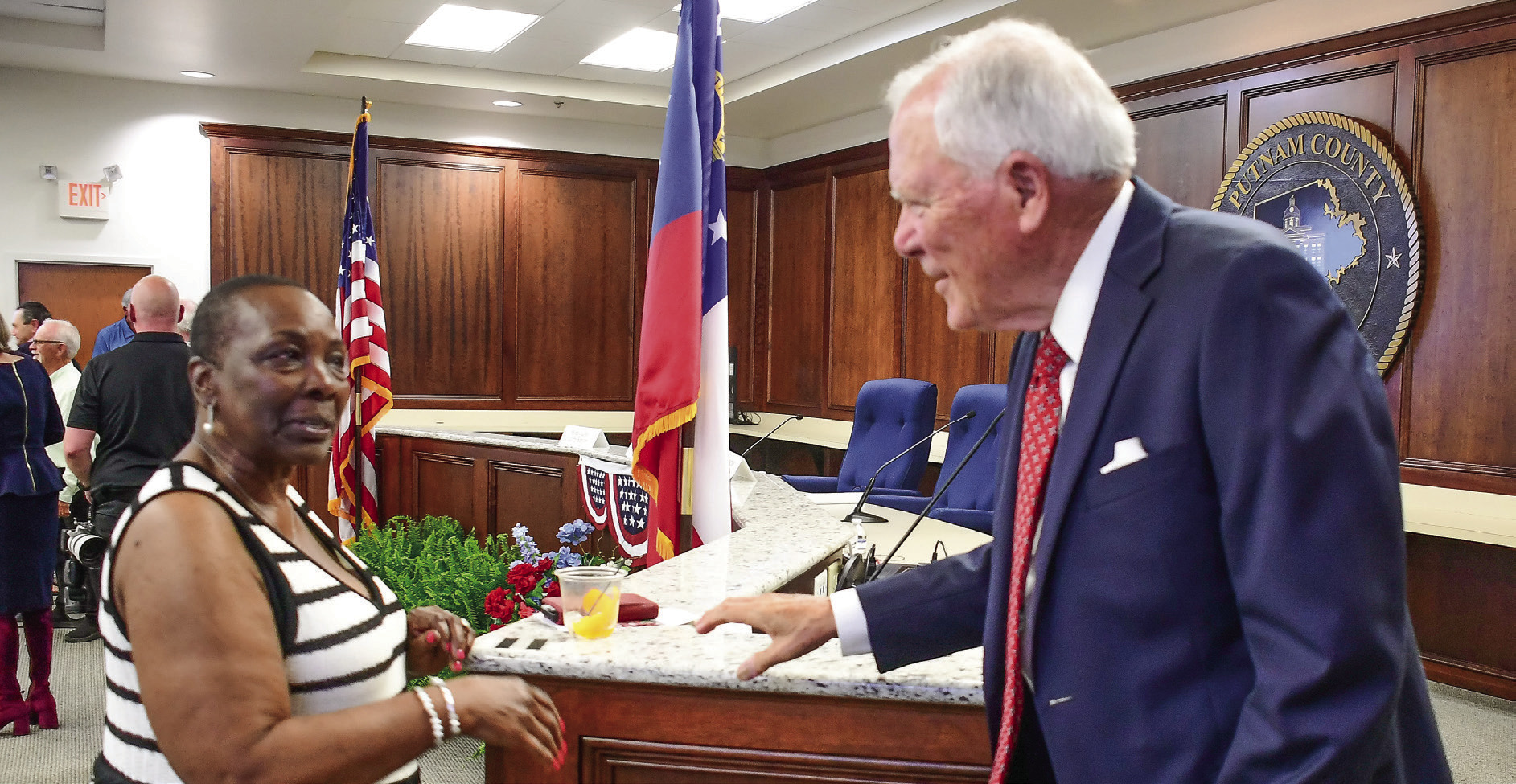

The month-long Smithsonian exhibit on American democracy, “Voices and Votes,” that opened Saturday morning at the Putnam County Annex building, served as the backdrop that evening for a wide-ranging and candid discussion on the state of the nation’s political system.
Hosted locally in conjunction with Georgia Humanities, the program brought together former Georgia Governor Nathan Deal and longtime legislator Calvin Smyre (pronounced “Smi-ree”) for a wide-ranging discussion moderated by GCSU President Cathy Cox, herself a former Georgia Secretary of State.
The conversation blended history, humor, and concern, as all three reflected on how democracy has evolved, and where it may be headed.
Deal framed American government as an “evolutionary process,” noting the nation did not begin as a democracy but as a republic. Quoting Benjamin Franklin, he reminded the audience: “It’s a republic, if you can keep it.” Over time, he explained, the system has shifted toward “a representative democracy,” shaped by expanding participation and changing expectations.
Smyre, who served nearly five decades in the Georgia House to become known as “Dean of the House,” emphasized the role of ordinary citizens. “The fact that I’m sitting here is a testament to democracy,” he said. “We the people; that’s how policy is developed.”
Both men traced dramatic changes in political campaigning. Smyre recalled a slower era reliant on newspapers, handshakes, and even novelty giveaways.
“Every picnic I went to, you had to carry the emery boards and the combs,” he said, joking that “we kept the pencil industry going pretty well.” Today, he noted, communication is instant and constant through social media.
Deal agreed, describing a shift from local outreach to highcost, media-driven campaigns.
“Everything has changed rapidly,” he pointed out; however, he also stressed one principle remains: “You can’t be a government of the people unless you know what the people are saying and thinking.”
That connection, both agreed, has become increasingly difficult to maintain. Deal warned that modern campaigning demands more fundraising and less face-to-face interaction, while public engagement has declined.
“People don’t want to come to events anymore; you are the exception,” Deal told the approximately 150 Putnam County and nearby citizens who filled the room where the county commission and Eatonton City Council routinely meet.
The conversation also turned to the importance of experience in government. Deal criticized the growing distrust of seasoned candidates, arguing that inexperience can lead to overreliance on staff and lobbyists. “We need more people to have a record,” he stressed.
On lobbyists, both speakers offered a nuanced view. Smyre described largely positive experiences, saying knowledgeable advocates can be valuable. Deal agreed, but stressed integrity is crucial for success.
“A good lobbyist,” he stated, “must be willing to tell only the truth.” He explained providing lawmakers with insight — good or bad — results in better legislation for everyone, but ultimately, he said, the responsibility lies with lawmakers to “ask the right questions.”
Both men highlighted moments when listening to and accepting differences led to more meaningful policies. Both cited reforms to Georgia’s HOPE Scholarship program, which faced financial strain, with Deal crediting bipartisan cooperation — including from Democrat rival Stacey Abrams — with helping to preserve and strengthen the program.
“That’s what happens when you listen,” he said.
Smyre echoed that sentiment, calling HOPE “one of the best programs the Georgia General Assembly has ever created,” while acknowledging the difficulty of scaling it back. “Once you give something … and then you’ve got to take it back, that’s a real dilemma.”
Throughout the discussion, civility emerged as a central theme. Smyre stressed the importance of maintaining relationships despite disagreements. Deal pointed to a broader decline in political cooperation, blaming partisan primary systems that favor extremes. “It seems like you cannot get through unless you move to the extreme edges,” he said, pointing out this leaves voters with polarized choices in general elections.
Both men urged a return to dialogue and mutual understanding. Deal said compromise requires a willingness to listen.
“We don’t do that now; we don’t listen to each other,” he lamented.
Smyre added that respect and understanding must go hand in hand.
“If we understood each other more, then I think we would respect each other more,” he said.
The discussion also touched on voter engagement, particularly among younger Americans.
Responding to concerns about apathy, Deal emphasized participation: “If you don’t vote, you can’t change anything.”
Smyre called for mentorship and outreach, urging communities to “reach one and teach one.”
Despite concerns about polarization and disengagement, both speakers expressed cautious optimism. Smyre reflected on his long career as proof of democracy’s potential, while Deal pointed to Georgia’s history of leadership during difficult moments as a model for the future.
In the end, their message was clear: democracy depends not just on institutions, but on the willingness of people to engage, listen, and work together.
