
Is mistletoe a concern?
Brennan Jackson
County Extension/ANR Agent
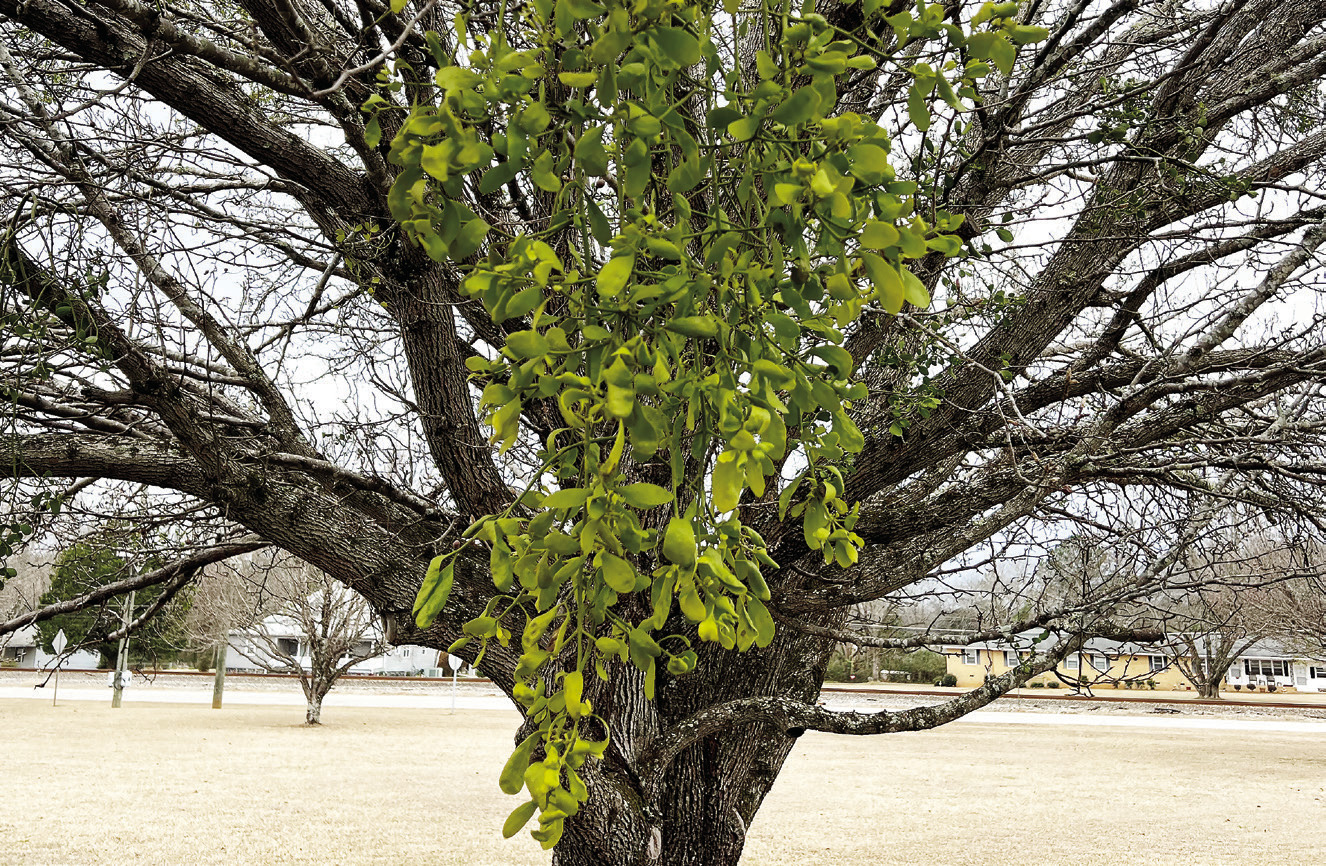
By now most of the leaves have fallen off the trees in preparation for winter. As vivid as the colors are in the spring, summer, and fall, there is a certain beauty as well of the bare trees. That beauty may be connected with the idea of the holidays approaching, colder weather nearing, or the sign of completion from the previous growing season, but it is not until those leaves drop that you begin to see the mistletoe.
Most everything else is going dormant, and there is the bright green mistletoe possibly sucking the life out of the tree.
Mistletoe is a parasite that will photosynthesize in the winter and pull water and nutrients from the tree. Seeing one of two mistletoe will not cause extreme damage, but a heavy infestation can kill the tree. The parasite can grow on up to 105 tree species, and they form a drooping green bush that can reach two to three feet long. They do have flowers that are yellow that appear in late winter and form white berries that are toxic to humans.
An infestation occurs when a seed germinates and develops a quasi-root that penetrates the bark which is how nutrients and water is obtained. The seeds from the berries are sticky, and when birds eat berries they can spread the seeds to other trees by defecating or wiping their beaks that are covered in the stick seeds on tree bark.
As with most issues that plague plants the best defense is a healthy plant. The healthier the plant is the less likely the plant will better handle the infestation than a plant that is already in decline. If the infestation is localized to individual branches, then simply removing the mistletoe will be beneficial if it is reachable. Best case scenario is to prune the tree two feet beyond the point of attachment of the mistletoe. However, if the location is too high in the tree or too many limbs are infected then the best-case scenario is to let nature take its course. That usually means a fatality, but it is not feasible to cut a lot of major branches. Additionally, it may not be economically feasible to hire someone to simply to cut off a single infection on a 100-foot tree. Please contact the Jones County Extension office with any agricultural questions you may have by stopping by the office, calling 478-986-3958, or emailing brennan4@uga.edu.
