

Rebecca Husted has been across the United States and in other countries utilizing her expertise in large animal rescues, but she and her husband share their talents locally as well.
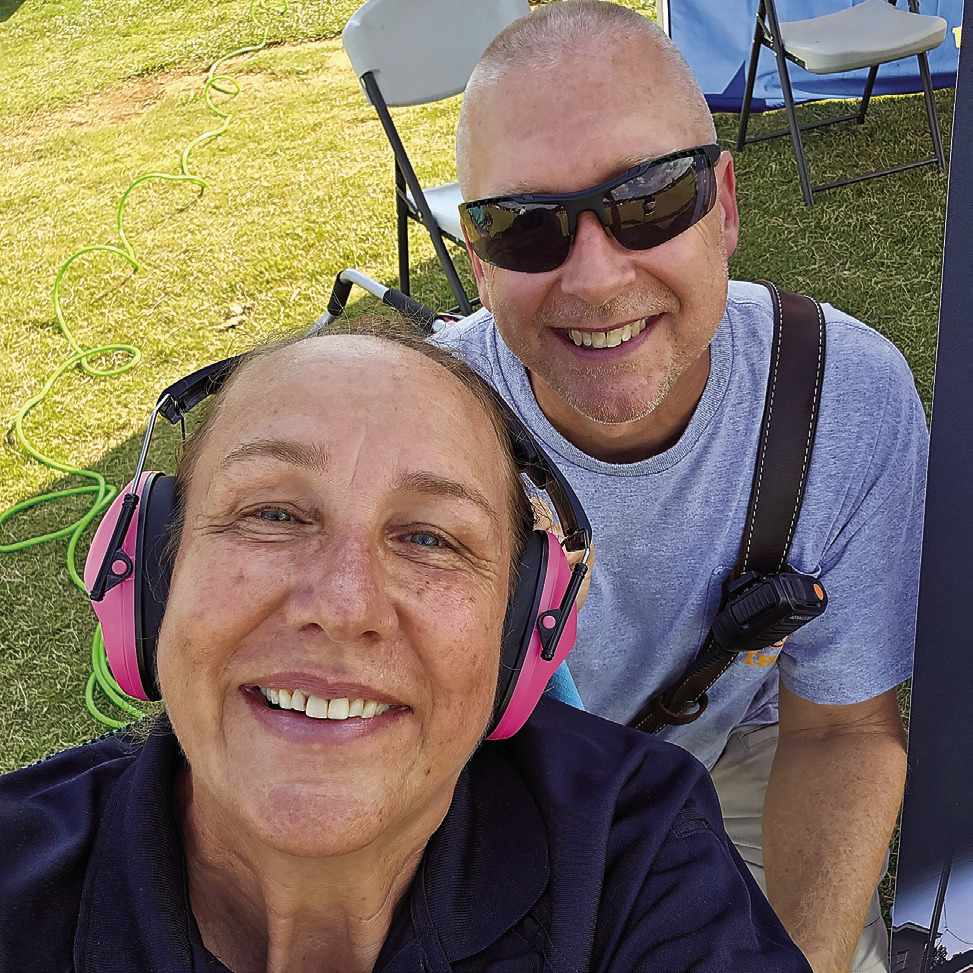
Husted has lived in Jones County for 11 years, and she and her husband, Mark, have been members of the Gray Volunteer Fire Department most of that time. She is the public information officer, and both help train new firefighters.
Husted, 58, is a third-generation Floridian who was in the Army Reserves from 1989-2016.
“I wanted to be fulltime in the military,” she declared. “But when I got my commission in ’89, that’s when [President H.W.] Bush was in, and he was bringing down the size of the military. So that’s when I got a reserve commission instead of active duty.”
She did a 2006-07 combat tour in Kuwait and Iraq as a communications officer and retired in 2016 as a major from the Joint Communication Staff at U.S. Southern Command in Miami.
The Husteds met while serving in the military and later married. He moved to the 20-acre parcel she had purchased on Highway 18 East.
Husted left Florida in 1985 following high school graduation and went to Wofford College in South Carolina, graduating in 1989 with a Bachelor of Science degree in Biology. She worked in the chemical industry in South Carolina until she decided she wanted to go to graduate school. She went to Clemson University, and, looking for some help in getting accepted, knocked on some doors and met a man who was the director of the Animal Dairy Veterinary Services Department. When she went into his office, she noticed a big propeller behind his desk.
“I figured he was military, figured he was probably Air Force, and he was probably a colonel when he retired,” she recalled. “So I walked in and said, ‘Hey, sir, are you a fly boy?’ He looked at me, and he said, ‘I am, and what are you?’ I said, ‘I’m a grunt sir.’ I stuck my hand out, shook his hand. He said, ‘You want to go to graduate school?’ So there you go. It ain’t what you know. It’s who you know.”
Husted earned her doctorate degree there and along the way met Dr. Tomas Gimenez, a veterinarian who was doing trainings for vets.
She started working with him, “my mentor at first, and eventually we got married.”
Gimenez was trying to keep the veterinarians safe, Husted explained.
“Because people were getting kicked. People were getting hurt. They were doing all kinds of things, handling horses. Even though they were veterinarians, they were getting hurt.”
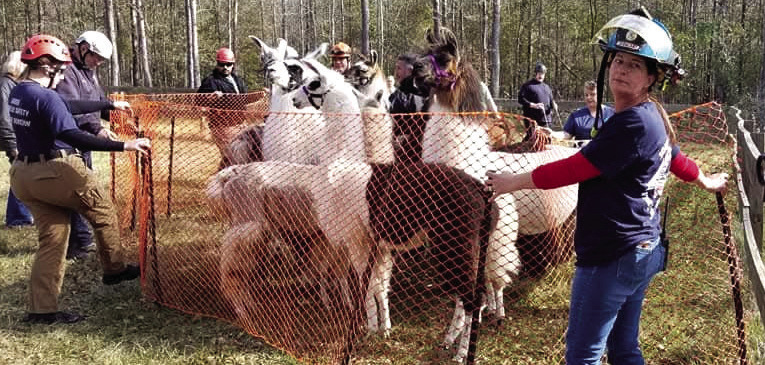
She started assisting Gimenez in his work, and they subsequently met a firefighter in Oconee County. He attended one of the training sessions, Husted recalled.
“He said, ‘This is great, but the heck with veterinarians. You need to be teaching the fire service.’
“He told us the veterinarians aren’t the only ones that get the 911 call that comes to the dispatch center and calls out the firefighters. He said firefighters don’t know anything about horses, and then they get out there, and people expect them to catch it, pull it out of the mud, pull it out of the trailer, and know something; and they’re the ones that are getting kicked. So that’s where we started.”
Husted said that was exactly 30 years ago, and that in 2013, Gimenez, by then her ex-husband, told her he wanted to retire. “I said ‘ok’. So, I’ve been doing it on my own since 2013.”
Husted is the primary instructor and owner/ president of Technical Large Animal Emergency Rescue Inc.
“I’m getting ready to go to Colorado, and then from there, I’m doing a class in Albuquerque, New Mexico. Then,” she said last week, “I come home for a couple days, and I go to Nova Scotia, Canada, and then up to Prince Edward Island, Canada. It’s August, so I hate it for y’all, but I’m going north.”
Husted has published countless critiques, techniques, and journal articles on large animal rescue training, leads training on the subject nationally and internationally, is or has been a member of 15 professional organizations, and holds more than 50 rescue-related and training certifications.
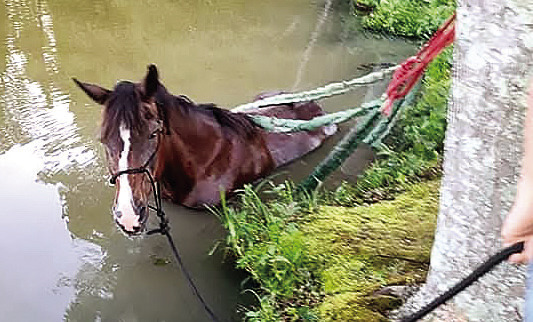
She has held numerous training sessions on her farm and actually assisted in the rescue of a horse owned by local enthusiast Jane Whitehead.
“These classes are related to the animals, yes. So it’s all about how to get them out of the situation. “But,” Husted added, “It’s really about people, because, for example, take her horse. It’s in the pond, and it can’t get out. And I promise you, if it could have gotten out, it would have left, because it doesn’t want to be there when a bunch of humans show up.
“So it’s not leaving. It can’t go anywhere. It can’t get itself out,” Husted pointed out. “So it comes down to the team of us, how we figure out how to work together and try to keep people safe and move a 1,000-lb. animal that ain’t happy about us moving it and can kick our ever-loving heads off.”
The question, Husted posed, is how do you do that?
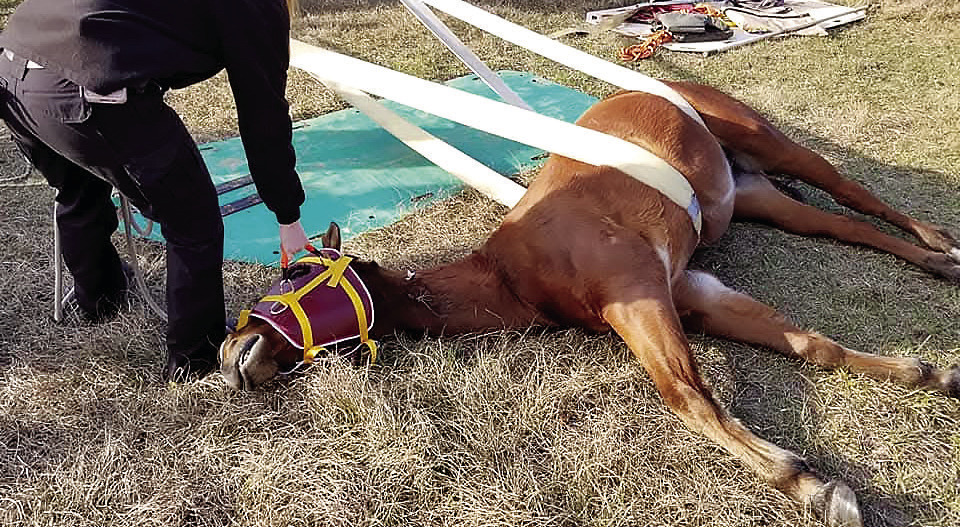
“So,” she explained, “I train people how to deal with a 1,000-pound patient. It’s not much different than dealing with a 200-pound patient, like in EMS and the fire service, except it’s 1000 lbs.; it doesn’t understand English, and it has steel shoes on its feet sometimes, so it can kick your head off, and that’s what makes it so dangerous.”
Husted said that in past training sessions she used live animals.
“My horses were trained to lay down on command, and we would drag them around and lift them with the mechanical equipment. And, in fact, eight times we’ve picked them up with helicopter slings. But over the years,” she said, “more and more people were like, you know, raising an eyebrow at me, like, is that fair to the horse?” Husted bought a mannequin in 2013 for $9,000. “Now it’s $15,000,” she shared.
“Before, we had to have everything just right, put the horse in the mud, and take the horse out of the mud quickly; so we don’t do that anymore. Once I got that, then we could put it in the mud and leave it there for three hours. And who cares?”
The professional instructor had just moved to Jones County when she contacted then-fire chief Max Wood about renting space for training sessions. He asked her if some of the firefighters could attend, then handed her a document.
“It was an application to join the fire department. And I said, ‘Chief, you know, I appreciate it, but I’m old, I’m crippled, I’m broke. I was in the military all those years, everything.’” Wood would not take no for answer, and she and Mark joined the department.
“And now, you know, we’re here for all the things,” she said. “We’re volunteers, but we feel like it’s important to give back to the community.”
