
EDUCATION

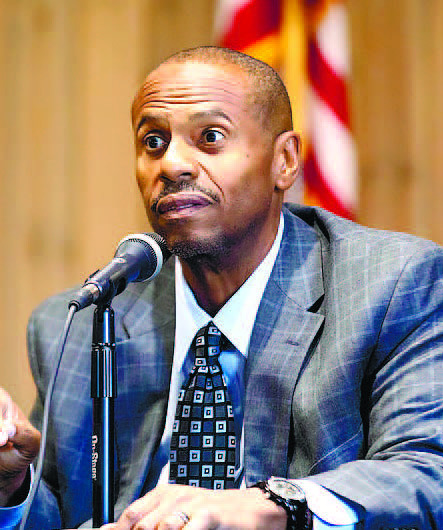
“For every wart, every flaw, for everything we disagree about, this is still the greatest country on Earth, and I work for one of the best states in that country,” said Dr. Ivan Allen, president of Central Georgia Technical College. “Why do I mention that? To keep our country strong, we have to make a commitment right now with what we’re doing for the next generation and the generation after that.”
Laura Rackley, founding CEO of the Jones County College and Career Academy, introduced Greg Dozier, commissioner of the Technical College System of Georgia, and Allen during the 2022 Lt. Governor’s Business and Education summit hosted in Gray.
Dozier said he and Allen were asked about the importance of technical education in Georgia’s future.
“I could tell from Dr. Allen that he was wondering why it took everybody so long to figure out the importance of technical education,” he said. “We know it’s important.”
One recent statistic said over 1.4 million new jobs will be created in the next five years that do not require a four-year degree, according to Dozier.
“We look at the great news that’s already been touted that Georgia is the No. 1 state for business for a ninth year in a row,” he said. “Quick Start has also been named 13 years in a row the No. 1 workforce development program in the nation.”
Dozier said the TCSG has a large footprint across Georgia.
“We’re a big operation of 22 colleges, 88 campuses, and last year we served 300,000 Georgians,” he said. “Our average student is 26 years of age, nine years in the workforce, 51% of our students are first-generation college students, 74% of our students are part-time. The results of those students is that 99% have placement and 86% are placed in field when they graduate. We have a 74% graduation rate.
“Last year, we had over 45,000 individuals get a certificate. Over 7,000 earned a diploma. We set an all-time record for the state of 8,739 associate degrees.”
Dozier turned the discussion over to Allen for more specifics about what’s happening on the ground at CGTC.
“We have to make sure each child has what’s right for him or her,” Allen said. “There can’t be a blanket, one-size-fits-all prescription for children.”
He said the TCSG offers multiple pathways to success. He thanked representatives from CCAs in attendance and said the college’s growth is coming from dual enrollment students.
“Why are we doing that?” Allen said. “We lead the state in technical education dual enrollment students and graduates, which is the important part.
“Industries need workers. It’s wonderful that we get them in the door, but it’s more important that we get them out the door and give them the opportunity to earn a livable wage.”
Allen said the work of technical colleges is helping to solve generational poverty. People who are in poverty are in a cycle that starts over and over.
“Students are coming from homes where neither parent has a college degree or even high school diploma,” he said. “Our technical colleges are so important in meeting those needs. We can show students, if they’re willing to work, we can get them a welding certificate to start earning $50,000 or $60,000 a year.
“We’re in a country that passed the largest infrastructure bill in a generation,” he said. “If you’ll go and get a certificate, there’s a pathway for you to be successful in a short amount of time.”
CGTC is also an accredited high school where students can get their high school diploma while also getting an associate’s degree or multiple technical certificates.
The U.S. Department of Transportation also recently changed the rules that allow an 18-year-old to drive an 18-wheeler.
“Given our logistics and supply chain challenges, where can we get the next set of drivers?” Allen said. “The average age of drivers in this country is approaching 60 years old. At Central Georgia Tech, we have to figure out a way to put transportation on the books as something we can achieve as these young men and women are graduation high school.
“We now have a program where you can get your truck driver’s license in an automatic truck,” he said. “We have automatic trucks now and even electric. We have to be on the forefront of that training.
Allen said, on the horizon, schools have to have more connections matching students and their abilities to opportunities.
“On a global scale, the technical college system is a gem in this state,” he said. “When I travel throughout the country, I see two-year college systems across the country. We have something special here.”
This is the second in a series of articles about education and industry from the Sept. 29 Lt.Governor’s Business and Education Summit. Read next week’s edition for the next installment.
