
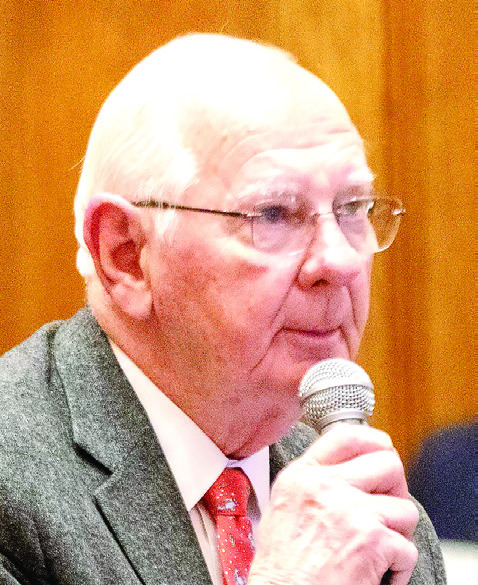
State Sen. Rick Williams of Milledgeville has opposition in the May 21 Republican Primary who is advocating legislation that he believes he could never support.
Williams, seeking his second term in the Senate and fifth overall in the General Assembly, is being challenged by Leland Olinger of Locust Grove. A portion of Henry County was drawn into the 25th Senate District in 2022, and then-State Sen. Burt Jones did not seek re-election, opting to run for Lt. Governor. Williams captured that seat in a four-way Republican Primary race without a runoff, while Olinger garnered just under four percent of the votes.
A key part of Olinger’s platform is the legalization of marijuana, and the suit he often wears features patterns with marijuana leaves. His auto has a campaign decal on the door panel that also includes a marijuana leaf.
Williams said marijuana has affected his life in a very meaningful way.
“I don’t know that I would ever be able to vote to legalize it,” he declared, explaining that his father was killed in an automobile accident in 2006 when another vehicle ran a stop sign and struck his automobile.
Williams said his father died instantly, his mother was seriously injured, and the driver of the other vehicle, a young girl, was taken to the hospital with injuries of her own.
“Turns out,” Williams said, “she was under the influence of marijuana. She had been smoking marijuana that afternoon.
“It’s dangerous,” he went on. “It took my father from me and my family and his grandchildren and great-grandchildren. I will never be able to vote to legalize marijuana.
“However,” he added. “I have voted and worked to help legalize medical cannabis. I have supported that.”
General Assembly records show that Williams has supported a lot of other legislation as well, and he said his four terms in the two legislative chambers are an advantage for his district.
“Having served eight years in the legislature builds up a little seniority,” he said, “and you are able to get more bills passed, and you’re able to sponsor meaningful legislation to really make a difference.”
Williams is chairman of the State Retirement Committee, vice chairman of the Ethics, Secretary of the Public Safety Committee, and is on the Higher Education and the State and Local Government committees, the last of which, he said, benefits from his prior experience.
“Having served as a former county commissioner, I understand the importance of the state legislature working with our local government.”
Williams recounted the numerous occasions when he was a county commissioner that legislation was passed requiring county services or funds with no reimbursement from the state.
“So,” he asserted, “it became an unfunded mandate. That, in turn, requires the local governments to come up with additional revenue, often in the form of higher taxes.
“We don’t want to do anything to cause taxes to be raised, and we try to work with our local counties and municipalities in making sure that we don’t put unnecessary hardships on them.”
Williams mentioned several pieces of legislation he either sponsored or co-sponsored.
“One of the bills I am most proud of sponsoring is ‘Gracie’s Law’. This prevents discrimination against anyone with developmental disabilities.”
Gracie was a girl with Down’s Syndrome, Williams said, and there was no state law to protect her and others with these type of disabilities from discrimination by the medical field. He noted that one example of the issue came from a physician.
“A doctor told me, ‘If I had to give a heart to someone with Down’s Syndrome versus someone who didn’t have it, then I would be inclined to give it to the person who didn’t have Down’s Syndrome.’” Williams authored the bill while a state representative, and it took two sessions to get it approved. It passed twice in the House unanimously but stalled in the Senate. He finally was able to negotiate for a hearing and get the measure through that chamber and signed into law.
Two bills he got passed helped military veterans, one providing HOPE scholarships to veterans who go straight from high school to the military, then after 20 years of service, retire and choose to enter a school of higher education. Another, passed this year, provides for professional licenses of spouses of military members who move to Georgia to be reciprocated here with only minimal paperwork.
“We’re trying to make things easier for the veterans and their families,” Williams commented.
The senator said he co-sponsored a bill – ‘Addie’s Law’, in recognition of a young girl who was killed after getting off a school bus – that requires children to be let off buses on the right side only on county roadways with a speed limit in excess of 45 mph.
Williams acknowledged that mental health is a big issue, “not only in Georgia, but everywhere.” He indicated he has a close relationship with sheriffs and is aware of their concerns housing individuals who are suffering from mental illness. He said a plan to help is in the works.
“I do intend on introducing legislation next year that the state will make plans and start building mental wellness centers, at least five scattered all over Georgia of 75 beds each,” he announced.
“I know that’s not going to solve all of our problems,” he acknowledged, “but we’ve got to make a start somewhere, and that’s what I intend on doing, working on that and pushing on that. That’s going to be my number one priority.”
“Williams pointed out that District 25 meanders from Baldwin County to Henry County and includes Jones, Putnam, Jasper, Butts and a small portion of Macon-Bibb. He said his father was from Butts County and that he has relatives there and across the district. In addition, he commented, “there are so many people I’ve gotten to know and built relationships with over 54 years in funeral business. This is something I’ve always enjoyed, helping people.”
The senator emphasized that working with and for constituents is a responsibility that he strives to fulfill.
“I have people call me that have issues with the Department of Labor, the Department of Revenue, with DFACS, with numerous state agencies,” he pointed out. “This is something I do have, a legislative liaison with all these state agencies that I can pick up the phone and call. I know who to call to cut through red tape, to get people help and to help them.”
Williams said, though, he understands that his main job in the General Assembly is to be a legislator, and he pointed out he has been the author of 43 bills in the Senate, in addition to measures he co-sponsored.
“So,” he declared, “I did go to Atlanta, to the Gold Dome, to be a worker, and that’s what I do.”
