
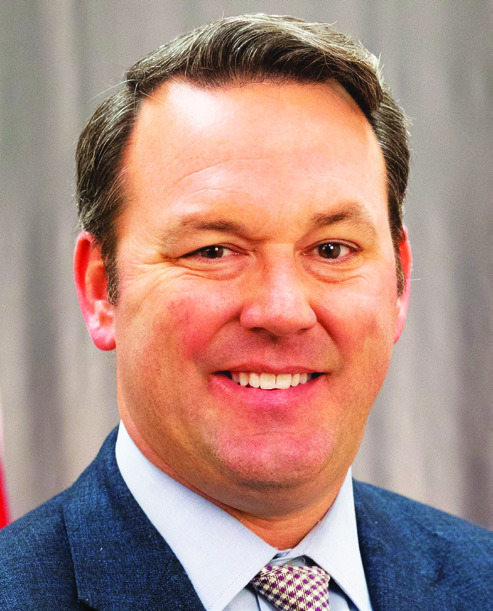

If Burt Jones becomes Georgia’s next governor, it would obviously be a very impressive accomplishment.
However, it might not be as impressive as the feat Jones pulled off back in 2012, when he upset incumbent Johnny Grant,III in the State Senate Republican primary and went on to win the State Senate seat in District 25. Until then, it had been a foregone conclusion that District 25 would always be represented by somebody from Baldwin County.
Jones, however, proved to be a skilled communicator and effective candidate on the campaign trail. It also didn’t hurt that his campaign was relatively well-funded. Also, around that time, Baldwin County was still reeling from the Great Recession, and many voters were looking for something new and different.
Jones then parlayed five terms in the state senate into a run for lieutenant governor, winning the 2022 general election and being sworn into office on Jan. 9, 2023. Now, Jones has his eyes on the Governor’s Mansion.
Jones’ path through the Republican primary for governor previously appeared pretty easy.
Then, around Christmas, a barrage of ads attacking Jones began to run. The commercials on television were hard to miss, portraying Jones as an “insider” who “lined his pockets” during his tenure as lieutenant governor.
All tolled, the ad buy topped $5 million. The purchaser of the ad buy was a mystery, and the only clue was a group called Georgians for Integrity. Political pundits were stumped, and much is still unknown about Georgians for Integrity.
Then, in early February, a second ad blitz was unleashed, this time from Rick Jackson, a wealthy businessman and late entry into the race for governor. A biographical ad chronicling Jackson’s ascent from foster child to successful businessman sometimes appeared twice within the span of one commercial break on television. Jackson, 71, has pledged to spend $50 million of his own money on his campaign.
Is it working?
Professional polling has been sparse, but Jackson currently is a heavy favorite in the two most prominent “prediction markets” – Kalshi and Polymarket. Jackson currently has a 52 percent change to win the GOP primary on Polymarket, which compares to 33 percent for Jones. On Kalshi, it’s a 62 percent chance for Jackson, and a 33 percent chance for Jones.
Predictions markets are similar to a sportsbook, where people vote on which team they think will win. When more money comes in on one team, the odds change.
Prediction markets, however, aren’t limited to sports and accept bets on politics, current events and obscure events such as “Who will will be the groomsman for the wedding of Travis Kelce and Taylor Swift?” and “Will there be a named hurricane in the Atlantic before June 1?”
The prediction markets gained notoriety in 2024, when they correctly predicted that the “Red Wall” of states in the south would hold strong and give its electoral votes to Donald Trump, while also predicting that Pennsylvania, Wisconsin and Michigan would swing Trump’s way.
The more money that is wagered on Kalshi or Polymarket for a particular political race, the more accurate its predictions become. However, the accuracy for more obscure state-level races is to be determined.
Local support
Rick Williams, who has been District 25’s State Senator since 2023, is backing Jones.
“I’ve known Burt for many years. He is someone who is very familiar with middle Georgia, and he knows many people here,” said Williams. “I feel like Burt is the best one for the job.” Asked about Jackson, Williams said “I don’t know him at all.”
“My first observation is that he’s out to buy the governor’s race,” he said.
“It concerns me that he’s someone who has made a lot of money off the government by taking advantage of the government, and now he wants us to trust him to do the right thing.”
Jackson’s company — Jackson Healthcare — billed the Georgia Department of Community Health more than $700 million during the COVID pandemic, according to a collaboration between The Atlanta Journal-Constitution and Healthbeat, a nonprofit news organization focusing on public health. Jackson Healthcare largely operates as a staffing agency, and the company helped provide essential medical workers during the pandemic after winning an “emergency no bid” contract, according to the reporting. Jackson Healthcare also has billed the Georgia Department of Behavioral Health & Developmental Disabilities roughly $240 million for staffing at its mental health facilities.
Back in March, Jackson promised to “responsibly unwind” any contracts that Jackson Healthcare has with the Georgia state government.
