
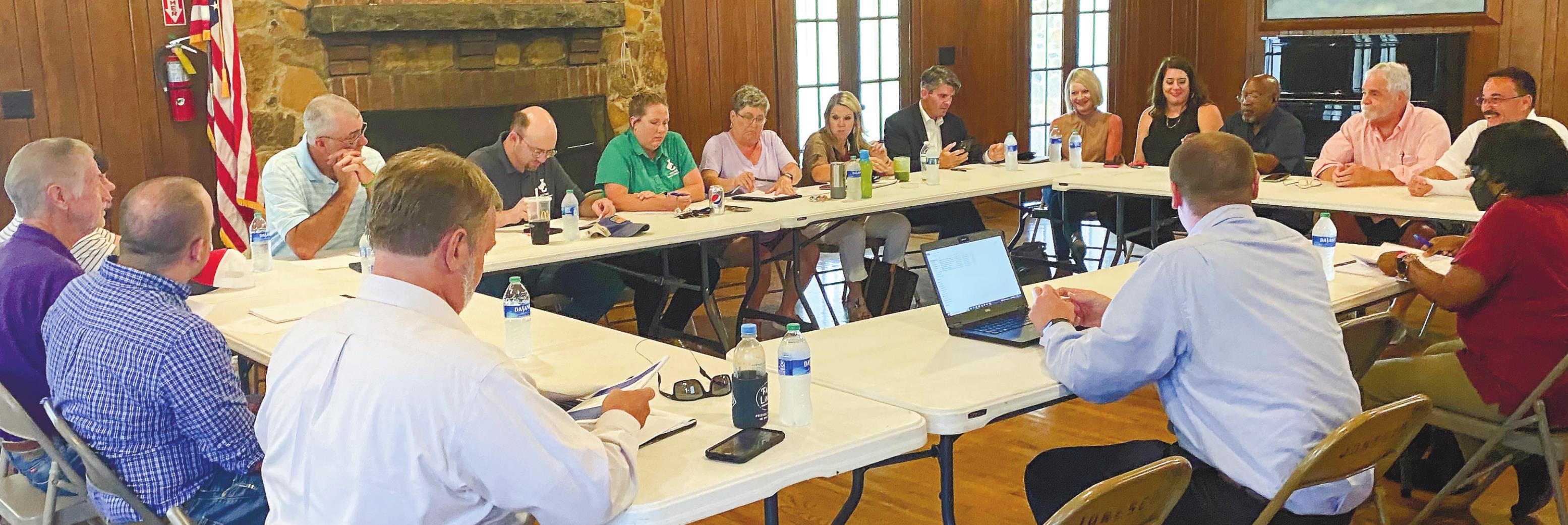
The Jones County Board of Commissioners and Gray City Councilmen started a once every decade negotiation.
The first meeting for the LOST negotiations ended without an agreement but with the understanding that they would try again. On the plus side, the entities are not nearly as far as part this year as they were when they began in 2012.
The July 27 meeting was called to order by Board of Commissioners Chairman Chris Weidner, and Commissioner Sam Kitchens led the opening prayer and pledge. The meeting was held at the Lake Jonesco Clubhouse.
At the first meeting in 2012, the city and county were 24. 5 percentage points apart. At the conclusion of Wednesday’s meeting, the difference started at 2 percent with at least two councilmen appearing to be flexible to perhaps less.
At this time, the split is 81 percent of the 1 cent tax collection, with the city collecting 19 percent.
Local Option Sales Tax (LOST) is a 1 percent sales tax that was authorized by the General Assembly in 1975 and was activated in counties by a local referendum. The negotiations are triggered by the U.S. Census count. LOST is imposed on the purchase, sale, rental, storage, use, or consumption of tangible personal property and related services.
The purpose of the tax is to roll back the milage rate for property owners.
Mayor Pro Tem James Collins spoke for the city at the July 27 meeting, after the city’s Finance Committee Chairman, Councilman Terrell Fulford, handed out the city’s proposal. That proposal started with an increase to 19.5 percent for the city in 2023, increasing to 20 percent in 2025, 20.5 percent in 2027 and the final increase in 2028 to 21 percent.
Collins stated that, with the opening of the North Gray Bypass, the city is now responsible for streets that were previously state highways. He said the city is also constructing a new wastewater treatment plant while working to replace and rehab aging sewer lines throughout the city.
“It’s important to the county that the city succeed, and it’s important to the city for the county to succeed,” the mayor pro tem said. “I think this offer is realistic and straightforward.”
Fulford added that the city has added 35 new businesses in the past 10 years.
Collins said he has checked with LOST splits in other cities and counties and felt like what is being proposed is in line.
Kitchens echoed the importance of the success of the city and county to each other.
“The issue is we are both fighting for our piece of the pie,” he said.
The tax is shared by cities and counties, and negotiation of the tax is a zero-sum game, meaning one jurisdiction’s gain corresponds directly to a loss of revenue by the other.
The commissioner said, based on the division of services, population, tax digest and other criteria, the current split seemed more than fair.
“Ninety percent of the population lives in the county, but the county is responsible for the entire population,” he said.
Kitchens said he comes to Gray for purchases, such as gas, and he appreciates the increase in the number of businesses. He said most people in the county spend their money in Gray.
The commissioner said using the new wastewater treatment plant as a reason for a larger tax percentage for the city was a bit of a sore spot for him.
“I think we all should have worked together on that,” he stated.
Kitchens said the growth of businesses in the city is true, but what would make more of a difference would be a growth of homes and population. The commissioner added that the county is looking at a huge expense in the repair of the courthouse.
Gray Mayor Ed Barbee said the increased number of businesses creates an increase in property taxes.
“We are asking for very little,” he said.
Kitchens said the county is not asking for a reduction in the city’s current 19 percent.
“In my opinion, the set value is fair. The population of the city and county have not changed,” he said. “I’m looking for a viable reason for a change.”
Collins said new houses are being constructed in the city.
“You can’t say we are not growing roof tops,” he said.
Kitchens said, according to the last census numbers, the city has added 211 people.
Wiedner noted that there is building in the county as well.
County Administrator Jason Rizner said there is no perfect way to look at the percentages. He said looking at suggested methods of determining the split, population, services provided, property taxes, expenditures and tax digest value, the closest the city comes is 12 percent.
Weidner said the 19 percent is more than those numbers.
Collins said Gray is growing because it is successful.
“Restaurants are coming to us,” he said.
Councilman Terry Favors asked what happens if the city and county cannot agree. The answer to that question is if the governments do not come to an agreement by the end of August, the negotiations will go to arbitration to try for a resolution. If that fails and no agreement is reached before the end of the year, LOST collections cease for both the city and the county.
Councilman David Tufts asked the impact to the county of giving the city a 0.5 percent increase.
“Every time we go into negotiations, it’s the same thing,” he said. “We are all family. We feel we are being short changed, but the city is still thriving. We are good stewards of taxpayers’ money.”
Tufts said the city deals with issues like crosswalks and traffic lights that the county does not have to deal with. Fulford pointed out that city taxpayers pay county taxes, too.
Kitchens said he felt the county could be open to a 0.5 percent increase, which would match the SPLOST split.
Collins said the city would acknowledge that the county needs the biggest ‘piece of the pie.’ Tufts noted that the Downtown Development Authority is working hard to develop Gray’s downtown area, which will benefit both the city and the county.
Kitchens said, if he felt there was legitimate population growth in the city, he would gladly entertain a bigger split. He said the city’s share went from 16.5 to 19 in the past 10 years.
“I’m looking for a valid reason for a change, then I’m all for it,” he said.
Favors asked if any commissioner was agreeable to the increase to 21 percent, and there was no response. He then asked if any council person wanted to agree to less, and there was no response.
“Let’s go home,” he suggested.
Collins said he did not want to start by asking for 25 percent because he wanted to start with a reasonable offer.
Kitchens said he believed the city’s offer was an honest negotiation. He also pointed out that the county was not asking for a reduction in the city’s split.
Collins’ last effort, which is said to have come from a discussion between him and Fulford, was an increase to 19.5 for five years then to 20 for the next five years.
Kitchens’ response was, “We are just not there.”
No date was set for the next meeting. It was suggested to have a thirdparty facilitator at that next meeting and for it to take place at a neutral location.
