
JONES COUNTY SHERIFF’S OFFICE
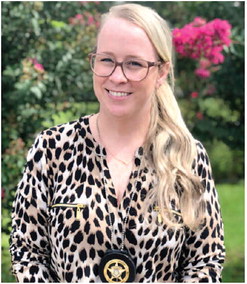
The Jones County Sheriff’s Office has another Certified Crime Scene Investigator with the Nov. 18 graduation of JCSO Investigator Crystal Murphy from the National Forensic Academy.
The University of Tennessee National Forensic Academy is a 10-week, intense, hands-on training for crime scene investigation. Murphy is the fourth JCSO investigator to achieve the certification, joining previous graduates Capt. Kenny Allen, Lt. Kenny Gleaton and Investigator John Simmons.
The Universityof Tennessee offers crime scene certification for law enforcement and forensic professionals worldwide, and, since 2001, has been recognized for its contribution to the forensic science community with the UT National Forensic Academy.
According to the university’s website, the training program has been attended by law enforcement officers, crime scene technicians and military law enforcement from 49 states and internationally.
Murphy reported to the National Forensic Academy Sept. 12. In a Nov. 21 interview, she talked about the training and its impact on her ability to do her job. She became an investigator with the sheriff’s office after graduating from Basic Mandate Law Enforcement Training at the training center in Forsyth in June of 2020, previously working as a probation officer in Jones County with the Georgia Department of Corrections.
Murphy said the NFA training included lectures and hands-on activities, starting with photography.
“It starts with basic crime scene investigation and the photography was what to take pictures of at a crime scene and how to photograph it for evidence,” she said.
Murphy said most of the students used the cameras on their phones, but they learned techniques of how to bring out details and use lighting to capture better images.
How to find and process fingerprints was another week’s focus. The investigator said they learned how to process prints on different surfaces, identify patterns and how to documents the prints through photographs.
She said the class members were shown the most basic ways to document a crime scene, using pencil and paper sketches and all the way up to digital scanning using the latest technology.
“They brought out several machines for us to see how helpful these types of devices are,” Murphy said.
She said one of the most fascinating classes was the medical examiner’s office, observing autopsies and hearing about death investigations.
“I know some people would think its morbid, but it was really interesting,” she said.
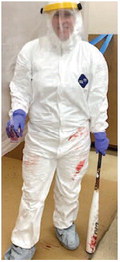
The investigator said they spent a week studying Bloodstain Pattern Analysis, learning all about the different types of bloodstains and patterns and how they are formed. She said all that helps to find out what happened in a crime scene.
Murphy said students made their own patterns and were able to see how things such as angle or height affect blood.
“It did get a little messy at times, but real crime scenes often are,” she said.
She said they learned about flight path and trajectories during the Shooting Incident Reconstruction class and got to do some live-fire work to see how different caliber ammunition affects different types of targets.
The investigator’s hands down favorite week of the course was Anthropology week. She said it started with looking at bones to determine how to first tell the difference between human and animal bones and then got more specific.
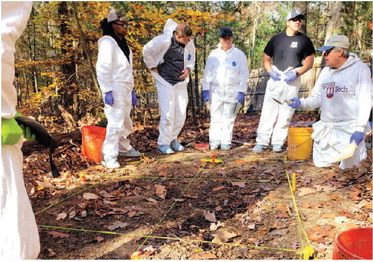
Entomology day was the study of insects and how they help with information such as the how long a person has been deceased. She said the final two days of that week were spent at the body farm working with bodies in various states of decomposition.
“Working in groups, we had to locate a grave and work to excavate the body. Once we had completely uncovered our body and ensured all the bones were accounted for, we then had to bury a new body for a future class to find,” Murphy said.
Arson, explosives and chemical compounds were covered during the final week. She said they blew up a car and found out how to handle the situation if they encounter explosives.
The investigator said there were 28 students in her class, and they were from all over the country, including from the military and Texas Rangers.
She said the farthest away was an Air Force CID Agent stationed in Japan.
Murphy said her roommate, Jada, was an Army CID Special Agent stationed at Ft. Meade, Maryland.
In addition to crime scene certification, she ended the training with certifications in Shooting Incident Reconstruction and Bloodstain Pattern Analysis.
The investigator said the 10 weeks at the academy were certainly worthwhile, and she definitely feels better prepared for her next crime scene.
“I’m more confident now of what I know what to look for and what we need to focus on at a crime scene,” she said.
