
BOARD OF EDUCATION
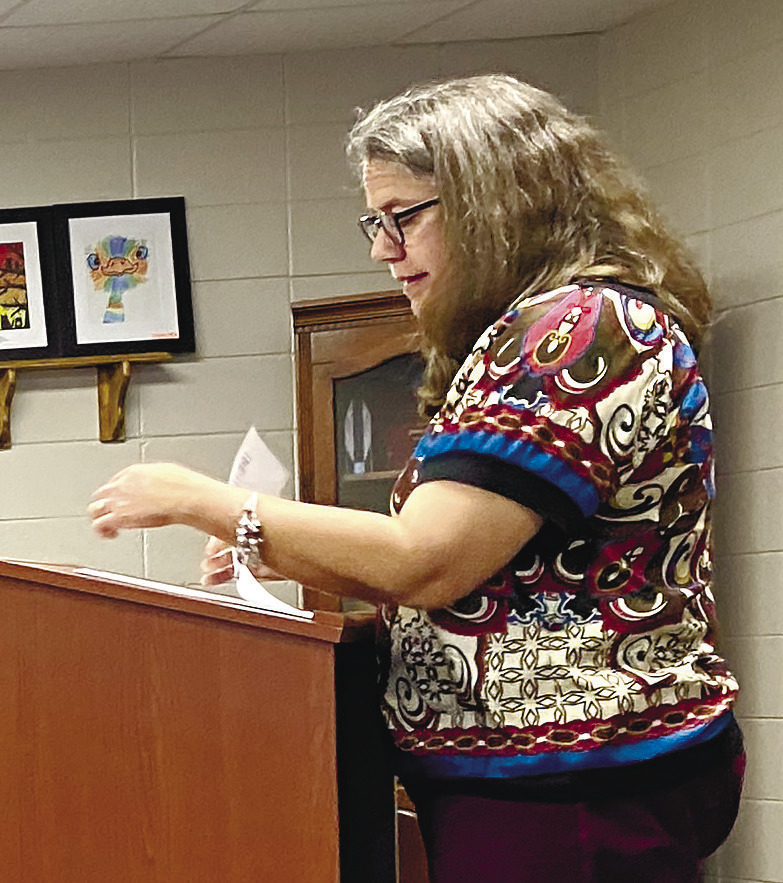
Board of Education members got an earful of information from group of engaged teachers during their March work session.
Board Chairman Ginger Bailey called the March 9 meeting to order and spoke about the College and Career Academy’s JC FLEX Entrepreneurship Competition. She said she would like to see the presentation brought to the board.
“It’s interesting to see them interested in business so early,” Bailey said. “Now I don’t have to watch students walk across that stage and wonder, ‘What will you do now?’” The chairman said the legislature was in full swing, and it was a busy time in Atlanta. She added that she appreciated the support education receives from the Jones County community.
Board member Dr. Nancy Nash expressed concern about the voucher bill passed by the Senate and encouraged everyone to be aware of its ramifications.
Board member Alfred Pitts said attention also needs to be paid to legislation that takes decisions away from local boards. He said changes needed to be made in public education. The board member said the state gives raises that cost local districts money.
“If we see a problem and don’t do anything about it, then we are the problem,” he said.
School Superintendent Charles Lundy talked about the JCHS basketball team that made it to the final four this year.
“Coach (Buck) Harris and the team are to be commended,” he said.
Lundy said the Jones County School System COGNIA accreditation review was complete and he anticipated a positive report. He said Teacher of the Year interviews took place Feb. 28, and the announcement ceremony would take place March 30 at Butler Hall.
The superintendent also announced that the Summer Greyhound Academy would take place at Wells Elementary and Clifton Ridge Middle schools.
Title I
Charlotte Foskey is the Executive Director of Federal Programs for JCSS. She and eight teachers from across the system gave board members an overview of ways Title I funds are supporting students.
Title I is a program that provides federal funds through the Georgia Department of Education to schools with high numbers of low-income students to help ensure that all children can meet academic achievement standards.
If Title I programs sound boring, the enthusiasm of these teachers for reaching students, beginning with Foskey, was unmistakable. The director said Title I dollars were specifically for meeting the needs of struggling learners.
“We know we have students who can’t read, but it’s hard to help students who are three to four years behind,” she said.
The amount of Title I funds received by each school is based on free and reduced lunch numbers.
Foskey said she has chosen to spend her career in the Jones County School System because she believes she can help the community in which she lives.
“Students with issues don’t leave. With a little work, we can give every child every benefit that can help them,” she said. “I want you to hear from the people in the classroom teaching it.”
Family Engagement Director Leslie Poythress began the presentation. She said, since COVID, the programs look different, but they are working this year to get people back in the buildings.
She said they use Title I funds for Family Engagement items such as supplies and displays, transition brochures for parents, signage, meetings, and take home bags.
“We want to give parents all the tools that can help them,” Poythress said.
The speaker talked about the Leaders in the Village program that works with non-traditional caregivers along with Jones County Family Connection. Many who benefit from that program are grandparents raising their grandchildren.
Poythress said monthly newsletters gives information and training to help parent support learners and the funds helps with professional learning.
Melody Nebel, a teacher at Dames Ferry Elementary School, talked about summer take-home resources for students. She said last year the focus was ‘backpacking with STEM,’ that had an emphasis on literacy.
The backpack is filled with books students can take home that are STEM related. She said each student was able to take home five books for the summer. Nebel said the project showcased longterm STEM projects.
The teacher said next year the plan is a summer bridge kit with activities in writing, reading and math and a guide for parents. She said the kit comes with two literacy books, two information books, flash cards and a backpack to put it all in.
“We’re excited to see how it works,” she said.
Principal Jennifer Holland of Gray Elementary School said she looked at data and realized a lot of time is spent on reading, but students were falling behind in math skills. Holland said the solution was an intervention teacher, but it was important to find the right person. She said Lavane Freeman was that person.
Holland said Freeman is able to intervene with students and works with them in small groups.
“Building relationships really makes a difference. We are thankful to have her,” she said.
The principal said Title I funds pay for paraprofessionals who can work with students where they are.
Bailey said she loves that they are able to work with one child at a time.
Rachel West of Mattie Wells Elementary talked about the Lexia Core 5 reading software. She said the process starts with an assessment of the student and lets her know where they need help.
West said at the beginning of the year student were reading 57 percent below grade level, and at year’s end they were at 23 percent. She said they use the program for 15 minutes a day. The goal is to get them reading above grade level.
Amy London at Turner Woods Elementary talked about the program’s Write Score and Fast ForWord. She said she found Fast ForWord in 2016 and was able to get a free trial. She said she worked with 23 students with reading deficits, and at the end of the year only one was not reading on grade level.
London said she was able to get a grant for the entire school. She said even students who appear to be proficient readers can have gaps.
She said Write Score is a writing program. The teacher said it is structured like the GMAS test and helps students to be comfortable taking that test. She said the program provides teaching resources.
LaDonna Olivieri at Clifton Ridge Middle School talked about Reading Plus, a reading intervention program that helps teach students how to read and take tests.
“It shows me students can be taught to read in the allotted time frame and understand,” she said.
Olivieri said the program assesses students on an entirely different level.
Shannon Smith and Amy Lundy at Gray Station Middle School talked about Math 180. Smith said they use MAP test scores to determine where students need help. Lundy uses the program with six, seventh and eighth graders at CRMS and GSMS for two lessons a week.
Alisha Gordon is a math intervention specialist at Jones County High School. She spoke about Math ‘Thinking’ Classrooms. She said the school has had a literacy initiative, but math scores had been spiraling. Gordon said teachers did not want another computer program.
She said the building thinking classrooms initiative uses vertical, nonpermanent surfaces and puts random groups of students together to answer thinking questions. Gordon said the groups are made up of three students and are changed each day.
Each classroom has from eight to 10 of the vertical boards, and the initiative is a focus on shifting student mindset to a growth mindset to explore thinking through mathematics.
“The sit and get procedures weren’t working,” the speaker said.
Gordon said the initiatives put in place this school year, including the Thinking Classrooms, has increased the performance of the students by 12 percent.
The supplies and intervention position are funded by Title I.
Economic development
Jones County Development Authority Executive Director Haley Watson gave a PowerPoint presentation to the board about economic development; its impact on education and education’s impact on economic development.
The director talked about the cost of community services and the relationship with industry and businesses. She pointed out that the skilled labor pool in a community is number one in site selection factors for prospects moving their companies and businesses. The next two are accessibility and quality of life.
Watson said teamwork is key to planning and the right strategy for a community to be successful.
“We are posted in a great geographical location, and we’ve been seeing more interest,” she said.
The meeting concluded with a discussion about changes to the dual enrollment criteria and board policy for non-residential students, and an expression of support by board members for the upcoming vote to renew the education Special Purpose Local Option Sales Tax.
The vote for the ESPLOST was the only item on the March 21 Special Election ballot.
