
Brennan Jackson
County Extension/ANR Agent
There are several trees in bloom right now including the saucer magnolia, cherry trees, and Eastern redbuds.
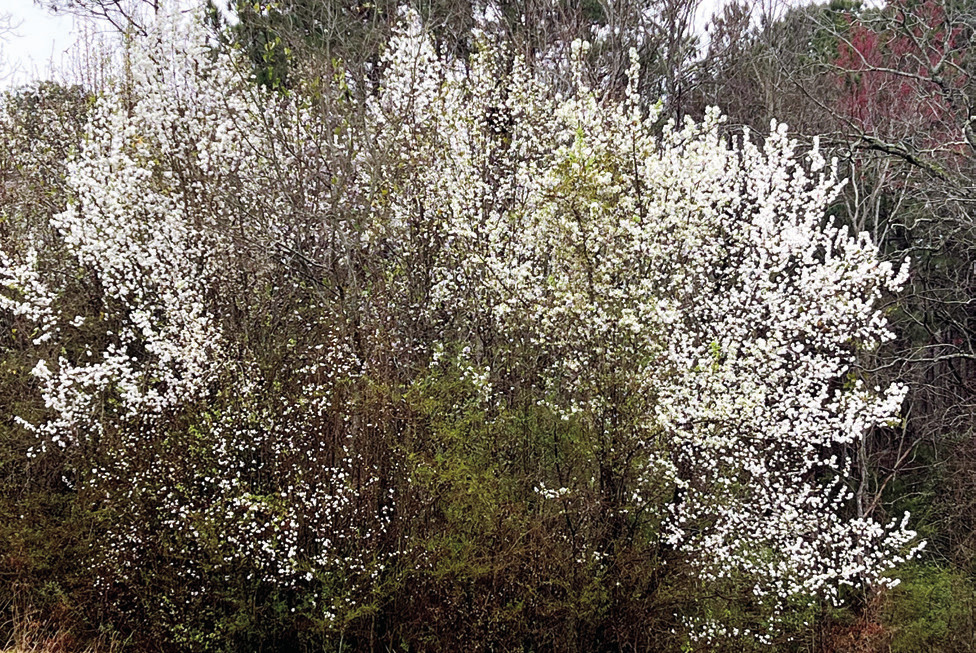
Another tree that is in bloom is the Bradford pear also known as the Callery pear. These trees are not native, but they have been widely planted across the southeastern region for years. While they do add color to the landscape as we are coming out of winter into spring, they have a horrible odor and they are structurally weak trees.
Additionally, and probably more importantly, Bradford pears are extremely invasive. While in a landscape setting the spread of Bradford pears is not as noticeable, the spread in natural areas is quite obvious. As they continue to spread they also spread disease that affect apples, pears, crabapples, loquat, etc. Bradford pears are fairly resistant to fire blight, which is a bacterial disease, that enters through wounds or flower blossoms and moves down the branches, but they do spread the disease to other trees when they cross-pollinate.
That description more than likely seems very negative, but there is really not a lot to say that is positive about this tree.
It does bear fruit, but it’s not viable. Therefore, the only thing that can be done is to get rid of as many as possible. In both North and South Carolina, there is actually a bounty program for Bradford pears where the program will provide free native trees for Bradford pears that are destroyed.
Ohio has a ban on the trees already, but Pennsylvania and South Carolina have passed laws banning the Bradford pear in their states beginning in this year. These bans are either the sale of Bradford pears or the sale and cultivation of the tree.
What is the best method of getting rid of Bradford pears? If you are treating saplings, the best method is applying a triclopyr herbicide labeled for trees.
For larger trees where a foliar application of a herbicide is not feasible, it will be necessary to cut branches or the entire tree and immediately spray the stumps with triclopyr or glyphosate.
Once the tree dies you can burn the stump and spray any new water sprouts.
For more information about the Bradford pear or other invasive species, please contact the Jones County Extension office at 478-986-3958 or email brennan4@uga.edu.
