
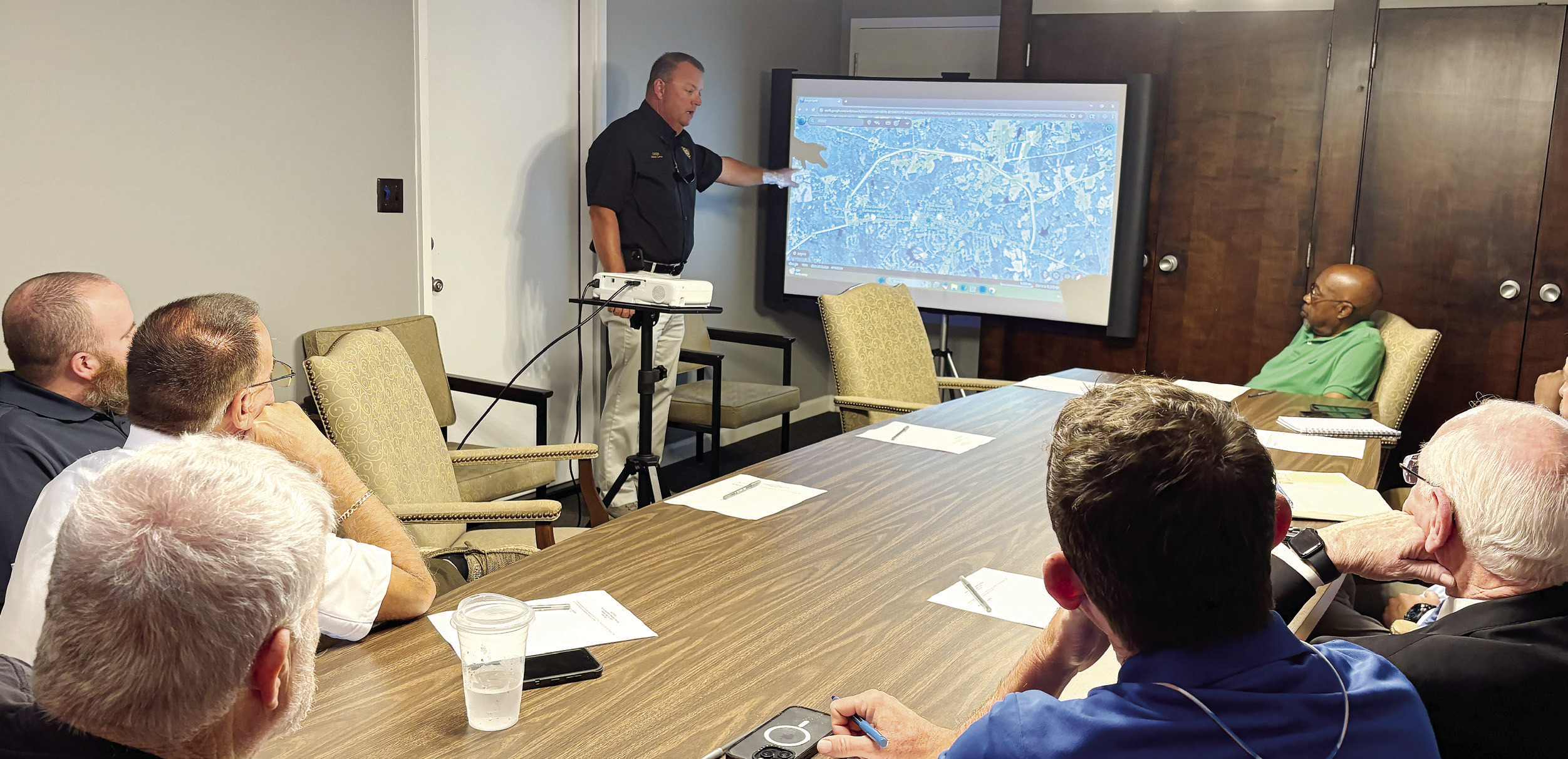
Gray City Council members met with Georgia Department of Transportation representatives last week to discuss issues the city is experiencing in maintaining former state route roads that became the city’s responsibility after the opening of the Gray Bypass.
The June 16 meeting included State Sen. Rick Williams, Jones County Commissioner John Wood and GDOT District 3 representatives Todd Tyler and Danny Miller, one of five area district engineers who works out of Macon.
District 3 covers 31 counties and operates out of Thomaston.
Gray Streets Committee Chairman David Tufts called the meeting to order, and Mayor Ed Barbee welcomed the visitors. He said he met Tyler at regional meetings and hoped a meeting with city council members would be beneficial.
The mayor said Gray Police Chief Adam Lowe is the city’s person on the streets every day and was the point person for the discussion of the issues with the former state routes.
“I hope we look at the big picture and can come up with a solution,” he said.
Lowe began by stating, before the bypass was under construction, paperwork was signed by the mayor of Gray and county commission chairman at the time and the GDOT, agreeing the city and county would take ownership of former state highways after they were routed over the bypass.
He said that was never voted on by city council members. An interesting point, the mayor at the time of the referenced 2007 agreement was Jason Briley, and Preston Hawkins was commission chairman. The two men were not known for agreeing on much, and the bypass would not be completed for another 10 years.
Lowe said the agreement about which state routes would be involved was first presented by Mike England, the District 3 engineer at the time, but he said each time the district engineer changed, so did the affected roads. Lowe said the end result is Gray is now responsible for all of them.
The state routes involved were state highways 44, 22 and 11 and US Highway 129, and the way they all overlap at the crossing intersection is very confusing.
The chief had a map displayed on big screen and pointed out each route and how they entered and exited the bypass and/or intersection.
The first time the issue with the state routes was brought to council was in February of 2017, a couple of months after it opened.
Lowe said the addition of Highway 44 did not come to the city’s attention until it was added to a radar map sent to the Gray Police Department in 2019.
“The roads are terrible. The GDOT agreed to help with the roads and the traffic signal at the crossing at a meeting in 2019, but none of that has happened,” he said.
The chief said the city had to repair the intersection of Highway 11 and Gray Highway. He said the GDOT gave the city $58,000 toward the $300,000 project. As a result of the continued road issues, the city declared no thru trucks to stop the damage to the roads.
“We’ve had signs up, but it hasn’t mattered. But we are not going to start writing tickets for 60 days,” he said.
Lowe said every large truck has been dumped in the city’s busiest intersection, the four-way stop during school traffic.
“We’ve got a taste of the poison,” he said.
The chief said the crossing intersection, that includes a railroad crossing, is one of the worst in the state and a nightmare for everyone.
“Everybody hates that traffic signal; it really needs to be redone,” he said.
Williams asked about the possibility of adjusting the state routes, and Lowe said anything would help alleviate the monstrous burden.
Mayor Pro Tem James Collins said the GDOT told the city it would not be left hanging. He added he’s been getting calls from log trucks since the ‘no thru trucks’ signs went up.
GDOT response
Tyler was interested in the original agreement. He said it was important to take a look at it.
“We need to know what was agreed to. After that, no one can make changes without another agreement,” he said.
The engineer said adding state routes back to the city was not an easy task. He said the purpose of the bypass was to address the truck traffic in downtown Gray. He went on to say if the downtown roads were made state routes, all vehicles can use them.
“If there is a consideration, it’s not going to be for the convenience of the trucking industry,” he said.
Tyler said there are grants for non-state route traffic signals and he could find what is available.
“It’s a complicated dinosaur, but we are willing to look at it again,” he said.
Lowe said before the no trucks signs were put up, he counted 37 trucks one morning at the crossing intersection in one hour.
Williams said the state could put more truck route ahead signs up leading to the bypass.
“We did it in Monticello to try to divert as many trucks as we can,” he said.
The senator said sometimes the problem is the drivers don’t see the signs until it is too late to make the turn to a bypass.
Lowe pointed out that the crossing intersection is the worst in the state for truck wrecks.
Tyler asked if the city’s LMIG funds were increased after the state routes were changed.
Barbee said what the city is looking for is help with putting a portion of Highway 44 back to a state route and assistance with replacement of the traffic signal at the crossing.
Tyler said he would go back to look at the original agreement and subsequent correspondence, and Williams said he would work on more truck route ahead signs.
Wood said there is a lot of territory in his district. He also pointed out that big trucks have a lot of liability, especially when making multiple turns.
“Truck traffic runs all night. They want the shortest route possible, and we need to work together,” he said.
Tyler said the bypass has been open eight years.
“This is not a new problem. The GDOT is not in the business of adding more miles to maintain; that can’t be the solution,” he said.
The engineer suggested the city and county get together because its their decision who travels their roads. He said the entities have the authority to create truck routes.
Collins asked how long it would take to get a response to the issues discussed, and Tyler said they could shoot for meeting again the end of the month.
“I’m looking for what was in the agreement and what was agreed to later,” Tyler said.
