
Cecil Ethridge Jr. has retired twice now, but he still refuses to quit working.
After 30 years in one full-time job and 18 in another that was considered full-time, Ethridge is enjoying a more relaxed schedule as a part-time funeral attendant.
Ethridge, 72, is the son of a railroad employee turned tax collector and florist. Cecil Sr. was the Jones County Tax Collector from 1968-84, and he and Miriam were the owners of a flower shop from 1959 until she turned 65 in 1987.
“I grew up helping in the flower shop, delivering flowers and all that kind of stuff,” Ethridge shared in an interview last week. “Even before I could drive, an uncle or somebody would drive me, and I’d hop out and take the flowers. Later on, I even learned to arrange them just by being in there. And then when I was 16, I could drive on my own.”
He also helped his dad at the courthouse.
“Way back in the day, when Daddy was tax collector, everybody had to have their car tags bought between January 1st and April 1st. And, it was always crowded the last of March to April 1. Usually that would be my spring holidays at school, and I’d wind up going up and help sell tags.”
Ethridge graduated from Jones County High and earned both bachelor’s and master’s degrees in education from Georgia College and State University, then obtained his six-year specialist degree in administration and supervision from the University of Georgia in 1980.
Two years later, Ethridge, who was attending Vineville Baptist Church in Macon, met his future wife, Betty Morris.
“She is from Cordele,” he said. “She came to Macon to go to nursing school, and then got a job at the Middle Georgia Hospital and stayed in Macon.”
The two married in June of 1983, and they have one son, Peyton, now a tax attorney in Atlanta.
“His name came from Peyton Pitts, who built Pitts Chapel Church,” Ethridge said. “That’s my great, great, great-grandfather.”
He began his teaching career at Califf Middle School before the administration decided to put in a gifted students program and tapped him to handle that.
“‘I’d go from Mattie Wells to Bradley-Wayside, which had a fourth grade, and Gray Elementary, pulling students that qualified and worked with them on a weekly basis, like twice a week,” he said. “It was interesting because I got to travel. I was the only one in Jones County, and it was just getting started in the state.”
Ethridge explained that he taught at least two classes daily, ranging from pre-algebra to Georgia history, world history and personal finance in high school.
“I liked them all. I did Georgia history the most. And then, as I was doing it, I learned we have a lot of history here in our own county. You know, there’s tons of things that go way back.”
That work would come back to influence Ethridge later in life.
The educator/administrator left Jones County, however. He started in 1991 in administration at Union Elementary in Macon, the largest elementary school in Bibb County at the time. In 2000 he went to Monroe County.
“I was assistant principal at the middle school when I retired in 2003.”
Ethridge used the system to retire as young as possible. He finished college in three years, going to school in the summers.
“I finished my classes in college and graduated on a Saturday and started working in Jones County on Monday.”
Twenty-nine years later, he did it again.
“I had a year’s worth of sick leave I hadn’t used,” he pointed out, “so, therefore, I was able to retire one year earlier. Yep, give me my 30.”
When reminded it had been 22 years since his first retirement, Ethridge chuckled.
“Tell me about it, because even some of the people I taught, it’s funny, especially if they’ve done a 30-year career in teaching or whatever; they’ve retired, and I’ve laughed and said, ‘Hey, these stores that give discounts to seniors, I need to take y’all with me, and maybe they’ll give me a double discount.’“ Ethridge didn’t retire to the living room and kick off his shoes, though.
The Ethridge family was on a trip to Italy with some of Peyton’s classmates and parents shortly before his retirement, and one father told Cecil, “Oh, I got a job for you.” He shared with the educator the possibilities of real estate.
“So I went and took the classes to be a realtor,” Ethridge recalled, “and I did real estate for 18 years with Fickling and Company.”
As it turned out, fellow Jones Countian (the late) Sandy Goolsby was working at the company also.
“We did a lot of stuff together. Being from Jones County, we could pair up and go co list something; or it was kind of like if she was gone on a certain day and needed a house shown, I could do it and vice versa.”
Ethridge, named Realtor of the Year by the area real estate association in 2015, decided to leave that profession as well in 2021.
“I guess just getting a little older,” he surmised as to that move. “When you do real estate, it can be a seven days a week, 24-hour job, because some people work during the day, nine to five, and they want to look at stuff in the afternoon or night, or they want to go on the weekends and that kind of thing.”
Once again, though, Ethridge ended up going back to work, though on a more part-time basis in his current job.
“I work at Hart’s (Mortuary),” he said. “And the nice thing about that is, you get to work with people. You get to see people, and you get to see people that you’ve known from the past. And it’s kind of like, too, if they call and I can’t work a particular day, it’s not like, oh, I’ve used all my sick leave or whatever. It’s like, yeah, I can work today. Or no, I can’t. So, it still gets you out there doing something.”
Ethridge pointed out that, as in the real estate business, defining job time for a funeral home attendant is nearly impossible. He mentioned visitation at night, funerals on weekends, and the weather as factors that must be considered.
“They’re all different,” he concluded. “There’s a lot of similarities, but tons of differences, depending on what people need.”
The retiree has interests other than those work-related.
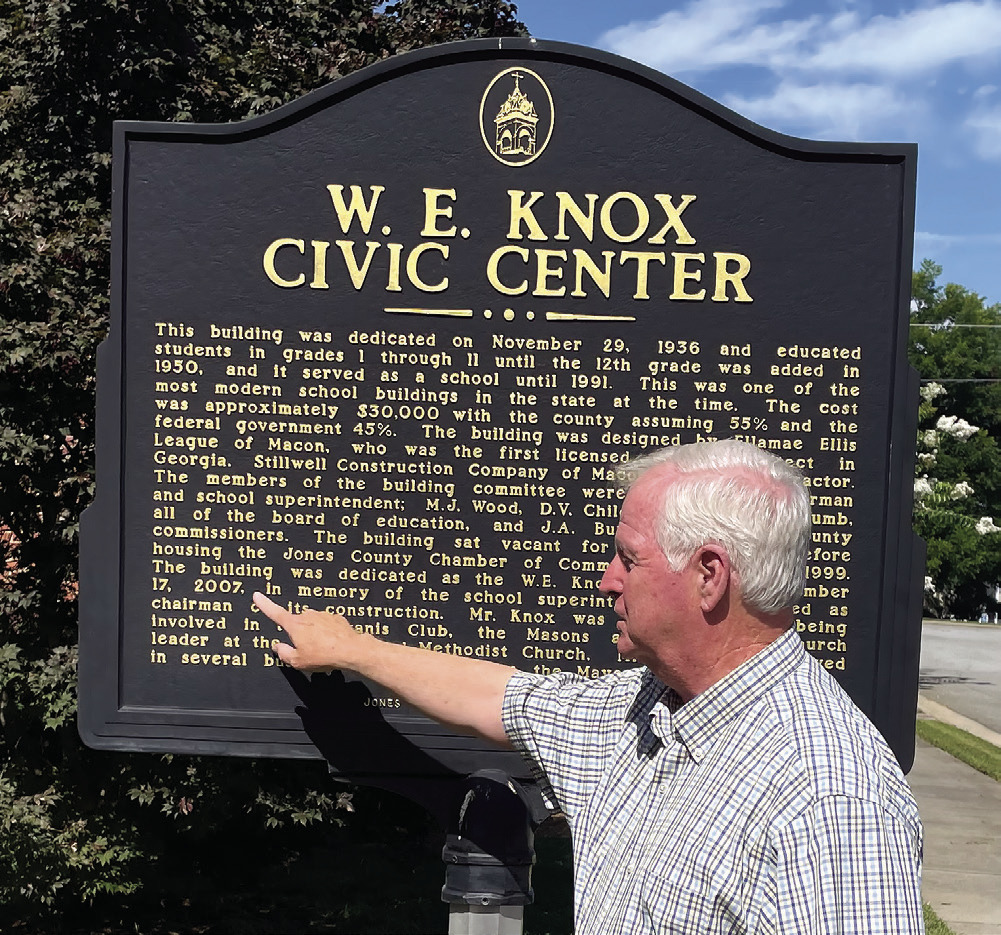
“I’m in the Jones County History and Heritage group,” he said, pointing out activities those volunteers have undertaken. Included is the establishment of a museum in two rooms of the old high school (W.E. Knox Civic Center).
“We also do these books,” he said, holding up a small publication with ‘107’ on the cover.
“107 was our tag number back in the day, when they were based on population. So we decided we would just go with that. And so we’ve done about seven of these … We’re trying to preserve history.”
Another project the group has begun is the installation of historical markers.
“I don’t even know if the state does it anymore,” Ethridge commented. “If a group asks for it, they pay for half of it, we match it, and then we do an unveiling. It takes anywhere from six to eight months to get them put together. But, it’s neat that we’ve got them scattered around.”
Among those in place now are markers at Elam Baptist, Plentitude, Pitts Chapel, the Haddock school, now Haddock Baptist, Califf, the former Gray Nursing Home, which was originally a school for Blacks, and one at the W.E. Knox Civic Center.
“So, there’s a ton of history,” he said.
In that regard, Ethridge has given programs on local history to various groups, including Gray Methodist, First Baptist, Elam, and the Daughters of the Confederacy in Macon, “whether it’s talking about certain things or taking them on a bus to point out certain things in our county because we do have a lot of history here.”
Ethridge is also on the Downtown Development Authority in Gray, and he pointed to one of the more visible results of the group’s efforts, the transformation of what was once Butler’s Garage. A representative of UGA’s economic development team came down and met with the volunteers, walking around Gray and checking out possibilities.
“And that’s how we came up with Butler Hall,” Ethridge reported. “We had thought of trying to buy it so we could have more parking space, like for the courthouse. He said, ‘Oh, you ought to turn this into an event center.’
“So, we got an idea, we put it together, and we got it done. And then,” he continued, “the school bus lot moved. We were able to purchase that to give parking. So, it’s worked out real well.”
Ethridge said the Authority has helped develop some ordinances aimed at improving the appearance of the city.
“It’s not that you’re trying to be so controlling, just trying to make it the best it can be.”
While at his former school building for a photo, Ethridge reflected on part of his early ‘education’ at the facility. One of his elementary teachers, Ms. Helen Pearson, took it upon herself to introduce her students to Mexican food.
“They went and bought the food at the grocery store and had it heated up in the lunchroom so we could sample Mexican food,” he recalled. “Now, look at Mexican restaurants and Taco Bell, and what kid out here now doesn’t know what Mexican food is?”
