
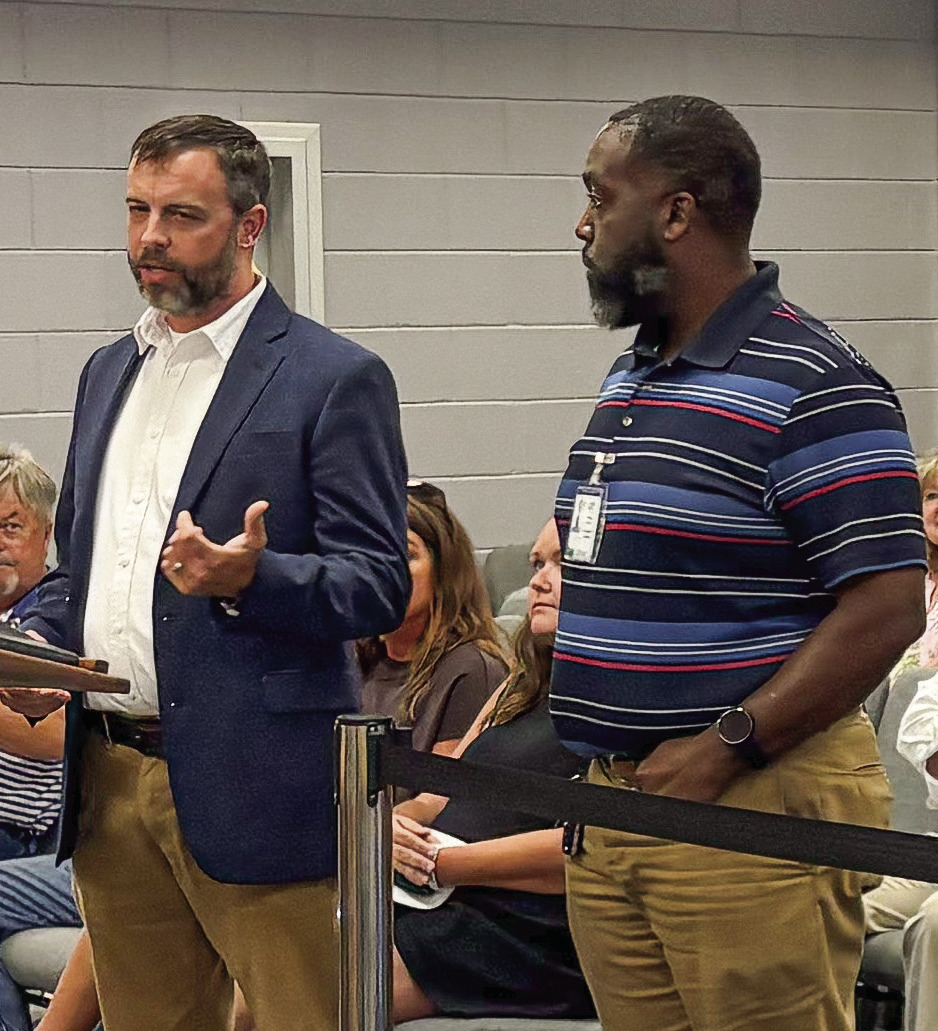
Georgia Department of Transportation officials were true to their word and came back to the July meeting of Gray’s committees for a continued discussion about the issue of former truck routes and large trucks in downtown Gray.
The D.V. Childs Civic Center was filled for the July 21 meeting, with several in the trucking business in attendance to let their complaints be known. GDOT District Engineer Tyler Peek and Area Engineer Danny Miller were at the June 16 All Committees meeting and returned to last week’s meeting.
State Sen. Rick Williams and State Rep. Dale Washburn came to the meeting as did three members of the Jones County Board of Commissioners — Chairman Chris Weidner and commissioners Sam Kitchens and John Wood.
Gray Mayor Pro Tem James Collins called the meeting to order and noted that the streets committee would be moved to first on the agenda. He said the meeting was a follow-up with the GDOT from the June meeting.
Peek said that discussion was about how the state routes were changed when the bypass was built and the agreements made by city and county officials and the GDOT.
“Now there are no state routes through downtown Gray. They follow the bypass; that is what was agreed in 2007,” the engineer said.
He said the records were pulled, and that is what the 2007 resolution states.
“And that’s the way it looks today,” Peek added.
He passed out maps to council members that show the change of the state routes to follow the bypass. Peek said State Routes 22 and 11 and U.S. Highway 129 follow the bypass, and SR 44 begins at the round-about at the bypass and U.S. 129.
Peek made the point that this happened in 2017 when the bypass opened. He said, since that time, the maintenances of the former state routes belong to the City of Gray and Jones County. The engineer said that includes 3.9 miles of the highways in the city and 2.4 miles in Jones County.
He said he understands the concern about the conditions of the highways, but the question of the GDOT agreeing to pave the roads has not been found in any correspondence.
“There is also the issue of the signal at the crossing,” Peek said.
He stated that the GDOT has a team in Atlanta that looks at signal upgrades, and they are already looking at Gray’s signal. The cost of the upgrade could range from $50,000 to $400,000, and he anticipates the study would be complete in the fall.
“I think we will participate once we have an understanding of the cost,” he said.
When it comes to the paving, Peek talked about the annual LMIG (Local Maintenance and Improvement Grant) available to the city and county and the LRA (Local Road Assistance) supplement. He said the city and county both participate with the grants, but he also realizes that they did not cover all the needs.
“You can ask for a one-time additional funding request for unexpected needs. That’s something the city and county could submit together with an estimated cost,” Peek said.
He noted that could be a one-time solution for the route paving issue. The engineer said the GDOT is giving a fresh look at the signage for the bypass to make sure it is accurate and giving the right information to commercial and non-commercial traffic.
Miller said the paving projects for Highways 22 and 11 in Gray are nearing completion, and all are ahead of schedule.
Collins asked when the state routes were officially turned over to the city and county. Peek said that was in 2017, but there was a transition period. Miller said the traffic signal was maintained through 2018 and 2019.
“We kept it on to get upgrades,” he said.
Mayor Ed Barbee said there is nothing that will make everyone happy. He said it was a lack of foresight to agree to the changes in the state routes. Barbee suggested there should be a way to correct an unforeseen problem that occurred after the state routes changed.
“That would be to let Highway 44 start at Bill Conn and bring it into the city, just common sense. If a truck misses the route, it has to go all the way to Highway 49,” he said.
Collins said, while he has been on council, the GDOT has told the city they were not going to drop these problems on the city.
“But that is what you have done. What’s left here is a mess,” he said.
Peek stated that the GDOT is not in the position to take or add to the state route system.
Lowe said a large percentage of the trucks go up 44, which is a straight shot through. He said 1.5 miles could fix it.
“This hurts the local folks the most,” he said.
Peek said the GDOT may be willing to trade maintenance if that was a possibility but is not interested in taking on more road maintenance.
City Clerk Cindy Yancey asked how the city would request additional funding, and Peek said it needed to be a formal letter to the GDOT that would include the cost estimate and what the city would contribute.
Collins said the bypass is a three-quarter loop and suggested the GDOT could complete it.
Several truck drivers at the meeting talked about the problems they are having attempting to maintain the truck route around the city.
“It feels like truck drivers are being personally attacked,” one driver commented.
Peek’s response was the state routes were changed eight years ago, and the GDOT is not responsible for when the truck route is enforced.
Elected officials weigh in
Williams said he listened to the issues but cannot promise the state can help.
“I feel for the truckers. I’ve watched the log trucks making those turns. They’re carrying a lot of weight. We have the same issue in Milledgeville,” he said.
The senator said he does not know the answer and understands the problem of going all the way around the city.
“We have to continue working to figure it out. These are hard-working people, and we need to come to a solution. My door is open, and I’m glad to meet with you,” he said.
Washburn said he is from Jones County.
“I’m honored to be here. I’m ready to listen and try to help,” he said.
The representative said they work with the GDOT but don’t have control of the department.
“I don’t know of a legislative remedy,” he said.
Collins said he did not feel it was fair to point the finger at the city’s enforcement of the truck route. He said the council is doing what is right for the city.
“The state put a disaster in our lap,” he said.
Street Committee Chairman Councilman David Tufts said the plan for the bypass went on for many years before any dirt was moved.
“We can’t please everyone, but we can try to improve the situation,” he said.
Tufts asked the commissioners if they would like to speak.
Kitchens said for him it was about safety.
“Every additional turn that these trucks make is a safety issue. We all pay state and local taxes and have the right to expect to drive on safe roads,” he said.
Tufts said he agreed and would like to try to do something.
Wood said it is important to look for a commonsense solution with safety in mind.
Committee meeting
At the conclusion of the state route discussion, council turned to committee business. Collins recognized the president of the Jones County/Gray Chamber of Commerce, Chloe Hester who talked to council members about the State of the Community event coming up Aug. 28 and invited them to attend.
She also asked if someone would speak on behalf of the city and Barbee said he would be happy to oblige.
Finance Committee Chairman Terrell Fulford said 99 percent of the 2024 property taxes have been collected, totaling $1,308,483.
Under the plan committee, City Attorney John Newberry said he had checked how other cities handle temporary businesses. He said Milledgeville charges $100 a day for a permit but Bibb County just charges the price of a business license.
Councilman Terry Favors suggested the topic placed on the agenda for the August committees meeting.
Favors recommended the council ratify a bid to replace the air conditioner in 102 E. Clinton Street so it would not have to wait for the August meeting. Council members agreed.
Micah Harley brought a problem to council that appeared to be caused by the resolution amending the truck route in Gray. He said online cost estimates to transport cars to and from his auto sales business have increased to a point that sales have plummeted.
He stated his business is not in the city limits.
Harley’s request was to change the wording of the ordinance to better designate the city’s boundary in order to clear up the online issue.
Newberry said he is working to remove the state route information from the city’s code.
“I think this will solve your problem,” he said.
Harley said he is not opposed to the truck route, just what the misunderstanding has done to his business.
Next steps
Most who came to the committee meeting left after the conversation about the truck routes concluded, but Peek and Miller did not. After the meeting adjourned, they stayed and talked with council members and commissioners.
It was suggested that the city and county submit a joint request to the GDOT asking for help with the state route situation due to safety concerns for the problems the large trucks are having with the turns being required to adhere to the truck route.
No promises were made, but Chief Adam Lowe thanked Peek for coming to the meeting and listening to concerns.
The next meeting of the City of Gray is scheduled Aug. 4.
