
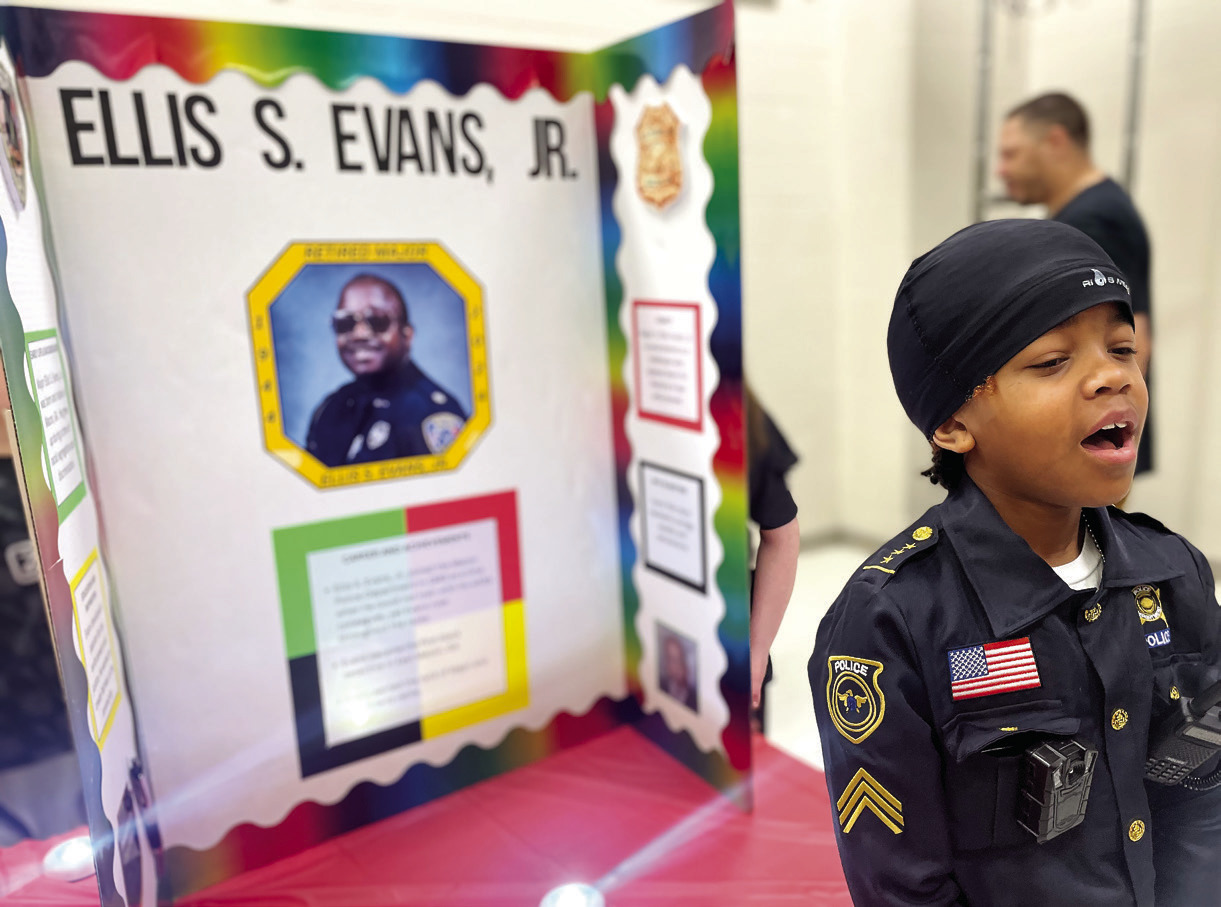
Mattie Wells Elementary School fifth graders presented a “Living Museum” for Black History Month, featuring presentations on historic and modern African American figures brought to life through student-led exhibits.
Fifth-grade teacher Stephanie Shi explained the project.
“Our fifth-grade students chose local figures who impacted our communities. They completed research and prepared a poster presentation and blurb to share through the wax museum. They dressed as their figures and came to life when their light was turned on by others,” she said.
The project showcased well-known, iconic figures in Black History along with lesser-known leaders and contemporary contributors who shaped history and culture through their influence. The range of figures presented provided students with a broader understanding of how achievements across many fields and eras continue to shape the world around them.
Students presented the museum to their families and the broader Jones County community after school on February 26 and then shared it with their peers in other grades during the school day on February 27.
Colton Simmons portrayed Jackie Robinson and said the baseball legend’s story stood out to him because of the barriers he broke in the sport they both love.
“Jackie Robinson was the first African American to play in major league baseball history. I like how he actually wanted to play baseball. I mean, I would worry to be the first person in Black history to play, like he did. He’s the first one to break that color barrier,” he said.
Melynie King portrayed Ruby Bridges and said that her bravery helped her understand the significance of standing up for what is right.
“My favorite thing to learn about Ruby Bridges was that she was one of the first Black children to go into an all-white school in a time when we weren’t really allowed to. Then, she became an author and a civil rights activist. I really liked learning about her,” she said.
Kynlee Aaron presented Coretta Scott King and said she was inspired by King’s lifelong commitment to civil rights.
“Mrs. Coretta Scott King was a hero. She was married to Martin Luther King Jr. and also stood up for people’s rights, and she led national civil rights efforts, so like she tried, and she gave an effort to help people,” she said.
Samiyah Bowdry introduced visitors to Mathilda Beasley, a figure she said she grew to admire as she learned more about her life and legacy.
“Mathilda Beasley was actually the first African American nun to serve in the state of Georgia. She founded a group of African American nuns and also one of the first United States orphanages for African American girls. Mathilda Beasley’s talent, strength, character, and sacrifice is why people should still learn about her today,” she said.
Bowdry said she entered the project with limited knowledge of Beasley but left with a deeper appreciation for her determination.
“Before this project, I had never heard of her before, and I have never seen her first name spelled that way before. I even kept saying her last name wrong, and it took me a minute to get it right. It took four weeks to get all the information, and it took me like a week to get my poster ready because I had to get all of my information from all of these sites, and I had to make sure it was all true,” she said.
Bowdry’s experience demonstrated how the museum expanded students’ understanding of influential figures whose stories may not be as widely known.
Kynsley Soles studied Lucille Hegamin and said her research introduced her to new music and history she had never encountered before.
“My favorite thing about Lucille Hegamin, I found when I was looking all the information up, is that she popularized blues music. I haven’t listened to her music yet, but I am so excited to,” she said.
Peyson Baker portrayed Sarah Randolph Bailey and said she appreciated Bailey’s role in opening doors for African American girls in the Girl Scouts.
“Sarah Randolph Bailey was born on August 25th, 1885. She is best known for getting African American girls to be able to join the Girl Scouts of America. She has the highest-achieving Girl Scout awards that an adult can have,” she said.
Raleigh Myers introduced Grace Towns Hamilton and said she wanted more people to understand Hamilton’s influence.
“Grace Towns Hamilton is a very important part of Black History. Grace served as Executive Director of the Atlanta Urban League. I feel like most people don’t know about her. Like, I feel it is important to learn about all of these people, so they are not forgotten in history,” she said.
Zion Dillard chose to portray Major Ellis S. Evans Jr. and said he appreciated studying a more modern and local figure whose career showed determination and progress in the Macon law enforcement community.
“Ellis S. Evans Jr. joined the Macon Police Department in 1965 at a time when he could not train with his white colleagues, yet Evans rose throughout the ranks.
Evans became the first Black detective in East Macon. Evans earned the rank of Major and was able to retire. Evan’s life story represents courage, equality, and perseverance. Major S. Ellis Evans Jr. is remembered as a trailblazer who opened doors for diversity in law enforcement,” he said.
Melanie Harvey highlighted Dr. Patrice Walker and said she admired studying a modern leader whose medical work continues to shape healthcare in Middle Georgia.
“Dr. Patrice Walker is a leader in Macon’s medical community, known for her work in improving healthcare access and patient care. Her trailblazing efforts highlight the growing impact of African American professionals in medicine throughout Middle Georgia,” she said.
Loki White represented Tyrus Turner and said he enjoyed learning about a modern musical figure from the local community.
“Tyrus Turner was born right here in Macon, Georgia. He began his singing at age eight, singing ‘Jesus Loves Me’ by Whitney Houston in church. He has been in major TV shows, like X Factor and American Idol,” he said.
Dillard, Harvey, and White’s presentations demonstrated how the museum helped students recognize the impact of influential figures who shaped change and progress right within their own communities, demonstrating that they have the power to work toward meaningful change themselves.
Students also portrayed Dexter Redding, Norm Nixon, Herschel Walker, Demaryius Thomas, Walter Morgan, Sallie Davis, Latavia Coleman, Calvin Johnson, and other influential figures who shaped local, state, and national history.
Shi said the project encouraged fifth-grade students to think about the importance of diversity and perseverance and underscored the importance of learning about Black History today.
“I believe that our kids need to learn about different cultures and diversity. I think this also teaches them about reaching for their dreams and not letting anything hold them back. A lot of times, kids can feel like they’re defeated or their voices are not heard, and this shows them they can achieve their dreams by learning about those who have gone before them,” she said.
Shi said she hopes this experience inspires students to continue exploring the stories of leaders who shaped the past and those who are working to improve the present.
“When students create a living museum, they work together to celebrate diversity, practice research and presentation skills, and inspire others to make positive change,” she said.
