
Defendants to serve life sentences
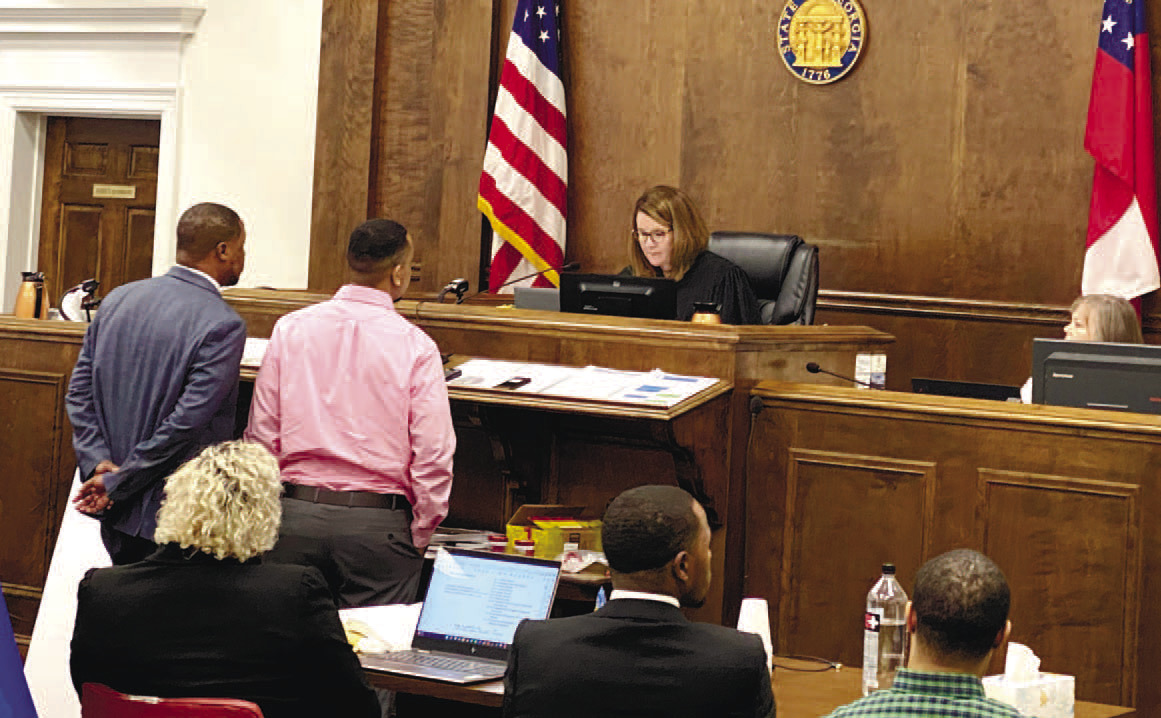
A senseless act of violence took the lives of four young men: one who was murdered, and three others sentenced to spend the rest of their lives in prison.
The trial of Cameren Myles Banks, Justerrious Shyhem Canty and Jaqualan Desean Clark ended Oct. 6, following six days of testimony in Jones County Superior Court.
The three defendants were arrested in December of 2017 for the Nov. 13 murder of 24-year-old Donald Marquis Hardwick. At the time of their arrests, Banks and Canty were 19 and Clark was 20, which means they are now the approximate age of the man whose life they took.
Superior Court Judge Alison Burleson presided over the case and pronounced the sentences of the defendants. Previously this year, the judge presided over the death penalty trial of Ricky Dubose in Putnam County for the murders of two corrections officers.
Prior to the Oct. 6 sentencing, Burleson took time to address the courtroom.
“I’m not one for speeches, but I feel like this merits something before sentencing. There are no winners here. No matter the sentence, it won’t bring this young man back, and three more men will pay with their lives,” the judge said.
Burleson said the families also lose, and she took no pleasure in the sentencing.
“How did we get here? Three young men broke into a home in Jones County, Georgia,” she said.
The judge said the defendants had the advantage of attending good schools, had family support and grew up in one of the best communities.
“This man was executed in a senseless act of violence for what? Words? It was very clearly an execution,” she said.
Burleson said she had never before experienced a case with such violence and rage.
“Their utter lack of respect for human life; this was a cold-blooded assassination,” she said.
The jury found the three defendants guilty on all counts for which they were charged.
Banks was sentenced to life without the possibility of parole for the crime of malice murder, 20 years for the crime of burglary in the first degree, a life sentence for the crime of armed robbery, a life sentence for the crime of home invasion, and 20 years for the crime of Violation of Street Gang Terrorism and Prevention Act. Banks’ total sentence is life without the possibility of parole, plus life, plus life, plus 40 years.
Canty’s sentence mirrors Banks’ sentence with the addition of 10 years for the crime of possession of a firearm by a first offender probationer. Canty’s total sentence is life without the possibility of parole, plus life, plus life, plus 50 years.
Clark was sentenced to the same as Canty with 20 more years added for an additional charge of street gang terrorism. Clark’s total sentence is life without the possibility of parole, plus life, plus life, plus 70 years.
The trial
The jury reported Monday morning, Sept. 26. It took two days to select the 15-member jury that included three alternates. The trial began the morning of Sept. 28 with opening statements by the attorneys, followed by the first witnesses.
The case was prosecuted by Ocmulgee Circuit District Attorney T. Wright Barksdale and Assistant District Attorney Cara Fiore.
Banks was represented by defense attorney Melvin Raines II, Canty by defense attorney Adrian Patrick, assisted by Cedric Davis, and Clark was represented by defense attorney Sarah Flack.
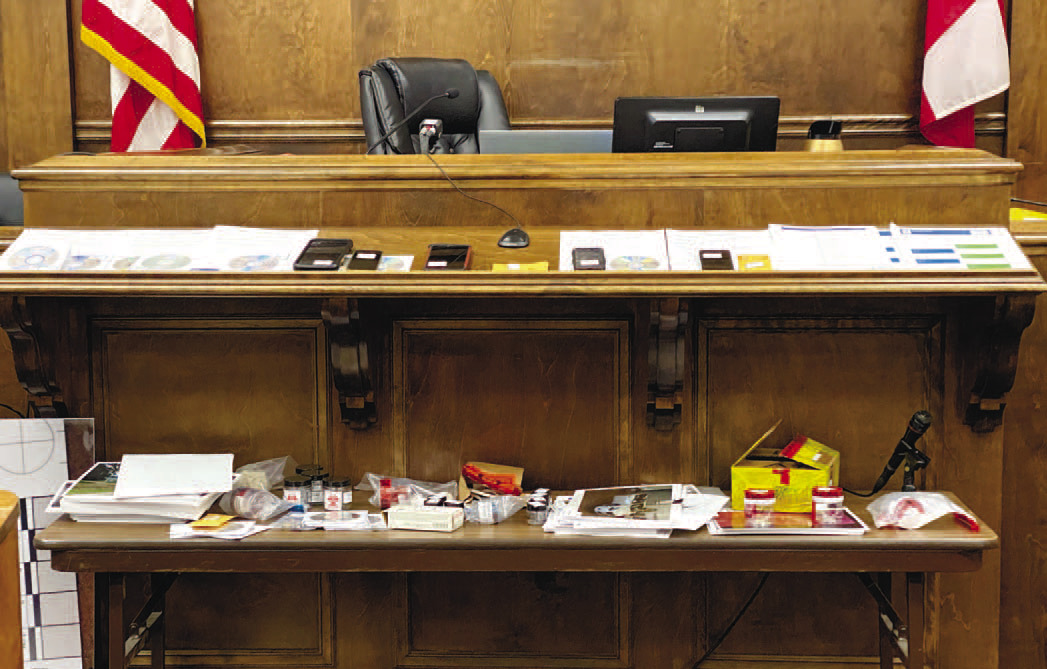
Jurors heard from more than 30 witnesses and watched as more than 500 items were entered into evidence.
Each witness was questioned by the state, and all three defense attorneys, and each piece of evidence, was either accepted or objected to by each of the attorneys.
Law enforcement officers described what they found when called to Hardwick’s apartment Nov. 13, 2017. The shooting was reported at 1:38 a.m. by the victim’s roommate, and Gray Police officers and Jones County Sheriff’ deputies were on the scene two minutes later. What they found was a back door with a window apparently broken out with a rock and Hardwick’s body in his bed in his upstairs bedroom. He had been shot 24 times.
Shell casings were found around the bed, and the first officers on the scene talked about the heavy smoke from gunpowder that filled the room.
JCSO crime scene investigators Capt. Kenny Allen and Lt. Kenny Gleaton testified to their examination of the scene, victim’s injuries and the pieces of glass and projectiles sent to the FBI and GBI for analysis.
Gleaton said there were 15 casings from a .40-caliber pistol and nine from a .380 caliber.
The investigators took pictures of everything at the scene, and the jury saw many of those pictures.
Friends of Hardwick gave the jury an idea of the victim’s personality and his conflict with the defendants. The witnesses described Hardwick as someone who loved to play basketball, was not afraid of a fight and would not back off from taunting the defendants and their gang, Rambros.
It was also revealed that the conflict between Hardwick and Rambros began with an ex-girlfriend. That encounter took place in July, and the state introduced evidence through witness testimony, text messages and Facebook posts that showed the escalation of the conflict and ultimately connected Banks, Canty and Clark to the murder.
Pictures from the posts showed defendants with a Smith and Wesson .40-caliber and .380 pistol, and texts included Clark attempting to get a friend to purchase ammunition.
A rap song written, performed and posted to Facebook by Canty was a key to the motive of the murder.
Not all state’s witnesses were happy to testify. Friends of the defendants, who had previously given false statements to law enforcement, reluctantly testified to conversations where the defendants talked about plans for the shooting and conversations after the murder claims that they were the ones who did it.
Investigator and tech guru Clay Wiggins testified to performing extraction of information on 30 phones during the investigation, and Deputy Jason Douglas presented evidence from a software program that demonstrated where the defendants’ phones connected to cell towers the night of the murder.
Jurors watched and listened to law enforcement interviews with each of the defendants. Banks had three interviews that included an ‘evolving’ story.
One of the most damaging witnesses was a neighbor of both Clark and Canty. Her testimony took quite a while because she attempted to refuse to answer Barksdale’s questions by pleading the fifth amendment.
Burleson excused the jury and spoke with the witness to find out how her testimony would put her in jeopardy of criminal charges. “You can’t just not testify because you don’t want to,” the judge said.
Burleson also explained the consequences of not answering the state’s questions and the penalties for contempt of the court.
When the jury returned, Barksdale’s examination of the witness began with simple questions about where she lived and who lived on her street. She admitted to placing a 911 call, which was then played in court.
In the call, she was heard telling the 911 operator that she had information that it was Clark and Canty who killed Hardwick and asked about the reward. She said Canty showed her a gold watch that belonged to Hardwick.
The watch had not been found at the scene of the murder and was a detail that had not been released to the public.
Barksdale asked her where Canty said he got the gold watch, and she said he told her from Hardwick’s house.
“He got it the night he murdered him?” the DA asked.
“Yes,” she said, and added it was a Michael Kors watch.
Experts
Expert witnesses included an FBI forensic examiner and geologist from Quantico. She testified to tests performed on glass from the back window at the scene and a small fragment of glass found in Bank’s car.
The expert said she does not use the word ‘match’ but the glass in the car was indistinguishable in elemental analysis from the window glass within 0.1 percent. That’s a complicated way to say it’s a 99.9 percent chance the glass found in the floor of the car is from the window.
The witness said the only 100 percent match would be if the pieces of glass physically fit together.
A GBI forensic pathologist and medical examiner went through the autopsy of Hardwick, and each of the multiple gunshot wounds was discussed. Wounds were found in his face, head, neck, chest, pelvis and leg.
A GBI forensic scientist and firearms expert explained his examination of the projectiles he tested. He said the projectiles were from .380 and .40 caliber weapons. The witness was able to narrow the .40-caliber projectile as coming from a Smith and Wesson pistol because of its markings.
Wrap up
The final state’s witness was the lead investigator in the case, Earl Humphries. He was a major over JCSO investigations at the time the investigation began and is currently the department’s chief deputy.
Humphries connected the dots that had been laid out by the state through its items of evidence and witnesses. The final interview with Banks was shown to the jury containing the last version of his story that Clark asked to switch cars with him the night of the murder.
At one point in the interview, Banks asked Humphries what he was asking.
“How about the truth?” Humphries replied.
Banks stated that Hardwick was mad because he found out Canty had sex with his ex-girlfriend.
“Since then, he wanted to fight and kept trying to get us to come to Gray,” he said.
The defendant went on to say Hardwick disrespected his family, referring to Rambros.
Humphries told the jury that during interviews he is interested in what the subject tells him and what they do not tell him.
“To me that absence means somebody is trying to hide something,” he said.
The witness said the sheriff’s office was asked by the Gray Police Department to assist with the investigation.
“That’s what we did,” he said.
Humphries said early in the investigation, two others were the prime suspects, but it was the evidence that led them to Banks, Canty and Clark.
“Their texts indicated they were more heavily involved than they let on,” he said.
The chief said Canty’s ‘No Hook’ video filled in the blanks and spelled out the motive for the murder.
In his cross examination of Humphries, Raines asked about the interview with the witness who testified to hearing the defendants talk about the murder plan. The captain said they learned more from that witness than they did from the defendants.
He asked about gang colors, handshakes or hand signs used by the defendants. The attorney put forward a theory that Hardwick’s murder was connected to his testimony in a 2014 case.
Humphries said he did not agree.
Flack questioned Humphries about the award offered for information.
Patrick questioned the timing of the release of the ‘No Hook’ video and asked Humphries if there were any eyewitnesses to the murder.
At the conclusion of Humphries’ testimony, the state rested.
The defendants chose not to testify, and none of the defense attorneys called witnesses. At that point, the judge declared the evidence closed.
Closing arguments
Raines’ closing focused on the piece of glass, which he said was the only thing tying Banks to the murder. He pointed out Banks’ car was not confiscated by law enforcement for 21 days after the crime.
He said the witness who testified to the murder plan was desperate and would say anything to get out of jail.
Raines said it was Hardwick who was the aggressor and questioned if the murder could have been a hit that was the result of a previous case.
Flack characterized the state’s case as a house of cards.
“The state’s house is built on lie after lie,” she said.
She attempted to impeach witnesses and debunk evidence and reminded jurors they are the ones who decide what to believe.
Patrick said the ‘No Hook’ song and video were art and simply a way that Canty expressed himself.
“Law enforcement is using it against him,” he said.
The attorney said the defendants were being chased by a bully, and the video was their expression of oppression.
He also questioned all the technology used.
“This case got caught up in technology, and they forgot the basics,” he said.
Patrick said there was no one presented as a witness who did not have an ulterior motive for testifying.
Barksdale opened his remarks stating that there was one point on which everyone agreed: Hardwick was murdered Nov. 13, 2017, and was shot 24 times. He said several of the witnesses were friends of the defendants and did not want to testify. That included the witness who testified to hearing the murder was going to happen and the other who was told by Canty they had killed Hardwick.
The DA said phone records put the three men together in Macon and then in Gray. He emphasized that Rambros was not a rap group. It was a gang.
“Evidence shows that Banks was the driver. There is no evidence he went into the house, but he is just as guilty,” he said.
Barksdale pointed out the importance of the witness testimony about the gold watch that Hardwick’s friends said he always wore.
“That was information only the defendants could know,” he said.
The DA asked the jury to look at everything – what the witnesses said and what the evidence and the texts and Facebook messages showed.
“The water tower at City Hall says Gray; this is Jones County,” he said. “Marquis lost his life. This was not just a murder; it was a shot across the bow. This doesn’t happen in Gray. It was a statement.
“You have the opportunity to make your own statement.”
The jury deliberated for two hours before bringing back their verdict.
