
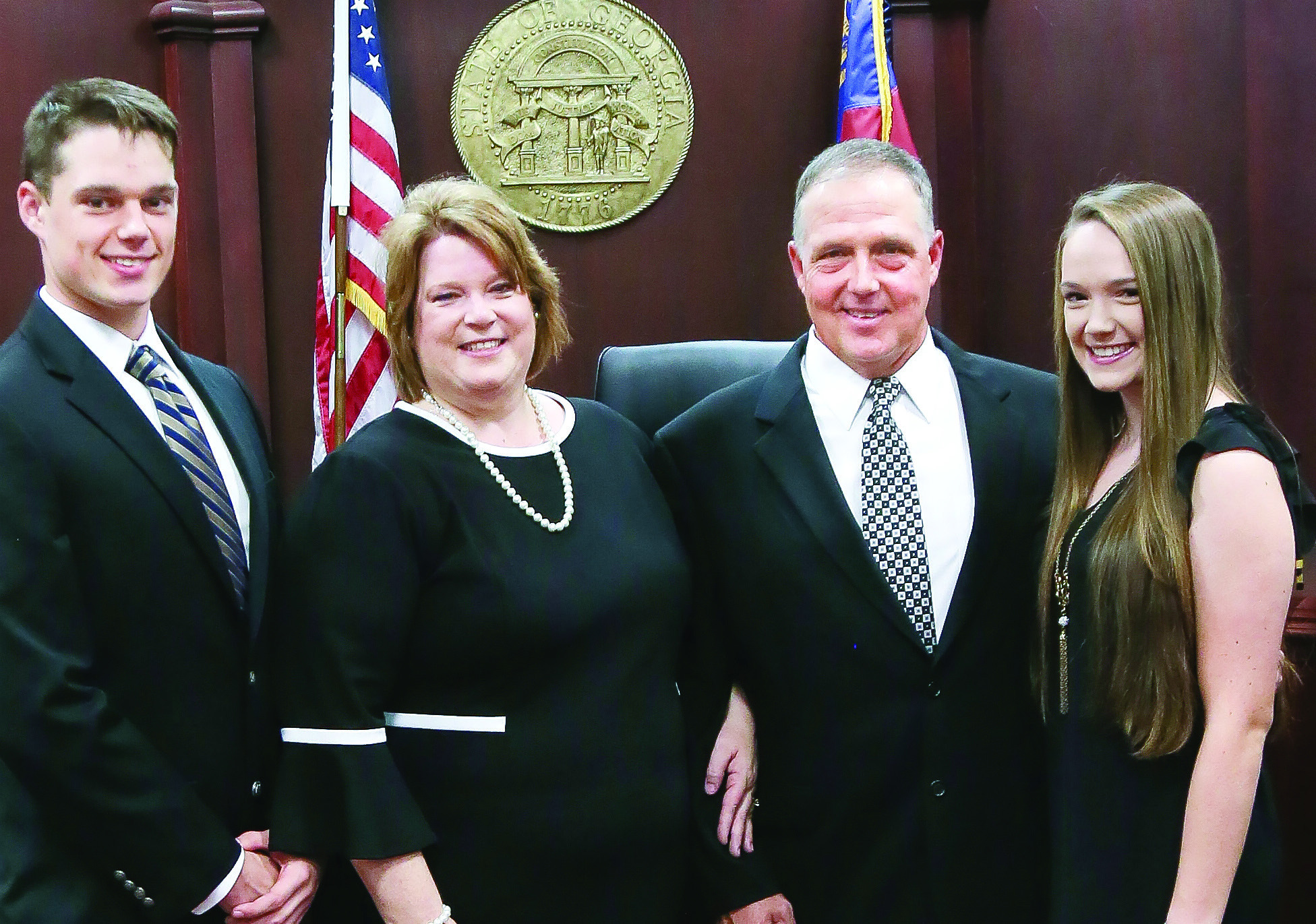

Kelli Cobb and Boyce Rutherford knew each other in kindergarten days, but they took their time getting to the altar to say “I do.” They began dating in the 11th grade and married 10-plus years and a few temporary separations later. “We were in the same kindergarten class, but we didn’t really know each other until well into high school,” Kelli recalled. “We started going together in December of 1986, and we married in August of ’97. We had three or four breakups along the way where we dated other people, and then we’d get back together.”
The marriage has produced two Georgia Tech students, Luke, 25, and Lauren, 22. He is an alumnus with a master’s degree, and she is about to graduate. Luke is with the Energy Authority in Jacksonville, and Lauren is graduating with a degree in neuroscience. She is applying to medical school.
Rutherford herself graduated from Jones County High in 1988 after being named class vice president her last four years. She obtained her undergraduate degree in psychology from Georgia Southern and earned her master’s degree in the same field at Georgia College in 1994.
The college grad worked for Charter Lake Hospital for a couple of years before changing directions.
“I now know it was God leading me that way, but at that time, I was planning on applying to PhD programs, and I just never did. And I said, ‘I think am going to law school.’ I went to Georgia State in Atlanta and graduated there in ’98.”
Rutherford, now 55, says she has no regrets about obtaining her master’s degree and working before opting for law school.
“All the things that I did really helped prepare me for what I do today because so many of the people that we work with now have either mental health problems or substance abuse issues, and it really helps to have that perspective going into it.”
Following law school graduation, Rutherford returned to Gray and ultimately started her own practice.“I did a lot of divorces. I did residential real estate closings, and I did my juvenile work as well. At that time, I represented parents and then delinquents.”
After a couple of years, Rutherford started doing guardian ad litem work in juvenile courts, first just in Jones County. “Then, before I knew it, I was going all over the circuit (eight counties) doing juvenile work.” A guardian ad litem, she explained, is the attorney for the child in DFACS or child welfare cases, looking out for their best interest.
Rutherford did that work until Luke was born in 2001, then decided to cut back to spend more time with him.
“So I ended up closing my practice,” she said, “and what I thought was ‘well, I’ll just keep my juvenile (work) because it’s just a couple times a month.’ Well, that’s when it really started picking up. And they said, oh, well, can you do these other counties? And I started adding on the other counties in the circuit.”
By the time Luke was 15 months old, she was up to two or three days a week instead of two to three days month. Lauren was born nearly three years after Luke, and when she was six months old, her mother was offered a position as Special Assistant Attorney General (SAAG) for DFACS.
Rutherford and her husband were in the process of buying land for a home at that time, and she recalled his words.
“He looked at me and said, ‘Well, if we buy this land, you’ve got to go back to work full time.’ “ Rutherford looked for some guidance.
“I was trying to decide. I went home, prayed that whole weekend. I was like, ‘Okay, am I going to open my practice back up and just do what I did before, or do I want to do something different?’ Well, that was on a Friday that we looked at the land. And then I prayed that whole weekend.”
She received three phone calls regarding the position the following Tuesday and accepted the offer.
Rutherford represented the agency from 2004 until 2020, when she was appointed Juvenile Court Judge by the circuit’s Superior Court judges. She is in her second fouryear term. “Hopefully I’ll have a couple more (terms),” she smiled.
Rutherford believes her experiences with the court helped guide her toward her new career.
“After I started in juvenile court and saw more of it, I felt like I did have a calling to do this job,” she said. “I think all those years of working in the court and being so much a part of the court really helped to shape that path and lead me in that direction. So, I can’t say that I wanted that from the time I went to law school, but after I started doing a lot of the juvenile stuff, I started to look to that as a next step to grow.”
Rutherford is generally satisfied with her first five years on the bench.
“It’s been good. We represent eight counties, so of course it’s a lot of volume. I think, although I completely understood how all the DFACS side works, some of the delinquency I’ve learned and had to learn and pick up on. I will say,” she added, “sometimes it’s discouraging the way our code is written because there’s some things that you feel like you should be able to do a lot more and you can’t. “
The judge pointed out that rural areas are more problematic in that services the state purports to provide for children are not available or are very limited.
“You may refer somebody to get some sort of counseling, family counseling, or family functional therapy. You may refer it, and then the child’s back in front of you in two or three months. And you say, ‘Well, how’s the therapy going?’ ‘Oh well, I hadn’t started yet because we’re on a waiting list.’
“We don’t have anybody to do it; so, to me that’s been very frustrating that we don’t have as many services as we should.”
Rutherford feels the Juvenile Court code needs to be amended to address certain issues. If not, the state should do more.
“If we’re going to stay under the code that they have now, then the state needs to provide more mental health services, more counseling, more of the things that they say we’re supposed to do to rehabilitate children before they have punishments … they need to provide it.”
Rutherford emphasized that the goal of the juvenile court system is rehabilitation, rather than punishment. However, when punishment is needed, the code is again in need of updating.
“If you have a felony, and you could have multiple felonies, but the most you are going to get for just a regular felony is 30 days. Period. That’s all you get. And sometimes you’ve come back two or three times now.”
The judge did acknowledge that a fourth felony can be identified as a ‘designated felony,’ which carries more incarceration time, as do certain violent crimes.
Rutherford said sentencing juveniles to incarceration is not something she enjoys doing. However, there are cases in which she must make a decision that is even more painful.
“In Juvenile Court with the DFACS cases, it’s all about families getting the help that they need to be stronger, so that children are protected, families are stronger,” she declared. “Ultimately, the goal is reunification. Sometimes we don’t get that. Sometimes, we’re not able to fix the problems in the family to keep the children safe. We may get to the point that we terminate parental rights, and that is probably the worst thing I do.”
Rutherford made it clear that termination of rights is the last resort.
“For me, it’s always making sure that we have given those families and those people every opportunity to do better.
You know, you can lead a horse to water, but you can’t make them drink. Sometimes they don’t, but as long as I feel like we have given them every opportunity and shown them the way, if they just didn’t take it, that’s up to them.”
The judge says helping the families is a cooperative effort in her court.
“I think that Juvenile Court is really a team because you have your same players,” she stated. “Usually there is a dedicated assistant district attorney and dedicated public defenders, so you see the same people. They work together all the time. We have parent attorneys who are under contract, and the SAAGs are hired by DFACS. Most of them have been there for years. And, we’ve all worked together so long that it really is a team effort.
“Sometimes the team struggles,” Rutherford acknowledged. “But if we all can stay focused on the fact that we’re here to help families and help children, and if we are focusing on that, then it’s really not an adversarial thing where somebody’s got to win. We win when the family’s better or when the children are stronger.”
For herself, Rutherford declared, she won’t quit trying.
“Sometimes you are just not going to be able to make a difference, and you have to realize that. But I never want to stop trying to make a difference. Sometimes I can’t, and I understand that, but I always want to try. That’s why I feel led to do this job.”
