
Brennan Jackson
County Extension/ANR Agent
Camellias are one of my favorite ornamental bushes that produce impeccable blooms in the winter and attractive foliage year-round.
These bushes are typically slow growing, but can grow up to 14 feet tall. They prefer slightly acidic soil (pH 5.5-6.5), and thrive in shade to partial shade. While there are many species of Camellias, the more common in our area are japonica and sasanqua. Sasanqua camellias can generally tolerate more sun than japonicas. While most people think about camellias in the winter due the timing of bloom, there are several things to consider or watch out for now.
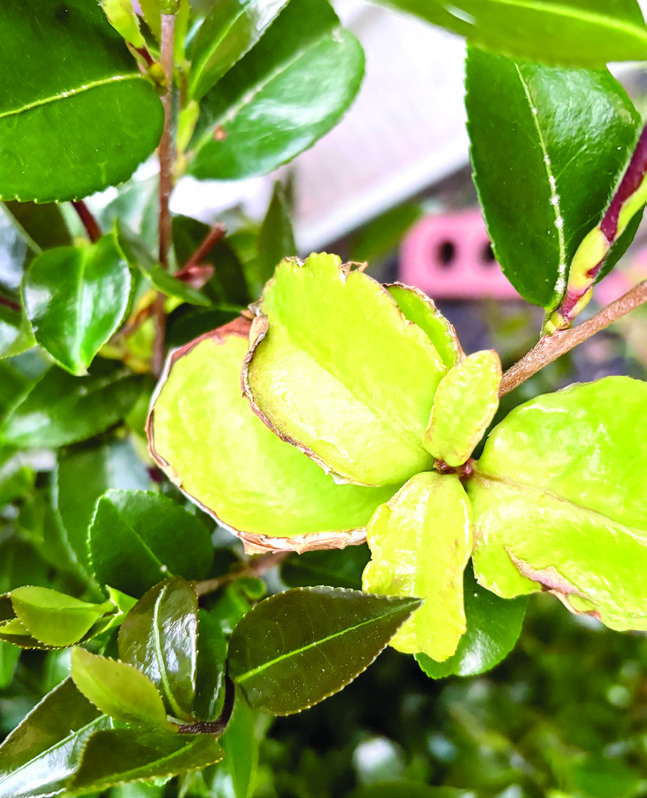
New growth should have begun already, but it will only continue through the early summer. Once the new growth has completed for the year, buds begin to form during the middle of the summer. Therefore, if there is any necessary pruning it should be done before the buds form. Since camellias grow rather slowly, it is usually not necessary to prune more than the dead, rubbing, or wild limbs. During the spring and summer it is a good idea to be on the look out for insect damage and the presence of disease. Aphids, spider mites, plant hoppers, and scale can cause issues. Different diseases that can be present are fungal leaf spots, viruses, anthracnose, and root rot. However, one disease that is present right now is leaf gall. Camellia leaf gall can be identified easily by thick, fleshy leaves that are light green or pink in color. As the disease progresses, the bottom layers of the leaves separate and allows the spores within to be carried off by wind or water. The pathogen is called Exobasidium camelliae. Once the spores disperse they will lay dormant until the next year where they will re-infect the plant. This particular pathogen is primarily found on Sasanqua camellias, but can be found on other species. The good news is that the management of leaf gall is easy. Simply remove the galls and dispose of them before they spread their spores. By checking your camellias for these leaf galls you can save yourself a lot of trouble in the future.
For now, ensure the bushes have adequate nutrients, receive an appropriate amount of water, preventatively prune if necessary, and monitor for insects and diseases. Not all insects or diseases are as easy to manage as leaf galls, but there are efficient ways to manage the different pests that can plague camellias. If you discover any issues with your camellias or other ornamentals you can contact the Extension office to get a diagnosis and management strategy by calling 478-986-3958 or emailing brennan4@uga.edu.
