
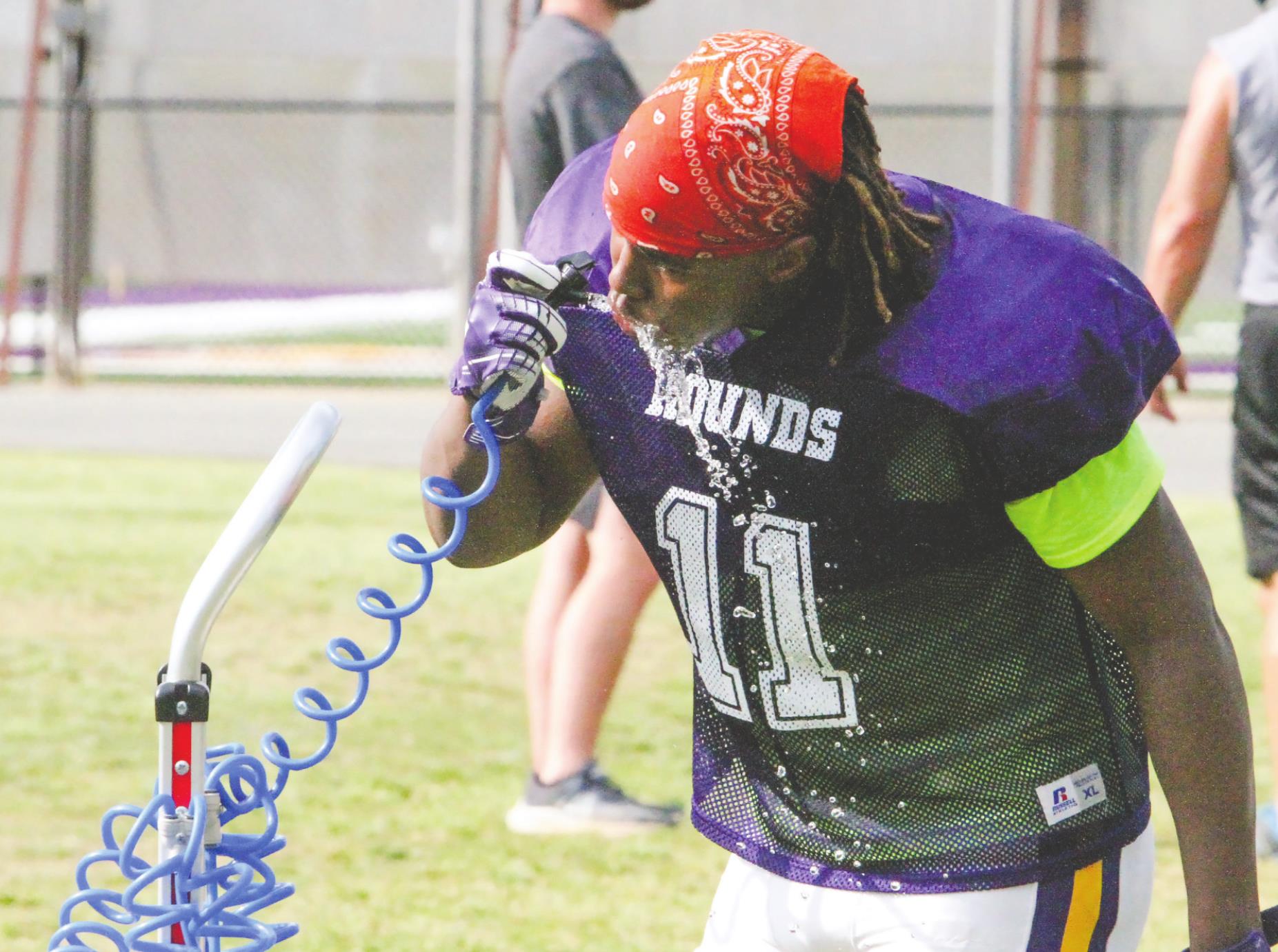
A veteran of the athletic training field, Jones County High School athletic trainer Brad Miles pauses when thinking about how hot this summer has been compared to those in the past.
“I can’t remember it being this bad for this long,” Miles said. “Sure, you’ve had an ‘oh my gosh, over the top day’ here or there. But for this long? No. This is unprecedented.”
In recent weeks, high temperatures have hovered at or above the century mark. Last Thursday, for example, the recorded high temperature in Macon was above 100 degrees for more than six hours.
But for Greyhound and Lady Greyhound student-athletes whose sport competes outdoors, there’s no getting around the fact that these months of voluntary workouts are critical to the offseason.
Sure, activities such as film sessions and instruction can take place in weight rooms or locker rooms, and hitting cage time can be held indoors for softball and baseball, but otherwise, most other activities have to take place in the elements. And although tactics such as practices in the morning can help, higher overall temperatures can contribute to even warmer conditions in the morning hours.
And with even warmer temperatures in place, It’s become all the more key to keep a close eye to guard against heat-related illnesses.
That’s where Miles’ role comes in, keeping a sharp eye on the Wet Bulb Globe Temperature, a composite temperature used to estimate the effect of air temperature, humidity and solar radiation on the human body.
“The Wet Bulb is the gold standard. We always check the Wet Bulb. We’ve adjusted practices. We haven’t gone full pads or anything like that (for football), obviously,” Miles said. “I’ve definitely had to double up on being cautious and being much more aware because it has never been this bad this long.”
Though generally geared for football, the Wet Bulb applies across all sports, according to Miles.
The readings are taken hourly, starting with 30 minutes prior to the start of scheduled practice to gauge what levels of activity may be permissible.
Under guidance issued by the GHSA, various requirements are in place depending on what the Wet Bulb Globe Temperature is. Under a reading of 82.0 to 86.9, discretion for intense or prolonged exercise is required with three separate rest breaks per hour that are at least four minutes long. For a reading of 87.0 to 89.9, the maximum practice time is two hours with four rest breaks of at least four minutes per hour being required. With a reading of 90.0 to 92.0, practice may not be more than an hour, and 20 minutes of rest must be distributed in the hour of practice. The most extreme reading is above 92.0. In that setting, no outdoor workouts are permitted, and practice must be delayed until a lower Web Bulb temperature is detected.
“I’ve told some of the teams, ‘the Wet Bulb is out of range. I can’t recommend that you do anything for the next three of four days until it breaks,” said Miles, who notes that he has had to call off softball and soccer workouts this summer.
And until the current heat wave dissipates, the heat figures to be a backdrop of various sports at JCHS.
“I lose sleep every night thinking, ‘man, what am I going to do tomorrow? What if the temperature is too high? Who am I going to have to contact and say don’t practice?” Miles said. “I have my little checklist that I go through three or four times an evening.”
